GiACTA Trial: Effect of the Tocilizumab on the Rates of Relapse During Glucocorticoid Tapering in Patients with Giant-cell Arteritis


Introduction
Giant-cell arteritis generally occurs in adults older than 50 years of age and is 3 times as likely to occur in women as in men. Glucocorticoids are the mainstay of treatment because they control headaches and systemic inflammation, normalize inflammatory markers, and prevent vision loss. However, long-term use of glucocorticoids is associated with side effects.
Aim
Giant-Cell Arteritis Actemra (GiACTA) trial investigated whether tocilizumab resulted in higher rates of sustained glucocorticoid-free remission of giant cell arteritis than placebo through a period of 52 weeks.
Patient Profile
- Patients 50 years of age or older who had active giant-cell arteritis within 6 weeks before baseline and who had a history of an elevated erythrocyte sedimentation rate (ESR) attributable to giant-cell arteritis
- Patients with newly diagnosed or relapsing disease
Methods
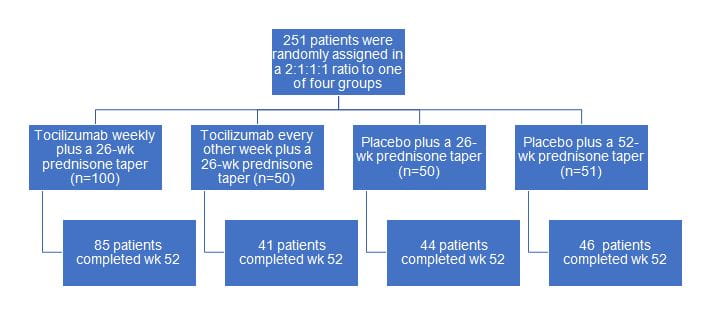
- Randomized, double-blind, placebo-controlled, phase 3 trial
Endpoints
- The primary outcome was the rate of sustained glucocorticoid-free remission at week 52 in each tocilizumab group as compared with the rate in the placebo group that underwent the 26-week prednisone taper
- The key secondary outcome was the rate of remission in each tocilizumab group as compared with the placebo group that underwent the 52-week prednisone taper
- Dosing of prednisone and safety were also assessed
Results
|
Characteristic |
Tocilizumab Weekly (N = 100) |
Tocilizumab Every Other Week (N = 50) |
Placebo + 26-Wk Taper (N = 50) |
Placebo + 52-Wk Taper (N = 51) |
|
Age — yr |
69.5±8.5 |
69.4±8.2 |
69.3±8.1 |
67.8±7.7 |
|
Female sex — no. (%) |
78 (78) |
35 (70) |
38 (76) |
37 (73) |
|
Weight — kg |
69.8±13.8 |
70.8±16.1 |
70.1±15.8 |
73.1±15.3 |
|
Body-mass index‡ |
26.0±4.4 |
26.0±6.2 |
25.7±4.5 |
25.8±4.1 |
|
Giant-cell arteritis — no. (%) |
|
|
|
|
|
Newly diagnosed |
47 (47) |
26 (52) |
23 (46) |
23 (45) |
|
Relapsing |
53 (53) |
24 (48) |
27 (54) |
28 (55) |
|
Prednisone dose — no. (%) |
|
|
|
|
|
≤30 mg/day |
52 (52) |
25 (50) |
27 (54) |
26 (51) |
|
>30 mg/day |
48 (48) |
25 (50) |
23 (46) |
25 (49) |
|
Disease duration — days |
307±564 |
258±501 |
365±570 |
255±436 |
|
Cranial signs or symptoms — no. (%) § |
78 (78) |
41 (82) |
40 (80) |
40 (78) |
|
Symptoms of polymyalgia rheumatica — no. (%)¶ |
59 (59) |
32 (64) |
30 (60) |
35 (69) |
|
Erythrocyte sedimentation rate — mm/hr |
24.6± 8.7 |
20.8±18.1 |
28.8±25.4 |
24.2±18.2 |
|
Diagnosis — no. (%) ? |
|
|
|
|
|
By means of positive temporal-artery biopsy |
57 (57) |
34 (68) |
36 (72) |
29 (57) |
|
By means of positive imaging |
50 (50) |
23 (46) |
19 (38) |
23 (45) |
*Plus–minus values are means ±SD. There were no significant differences among the four trial groups.
† Race was reported by the patients and confirmed by the investigators during screening.
‡ The body-mass index is the weight in kilograms divided by the square of the height in meters.
§ Cranial signs and symptoms were new-onset localized headache, scalp tenderness, temporal-artery tenderness, decreased pulsation, or jaw or mouth claudication.
¶ Symptoms of polymyalgia rheumatica were morning stiffness or pain in the shoulder or hip girdles. ? The diagnosis could have been based on either or both types of assessment
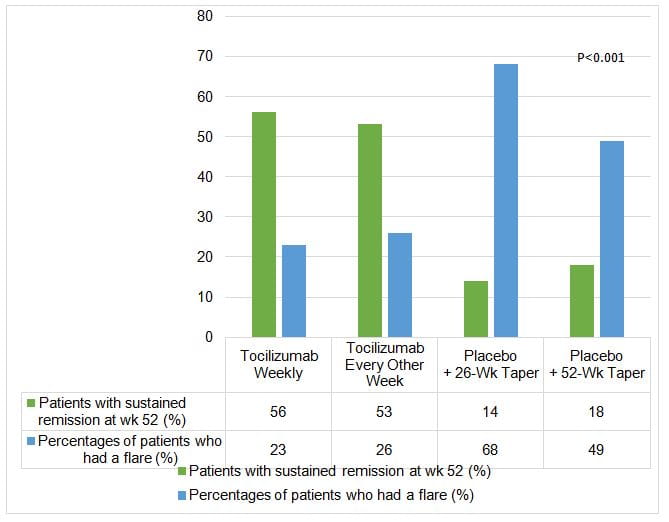
- The two regimens of tocilizumab weekly and of tocilizumab every other week, in combination with a prednisone taper over a period of 26 weeks, were superior to placebo plus a prednisone taper of 26 weeks and placebo plus a prednisone taper of 52 weeks with regard to sustained remission
Cumulative Prednisone Dose
- The cumulative median prednisone dose over the 52 weeks was tocilizumab group=1862 mg, as compared with 3296 mg in the placebo group that underwent the 26-week taper (P<0.001 for both comparisons) and 3818 mg in the placebo group that underwent the 52-week taper (P<0.001 for both comparisons).
Subgroup Analysis
- Patients who had relapsing disease
- The risk of a flare was lower in the group that received weekly tocilizumab than in the placebo group that underwent the 26-week taper (hazard ratio, 0.23; P<0.001) than in the placebo group that underwent the 52-week taper (hazard ratio, 0.36; P = 0.01)
- Patients with relapsing disease
- Patients who were treated with tocilizumab every other week did not have a significantly different risk of flare than those in either placebo group (hazard ratio vs placebo group with 26-week taper, 0.42; P = 0.05; hazard ratio vs placebo group with 52-week taper, 0.67; P = 0.37).
Safety
- The percentages of patients with adverse events were similar in all the study groups
- Anterior ischemic optic neuropathy developed in one patient in the group that received tocilizumab every other week
|
|
Tocilizumab |
Tocilizumab |
Placebo |
Placebo | ||||
|
|
Weekly |
Every Other Week |
+ 26-Wk Taper |
+ 52-Wk Taper | ||||
|
Variable |
(N = 100) |
(N = 49) |
(N = 50) |
(N = 51) | ||||
|
Duration in trial — patient-yr |
92.9 |
45.6 |
47.4 |
48.1 | ||||
|
Patients with ≥1 adverse event — no. (%) |
98 |
(98) |
47 |
(96) |
48 |
(96) |
47 |
(92) |
|
Adverse events |
|
|
|
|
|
|
|
|
|
No. of events |
810 |
432 |
470 |
486 | ||||
|
Rate per 100 patient-yr |
872.0 |
948.0 |
990.8 |
1011.2 | ||||
|
Patients with ≥1 infection — no. (%) |
|
|
|
|
|
|
|
|
|
Any |
75 |
(75) |
36 |
(73) |
38 |
(76) |
33 |
(65) |
|
Serious |
7 |
(7) |
2 |
(4) |
2 |
(4) |
6 (12) | |
|
Patients who withdrew from the trial because of adverse |
6 |
(6) |
3 |
(6) |
2 |
(4) |
|
0 |
|
events — no. (%)† |
|
|
|
|
|
|
|
|
|
Patients with injection-site reaction — no. (%) |
7 |
(7) |
7 (14) |
5 (10) |
1 |
(2) | ||
|
Flare of giant-cell arteritis reported as serious adverse |
1 |
(1) |
1 (2)§ |
1 |
(2) |
1 |
(2) | |
|
event — no. (%)‡ |
|
|
|
|
|
|
|
|
|
Patients with ≥1 serious adverse event — no. (%) |
|
|
|
|
|
|
|
|
|
Any |
15 |
(15) |
7 (14) |
11 |
(22) |
13 |
(25) | |
|
According to system organ class¶ |
|
|
|
|
|
|
|
|
|
Infection or infestation |
7 |
(7) |
2 |
(4) |
2 |
(4) |
6 (12) | |
|
Vascular disorder |
4 |
(4) |
2 |
(4) |
2 |
(4) |
1 |
(2) |
|
Respiratory, thoracic, or mediastinal disorder |
2 |
(2) |
1 |
(2) |
2 |
(4) |
2 |
(4) |
|
Injury, poisoning, or procedural complication |
3 |
(3) |
1 |
(2) |
1 |
(2) |
|
0 |
|
Nervous system disorder |
1 |
(1) |
1 |
(2) |
2 |
(4) |
1 |
(2) |
|
Cardiac disorder |
2 |
(2) |
|
0 |
|
0 |
2 |
(4) |
|
Musculoskeletal or connective-tissue disorder |
1 |
(1) |
|
0 |
1 |
(2) |
2 |
(4) |
|
Gastrointestinal disorder |
1 |
(1) |
|
0 |
2 |
(4) |
|
0 |
|
Cancer |
|
0 |
|
0? |
1 |
(2) |
1 |
(2) |
* No gastrointestinal perforations were reported, and no patients died.
- Values are reported for the entire trial population; that is, values were included for 50 patients in the group that received tocilizumab every other week (i.e., including the patient who did not receive tocilizumab).
- Values are for flares of giant-cell arteritis that met the protocol-defined criteria for being reported as a serious adverse event. § This patient had anterior ischemic optic neuropathy after randomization.¶ Values were those reported in at least 1% of the patients overall. Patients may have had more than one class of serious adverse event. ? One patient in the group that received tocilizumab every other week had a benign ovarian adenoma.
Conclusion
- Tocilizumab combined with a 26-week prednisone taper was superior to either a 26-week or 52-week prednisone taper plus placebo with regard to the sustained remission of giant-cell arteritis
- Tocilizumab treatment was associated with a reduction in the cumulative prednisone dose over the 52-week trial period
- Weekly treatment with tocilizumab resulted in greater disease control than did treatment with tocilizumab every other week
Reference
N Engl J Med 2017;377:317-28