

Eri-001 Trial: Eribulin, An Effective and Safe Therapeutic Option in Heavily Pre-treated patients with Advanced Breast Cancer Treatment


Introduction
Eribulin mesylate is currently approved in the EU for the treatment of advanced breast cancer (aBC) in patients who have previously received an anthracycline and a taxane in either the adjuvant or the metastatic setting, and at least one chemotherapeutic regimen for metastatic disease.
Aim
To investigate the efficacy and tolerability of eribulin as second or further-line chemotherapy in women affected by locally advanced unresectable or MBC
Patient Profile
- N=137
- Patients with locally advanced unresectable or MBC received eribulin as second or further line of treatment
- Cytological or histologically confirmed diagnosis of locally advanced (unresectable) or MBC
- Age ≥18 years, administration of at least one cycle of eribulin until disease progression
- Unacceptable toxicity or patient refusal, availability of clinical-pathological
- Radiological and laboratory parameters before eribulin treatment (baseline)
- Response evaluation and survival data
- Prior anthracycline and taxane-based chemotherapy in the adjuvant or metastatic setting
|
Characteristics |
Total n=137 |
% |
|
Age (median) Range |
58.1 |
|
|
Age, years |
|
|
|
>70 |
22 |
16.1 |
|
<70 |
115 |
83.9 |
|
ECOG PS |
|
|
|
0–1 |
133 |
97.1 |
|
2 |
4 |
2.9 |
|
Menopausal status |
|
|
|
Premenopausal |
38 |
27.7 |
|
Postmenopausal |
99 |
72.3 |
|
Histology |
|
|
|
Invasive lobular carcinoma |
27 |
19.7 |
|
Invasive ductal carcinoma |
104 |
75.9 |
|
Invasive ductal-lobular carcinoma |
6 |
4.4 |
|
Grading* |
|
|
|
Grades1–2 |
68 |
49.6 |
|
Grade3 |
69 |
50.4 |
|
Hormone receptor status* |
|
|
|
ER and/or PgR negative |
26 |
19 |
|
ER and/or PgR positive |
111 |
81 |
|
HER2 status* |
|
|
|
Negative |
111 |
81 |
|
Positive |
26 |
19 |
|
Molecular subtypes |
|
|
|
Luminal A |
20 |
14.6 |
|
Luminal B Her2 positive |
18 |
13.1 |
|
Luminal B Her2 negative |
74 |
54 |
|
HERr2-like |
7 |
5.1 |
|
Triple-negative |
18 |
13.1 |
|
Stage at diagnosis |
|
|
|
IA |
18 |
13.1 |
|
IIA |
44 |
32.1 |
|
IIB |
13 |
9.5 |
|
IIIA |
28 |
20.4 |
|
IIIB |
1 |
0.7 |
|
IIIC |
13 |
9.5 |
|
IV |
20 |
14.6 |
|
Site of metastases |
|
|
|
Visceral |
67 |
48.9 |
|
Visceral + bone |
64 |
46.7 |
|
Bone alone |
6 |
4.4 |
|
Surgery (primary tumour) |
|
|
|
Yes |
126 |
92 |
|
No |
11 |
8 |
|
Adjuvant chemotherapy |
|
|
|
Yes |
80 |
58.4 |
|
No |
57 |
41.6 |
|
Adjuvant trastuzumab |
18 |
13.1 |
|
Adjuvant hormonal therapy |
|
|
|
Yes |
77 |
56.2 |
|
No |
60 |
43.8 |
|
Number of prior chemotherapy for advanced disease |
|
|
|
1 |
22 |
16.1 |
|
2 |
52 |
38 |
|
3 |
27 |
19.7 |
|
≥4 |
36 |
26.2 |
|
Median (range) |
4 (1–7) |
– |
|
Previous chemotherapy for MBC |
|
|
|
Anthracyclines |
54 |
35 |
|
Taxanes |
120 |
87.5 |
|
Capecitabine |
89 |
65 |
|
Vinorelbine |
88 |
64.2 |
|
Gemcitabine |
34 |
24.8 |
|
Previous hormonal therapy for advanced disease |
95 |
66.4 |
|
Eribulin cycles administered, median(range) |
5 (1–24) |
– |
Methods
- The final analysis included 137 patients with locally advanced unresectable or MBC treated with eribulin monotherapy in different lines of therapy to evaluate its safety profile, activity, and efficacy
- Patients treated at 13 different centers in the Campania region (Italy), according to current drug indications, were analysed
- Progression-free survival (PFS) was defined as the time elapsed between the first eribulin dose to the detection of disease progression or death for any cause
- Differences in PFS according to clinical parameters or line of treatment were evaluated by the log-rank test and described by the Kaplan-Meier method
- Cox proportional hazards model was applied to multivariate survival analysis,
Results
Efficacy
- Eribulin as monotherapy provided benefit in terms of progression-free survival (PFS), response rate (RR) and disease control rate (DCR) independently of its use as second or late-line therapy
- The overall RR and DCR were 17.5% and 64%
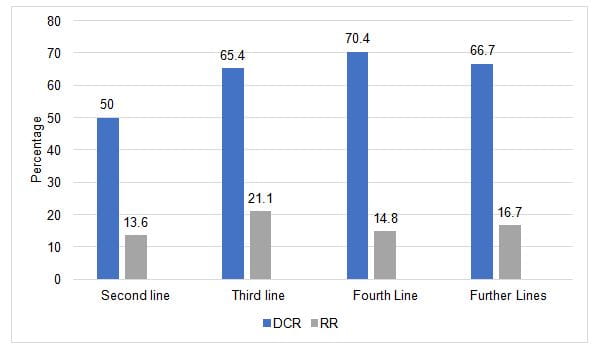
|
Response |
All patients (%) |
Second line (%) |
Third line (%) |
Fourth line (%) |
>4th line (%) |
|
Complete response |
– |
|
|
|
|
|
Stable disease |
46.7 |
36.4 |
44.2 |
55.5 |
50 |
|
Partial response |
17.5 |
13.6 |
21.1 |
14.8 |
16.7 |
|
Progression disease |
35.8 |
50 |
34.6 |
29.6 |
33.3 |
|
Disease control rate |
64.2 |
50 |
65.4 |
70.4 |
66.7 |
- The longer median PFS was recorded in patients treated with eribulin in the third line (6.3 months)
- eribulin in second-line =5.7 months
- eribulin in fourth line= 4.5 months
- eribulin in subsequent lines = 4.0 months
- Subgroup analysis results showed that
- HER2 negative patients appeared to benefit from treatment with eribulin
- HER2-positive breast cancer patients displayed a shorter mPFS (4.2 vs 5.4 months, respectively)
- No significant difference in terms of mPFS was found between the various BC subtypes
- In elderly patients (>70 years), mPFS was 6.4 months and experienced only mild drug toxicity
Adverse events
- Overall, eribulin resulted safe and most adverse events were of grade 1 or 2 and easily manageable
- Neutropenia was the most common grades 3–4 haematological adverse event (12.4%)
- Grades 3–4 toxicities were neutropaenia and neurotoxicity
Conclusion
- Eribulin was shown to be an effective and safe therapeutic option for second and further lines of treatment in patients with advanced BC
- The data supports its use in daily clinical practice
Reference
ESMO Open 2017;2: e000176. doi:10.1136/esmoopen-2017-000176