Efficacy of Zoledronic Acid in Patients with Cervical Spondylosis and Osteoporosis after Anterior Cervical Discectomy and Fusion Surgery

Introduction
Bisphosphonates are the most widely used anti-osteoporosis drugs in clinical practice, mainly including alendronate sodium, ZA, risedronate sodium, ibandronate sodium. Zoledronic acid (ZA) is a bisphosphonate drug, which is often used in combination with other drugs (calcium) for anti-osteoporosis treatment in patients with osteoporosis.
Aim
To study whether the intravenous application of ZA after anterior cervical discectomy and fusion (ACDF) surgery has an auxiliary therapeutic effect and its effect on local bone graft fusion.
Patient Profile
- Patients with cervical spondylosis and osteoporosis
- All patients were diagnosed with cervical spondylosis (cervical spondylotic radiculopathy or cervical spondylotic myelopathy) before surgery and diagnosed with osteoporosis (T < 0_2.5 SD) by dual-energy X-ray examination
Methods
- Randomized controlled study
- 52 patients were selected,
- All patients were divided into the study group and the control group according to the sequence of surgery time
- Study group n=21
- Control group n=22
Postoperative anti-osteoporosis treatment program
- On the fifth day after surgery, the study group patients were given 5-mg ZA injection which was hydrated with 0.9% sodium chloride injection 500 ml before the infusion, and the intravenous infusion time was >30 min.
- The control group was given 100 ml of normal saline intravenous drip on the fifth day after surgery
- Both the groups received 2 tablets/day of 1.5 g of calcium carbonate and vitamin D3 125 international units per tablet and 1 tablet/day of 0.25 mg ossification triol per pill.
Follow-up and Assessment
- Follow-up was conducted at the 3rd, 6th, and 12th month after surgery
- Each observation included the
- neck disability index (NDI)
- bone resorption marker carboxy terminal cross-linked telopeptide of type-I collagen (CTX)
- bone formation marker amino terminal propeptide of type I procollagen (PINP)
- BMD measurement
- cervical anteroposterior and lateral and functional X-ray film
- cervical 3D CT scan
Results
- Forty-three cases completed the follow-ups
NDI Scores
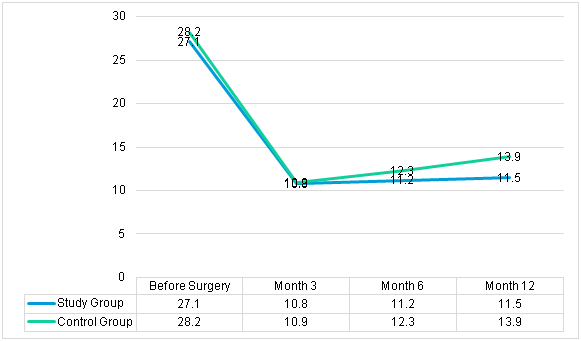
NDI scores of the two groups at each time point significantly decreased compared with the preoperative ones which have statistically significant differences (p < 0.05)
- The NDI score of the study group was lower than that of the control group at the 12th month after surgery (p= 0.026 < 0.05)
Changes of Biochemical Markers in Bone Turnover
- PINP in the study group showed a downward trend at each time point after surgery, which decreased by 40.5% at the 12th month compared with the preoperative level
- CTX in the study group showed a downward trend at each time point after surgery, which was 70.4% lower than the preoperative level at the 12th month
- There was no significant change in the control group
|
|
|
PINP |
|
|
CTX |
|
|
Time |
Study group |
Control group |
p-Value |
Study group |
Control group |
p-Value |
|
Before surgery |
45.2 + 3.17 |
46.0 + 3.66 |
0.764 |
0.54 + 0.07 |
0.65 + 0.04 |
0.556 |
|
3 months after surgery |
28.3 + 3.23 |
46.9 + 3.18 |
<0.001 |
0.19 + 0.05 |
0.62 + 0.05 |
<0.001 |
|
6 months after surgery |
27.6 + 4.01 |
47.6 + 2.51 |
<0.001 |
0.17 + 0.06 |
0.58 + 0.06 |
<0.001 |
|
12 months after surgery |
26.9 + 3.77 |
48.2 + 2.96 |
<0.001 |
0.16 + 0.06 |
0.60 + 0.05 |
<0.001 |
|
PINP: amino terminal propeptide of type-I procollagen. aStudent’s t test was used. | ||||||
Change of BMD
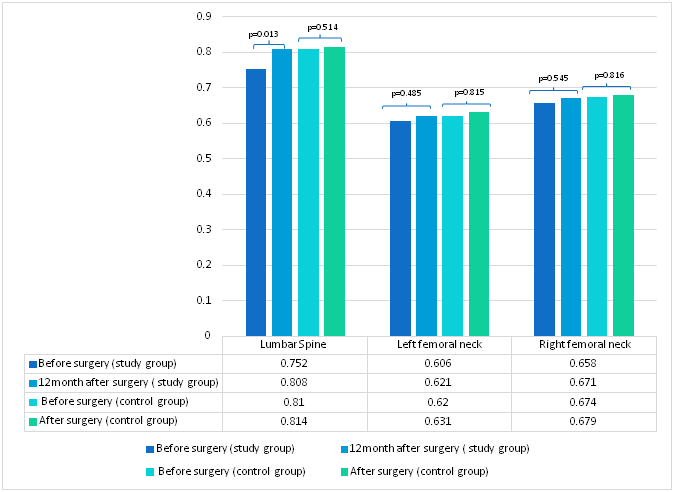
- The BMD in the three parts of the study group was improved at 12month follow-up after surgery
- BMD of the lumbar spine was significantly improved compared with that of the preoperative group, and the difference was statistically significant (p = 0.013 < 0.05)
- There was no significant difference in the control group
Imaging evaluation
- All patients in both groups achieved grade 1/2 osteogenesis at the 12th month follow-up after surgery, and all achieved the standard of cervical stable fusion.
- 3rd month after surgery: study group: 76.2% vs control group: 45.5% (?2= 4.246, p = 0.039 < 0.05)
- 6th month after surgery: study group 90.5% vs control group :68.2% (?2 =4.337, p = 0.037 > 0.05
Conclusion
- The study demonstrated that intravenous application of ZA in patients with cervical spondylosis and osteoporosis after anterior cervical decompression and fusion can shorten the time of cervical osteogenesis, promote local bone graft fusion, and improve the postoperative clinical effect to some extent
Reference
J Orthop Surg (Hong Kong). 2019;27(2):2309499019847028.