


Efficacy of Tenofovir Alafenamide and Tenofovir Disoproxil Fumarate in Reducing Risk of Vertical Transmission of HBV

Introduction
Despite immunoprophylaxis with hepatitis B immune globulin (HBIG) and hepatitis B vaccine, there is a risk of vertical transmission of HBV from mother to child, especially when maternal viral load is very high at time of delivery. Various guidelines have recommended tenofovir disoproxil fumarate (TDF) as the preferred choice for preventing mother-to-child transmission (pMTCT) of HBV. Tenofovir alafenamide (TAF) has non-inferior efficacy to TDF in chronic HBV patients with elevated viral load. However, studies on TAF in pregnant women are ongoing and results are awaited.
Aim
This is an analysis of the kinetics of viral load reduction with TAF and TDF in women of childbearing potential (WOCBP) having high baseline viral loads (>2,00,000 IU/ml) participating in 2 randomized, double-blind, Phase 3 studies.
Method
Study Design
- Secondary analysis of 2prospective , randomized, double-blind phase 3 studies.
Patient Profile
- WOCBP aged 18 to 49 years
- Baseline HBV DNA >2,00,000 IU/ml
- Without history of hysterectomy, bilateral oophorectomy or ovarian failure
Treatment Strategy
- Blood samples were collected after every 4 weeks
- Rates of viral suppression with TAF or TDF in achieving the target of HBV DNA <200,000 IU/mL at weeks 12 and 24 were compared.
- Multivariate logistic regression analysis was done for identifications of factors predictive of failure to suppress HBV DNA to the target level.
End Points
Primary End Point
- % women with HBV DNA <2,00,000 IU/ml at week 12 and week 24
Secondary End Points
- % with viral decline to <20,000 IU/ml and <29 IU/ml at week 12 and week 24
- Alanine transaminase (ALT) levels
- Adverse events
- Change in estimated glomerular filtration rate (eGFR)
- Change in bone mineral density (BMD)
Results
- Out of the overall cohort of 1298 patients across the 2 studies, 275 (21%) met the inclusion criteria.
- Of the 275 WOCBP, 71% received TAF and 29% received TDF.
- The primary endpoint was achieved by 93% and 96% at weeks 12 and 24 respectively
- Viral decline was achieved by slightly higher proportion of women in the TAF group at week 12 (p=0.504) and at week 24 (p=0.105) as seen in Figure 1.
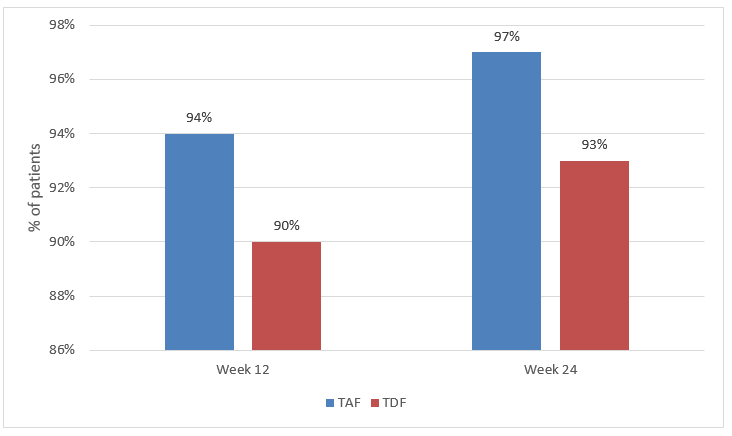
- High baseline HBV DNA level, genotype D infection, and prior interferon (week 24 only) were identified as the predictors for failure to achieve the target level.
- Normalization of alanine transaminase levels was achieved in 44% and 64% at weeks 12 and 24 respectively
- Most AEs were mild or moderate in severity with no patients discontinuing the treatment.
- The incidence of WOCBP with at least 1 AE was similar in both groups (71% vs 68% in TAF and TDF groups at week 24 respectively)
- TAF group demonstrated increases in eGFR as compared to decline in TDF treated patients at week 12. However, the change in eGFR was similar in both groups at week 24.
- Loss in BMD was slightly more in TDF group vs TAF group.
Conclusions
- Treatment with tenofovir alafenamide and tenofovir disoproxil fumarate for 24 weeks in women with high viral load, demonstrated similar efficacy in reducing the HBV DNA to levels associated with minimal transmission risk in infants who receive complete HBV passive-active immunoprophylaxis.
PLoS One. 2021 May 13;16(5):e0251552. Doi: 10.1371/journal.pone.0251552.