Efficacy of Reduced Doses of both TDF and EFV for the Treatment of HIV-1 Infection


Introduction
The combination of efavirenz (EFV), lamivudine (3TC) and tenofovir disoproxil fumarate (TDF) is still extensively prescribed worldwide either as separate entities or as a single tablet regimen. However, this combination often causes significant adverse effects, mainly due to EFV. Because of this, TDF plus 3TC, and a reduced dose of 400 mg EFV was recommended as the alternative first-line regimens by the WHO. Reduced doses of antiretroviral (ARV) drugs may lower toxicity while preserving efficacy.
Aim
To evaluate the efficacy of reduced doses of both tenofovir disoproxil fumarate (TDF) and efavirenz for the treatment of HIV-1 infection
Patient Profile
- HIV-1-infected antiretroviral-naive adults older than 18 years
Methods
- A randomized, open-label, non-inferiority trial
- N=184
- Randomly assigned patients (1:1) to
- Standard Dose group (n= 92): Standard dose regimen of TDF 300 mg, 3TC 300 mg plus EFV 600 mg
- Low dose group (n=92): A lower dose regimen of TDF 200 mg, 3TC 300 mg plus EFV 400 mg
Endpoints
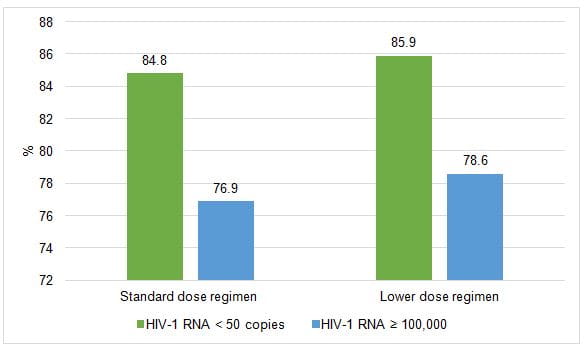
- The primary endpoint: The proportion of participants with HIV-1 RNA≤ 50 copies/mL at week 48 using a non-inferiority margin of –10%.
- Safety endpoints: Incidence and severity of adverse events according to the WHO toxicity scale
Results
|
|
Lower dose group (n = 92) |
Standard dose group (n = 92) |
Total (n = 184) |
|
Men |
83 (90.2%) |
87 (94.6%) |
170 (92.4%) |
|
Age (years) |
31 (25–36.5) |
28 (25–36) |
30 (25–36) |
|
Weight (kg) |
65.0 ± 8.6 |
63.0 ± 9.3 |
64.0 ± 8.9 |
|
BMI (kg/m2) |
21.8 ± 2.5 |
21.2 ± 2.6 |
21.5 ± 2.6 |
|
Median (IQR) plasma HIV RNA in log10 copies per mL |
4.4 (3.9–4.8) |
4.5 (4.2–4.9) |
4.5 (4–4.8) |
|
Plasma HIV RNA copies per mL ≥100,000 copies/mL – no. (%) |
14 (15.2%) |
13 (14.1%) |
27 (14.6%) |
|
Baseline CD4 T-cell count (cells/µL) |
310 (190–466) |
272 (206–376) |
292 (199–426) |
|
Creatinine clearance (mL/min) |
113.9 (105.8–121.8) |
112.2 (104.5–120.9) |
113.7 (104.8–121.3) |
Efficacy Endpoint Results
- A lower dose regimen was non-inferior to the standard dose regimen
Safety Results
- There were a total of 345 adverse events during the 48-week study period
- Drug-related adverse events occurred more frequently in the participants receiving the standard dose regimen compared with the lower dose one
|
|
Lower dose regimen (n = 92) |
Standard dose regimen (n = 92) |
Total (n = 184) |
P value |
|
Any adverse events |
64 (69.6%) |
76 (82.6%) |
140 (76.1%) |
0.06 |
|
Adverse events definitely or probably related to study drug |
58 (63.0%) |
74 (80.4%) |
132 (71.7%) |
0.01 |
|
Patients stopping drug due to drug- related adverse events |
3 (3.3%) |
5 (5.4%) |
8 (4.3%) |
0.72 |
|
Serious adverse events |
2 (2.2%) |
1 (1.1%) |
3 (1.6%) |
1.0 |
|
Serious adverse events definitely or probably related to study drug |
0 (0) |
1 (1.1%) |
1 (0.5%) |
1.0 |
|
Central nervous system-related adverse events |
36 (39.1%) |
49 (53.3%) |
85 (46.2%) |
0.08 |
|
Rash |
17 (18.5%) |
14 (15.2%) |
31 (16.8%) |
0.69 |
|
Gastrointestinal adverse events |
4 (4.3%) |
12 (13.0%) |
16 (8.7%) |
0.07 |
- Changes in estimated glomerular filtration rate and bone mineral density were comparable between the two groups (table 3)
- The two groups showed no significant difference in changes in eGFR and BMD
|
|
Standard dose group |
Lower dose group |
P-value |
|
eGFR |
2.3 (-2.6-8.8) mL/min/1.73m2 |
3.7 (-2.5-8.3) mL/min/1.73m2 |
0.85 |
|
|
|
|
|
|
BMD changes in Spine |
2.6 (-4.9 to 0.3%) |
-2.3 (-3.9 -0.0%) |
0.67 |
|
|
|
|
|
|
BMD Changes in Hip |
-1.8% (-4.6%-1.0%) |
-1.0% (-3.6%-1.6%) |
0.35 |
Conclusion
The study demonstrated that a lower dose ARV regimen composed of TDF 200 mg, EFV 400 mg and standard-dose lamivudine (300 mg) was non-inferior to the standard dose regimen but with a lower frequency of adverse events.
Reference
Emerg Microbes Infect. 2020; 9(1): 843–850.