

Efficacy and Safety of Trastuzumab and Lapatinib Combined Chemotherapy in Real-World Setting HER2+ MBC


Introduction
Combination of trastuzumab (T) and lapatinib (L) has been shown to significantly improve the prognosis of HER2+ heavily pretreated metastatic breast cancer (MBC). TL combined chemotherapy (TLC) has become one of the commonly used therapeutic
schemes, but the efficacy and safety of TLC is still lack of large-scale clinical research, especially in the metastatic setting.
Aim
To report the first real-world data of TLC in HER2+ MBC, including the efficacy, safety and treatment patterns
Patient Profile
- N= 285 patients
- Female patients age > 18 years with “histologically or cytologically confirmed MBC with documentation of HER2 overexpression (i.e., immunohistochemistry 3 + and/or fluorescent in situ hybridization-positive by local assessment)”
- Patients received trastuzumab 6 mg/kg weekly (after the initial 8 mg/kg loading dose) plus lapatinib (750 mg−1,250 mg/day) plus chemotherapy regimen (by physicians’ choice), starting from September 2013 to July 2019
Methods
Study Design
- Retrospective, multicenter study
- Patients were prescribed with TLC in clinical practice.
- The combination therapy with cytotoxic drugs and the starting dose, dose modification and treatment discontinuation of TLC was determined by physicians’ choice based on previous clinical trials results, general health status and willing of patients.
|
TLC treatment |
Number of patients (%) (N = 285) |
|
STARTING REGIMENS |
|
|
TL+ capecitabine |
116 (40.7) |
|
TL+ vinorelbine |
61 (21.4) |
|
TL+ paclitaxel |
33 (11.6) |
|
TL+ paclitaxel+ carboplatin |
17 (6.0) |
|
TL+ gemcitabine |
14 (5.0) |
|
TL+ docetaxel |
13 (4.6) |
|
TL+ vinorelbine + capecitabine |
7 (2.5) |
|
Other |
24 (8.4) |
|
Maintenance treatment regimen |
93 (33.0) |
|
TL |
22 (23.7) |
|
TL+ capecitabine |
20 (21.5) |
|
T+ CT |
18 (19.4) |
|
L+ CT |
18 (19.4) |
|
TL+ endocrine therapy |
7 (7.5) |
|
TL+ another CT |
5 (5.4) |
|
T |
3 (3.2) |
|
LAPATINIB Starting dosage (mg/day) |
|
|
1,250 |
141 (49.5) |
|
1,000 |
99 (34.7) |
|
750 |
37 (13.0) |
|
500 |
8 (2.8) |
|
Dose reduction (mg/day) |
|
|
1,250→ 1,000 |
27 (9.5) |
|
1,250→ 1,000→ 750 |
4 (1.4) |
|
1,000→ 750 |
17 (6.0) |
|
1,000→ 750→ 500 |
4 (3.5) |
|
1,000→ 750→ 1000 |
1 (0.4) |
|
750→ 500 |
3 (1.1) |
|
Dose escalation (mg/day) |
|
|
500→ 750→ 1,000 |
1 (0.4) |
|
1,000→ 1,200 |
5 (1.8) |
|
Interruption of lapatinib treatment |
30 (10.5) |
|
Lapatinib treatment discontinuation due to AEs |
16 (5.7) |
|
CHEMOTHERAPY |
|
|
Dose reduction |
|
|
Yes |
53 (18.6) |
|
No |
232 (81.4) |
T, trastuzumab; L, lapatinib; C; chemotherapy; AEs, adverse events.
Study Outcomes
- Primary Outcome
- Progression-free survival (PFS), defined as the time from initiating TLC to date of tumour progression or death of any cause
- Secondary Outcomes
- Objective response rate (ORR), defined as the percentage of patients with complete response (CR) or partial response (PR)
- overall survival (OS) defined as the time period from initial treatment of TLC to death or last follow-up
- Adverse events (AEs) were retrospectively collected based on patients’ laboratory
Results
|
Characteristics |
Number of patients (%) (N = 285) |
|
|
Median age (years, range) |
50 (26–87) |
|
|
ECOG PERFORMANCE-STATUS SCORE |
|
|
|
0 |
78 (27.3) |
|
|
1 |
193 (67.7) |
|
|
2 |
14 (5.0) |
|
|
HORMONE RECEPTOR STATUS |
|
|
|
HR-positive |
115 (40.4) |
|
|
HR negative |
170 (59.6) |
|
|
DISEASE-FREE INTERVAL |
|
|
|
Primary metastatic |
69 (24.2) |
|
|
DFI ≤ 1year |
71 (25.0) |
|
|
DFI > 1year |
145 (50.9) |
|
|
METASTATIC SITES |
|
|
|
Lung |
112 (39.3) |
|
|
Liver |
107 (37.5) |
|
|
Bone |
119 (41.8) |
|
|
Brain |
69 (24.2) |
|
|
NUMBER OF METASTATIC SITES |
|
|
|
1 |
77 (27.0) |
|
|
2 |
91 (32.0) |
|
|
≥3 |
117 (41.1) |
|
|
VISCERAL METASTASES |
|
|
|
Yes |
209 (73.3) |
|
|
No |
76 (26.7) |
|
|
LINES OF ADVANCED SYSTEMATIC THERAPY OF TLC |
|
|
|
1 |
65 (22.8) |
|
|
2 |
80 (28.1) |
|
|
≥3 |
140(49.1) |
|
|
TRASTUZUMAB RESISTANCE STATUS |
|
|
|
Resistance |
118 (41.4) |
|
|
Refractoriness |
133 (46.7) |
|
|
Unknown |
28 (10.0) |
|
|
PRIOR HER2-TARGETED THERAPY |
|
|
|
Trastuzumab |
253 (88.8) |
|
|
Lapatinib |
52 (18.2) |
|
|
T-DM1 |
15 (5.3) |
|
|
Pertuzumab |
2 (0.7) |
|
- 88.8% were exposed to trastuzumab, and 49.2% received 2 or more lines of systematic therapy before TLC previously.
- The most common chemotherapy regimens combined with TL were capecitabine (40.7%), and vinorelbine (21.4%) and almost 1/3 received maintenance treatment after TLC.
- At a median follow-up of 16 months
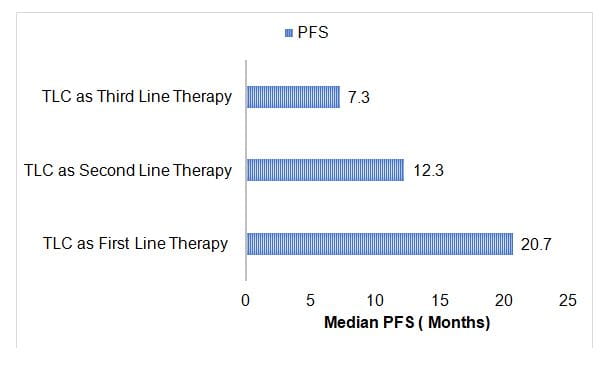
- 189 patients experienced progressive disease, resulted in a median PFS of 10.9 (9.67–12.07) months
- Patients received TLC as a first-line treatment showed the longest median PFS of 20.7 months
- Patients pretreated with trastuzumab showed a median PFS of 10.2 months.
- In patients who were pretreated with trastuzumab, the continuation of trastuzumab based on standard lapatinib plus capecitabine had a median PFS of 11.3 months.
- No significant difference in median PFS was reported in patients treated with TL combined with capecitabine or vinorelbine
- TL combined with capecitabine had numerically prolongation (11.4 vs 8.5 months, p = 0.231).
- Patients with brain metastasis (BM) also showed a median PFS (intracranial and extracranial lesions considered) of 10.6 months
- Univariate analysis indicated that
- number of metastatic sites (<2 vs>2)
- types of metastasis (visceral vs non-visceral)
- lines of metastatic systematic therapy of TLC (1 vs 2 vs>3)
- prior exposure to lapatinib were significantly correlated with PFS
|
Characteristic |
HR |
Log-rank analysis P-value |
HR |
Cox multivariate analysis P-value |
|
Age group (<60 vs ≥60) |
1.174 |
0.356 |
|
|
|
Hormone receptor status (HR+ vs. HR-) |
1.062 |
0.684 |
|
|
|
DFI (>1year vs. ≤1year) |
1.181 |
0.370 |
|
0.328 |
|
Number of metastatic sites (≤2 vs>2) |
1.661 |
0.001 |
1.373 |
0.054 |
|
Types of metastasis (visceral vs. non-visceral) |
1.511 |
0.018 |
1.079 |
0.650 |
|
Lines of advanced systematic therapy of TLC (1 vs 2 vs ≥3) |
1.891 |
<0.001 |
1.778 |
<0.001 |
|
Trastuzumab Resistance Status (resistance vs. refractoriness) |
1.244 |
0.159 |
|
|
|
Prior exposure to lapatinib (yes vs. no) |
1.684 |
0.005 |
1.257 |
0.302 |
HR, Hormone receptor; DFI, Disease-free interval; TLC, trastuzumab+ lapatinib+ chemotherapy.
- Two patients (0.7%) achieved a complete response, 116 patients (41.9%) had Partial response R, resulted in an objective response rate, of 42.6%.
Safety
- Overall, the safety of TLC was controllable and tolerable.
- The most common grade 3 and 4 AEs were
- neutropenia (16.8%)
- leukopenia (14.7%)
- diarrhea (9.5%)
- palmar–plantar erythrodysesthesia syndrome (PPES, 8.4%) anemia (7.7%).
- In patients received initial TL plus capecitabine, the most common grade 3 to 4 AEs were PPES (12.9%) and diarrhoea (6.9%)
- No treatment-related death was reported during TLC
- The most common grade 3 and 4 AEs were
Conclusions
- TLC demonstrated promising effects and tolerable safety in HER2+MBC, even in patients with BM, providing a theoretical basis for clinical practice
- TLC therapy resulted in median PFS of 10.9 months and an ORR of 42.6%
- The triplet combination of trastuzumab, lapatinib and chemotherapy demonstrated promising efficacy in HER2+ MBC with tolerable toxicity
- In patients with BM, TLC also demonstrated promising anti-tumoral activity
Reference
Front Oncol. 2020 Mar 3;10:271. doi: 10.3389/fonc.2020.00271