




Efficacy and Safety of Rizatriptan 10 mg for the Treatment of Migraine Patients Switched from Non-triptan Treatment Regimen

10 Mar, 22


Introduction
Migraine patients often fail to achieve therapeutic response with various over the counter non-triptan medications. Such patients may benefit from triptan-based treatments. It is therefore important to evaluate the incremental benefit, safety, and tolerability of switching migraine treatment from non-triptan to triptan-based regimens in a real-life setting.
Aim
To ascertain the effectiveness of rizatriptan in the management of migraine attacks for patients who have not responded to non-triptan treatment
Patient Profile
- Patients (age; 18-65 years) with a history of migraine for at least 6 months with or without aura (frequency of 2 to 7 attacks per month), and had not used triptan medications within 3 months prior to participating in the study.
- All patients were candidates for switching treatment from non-triptan to triptans and had a Migraine-ACT score of 0 to 3 (Higher Migraine ACT scores indicates less severity of migraine attack)
Methods
Study Design
- Phase IV, open-label, multi-center, prospective cohort study
Treatment Strategy & Assessment
- Patients were treated with one rizatriptan 10 mg wafer at the onset of each migraine attack and were assessed after a minimum of one and a maximum of two consecutive headache episodes
Outcomes
Primary Efficacy Outcome
- Proportion of patients who were headache pain-free at 2 hours after treatment initiation
Secondary Efficacy Outcomes
- Proportion of patients with response to treatment (defined as reduced headache severity without using any rescue medication)
- Change in the distribution of responses to the individual items and in the total Migraine ACT questionnaire score during the study
- Severity of pain and the presence of associated symptoms during the 2 hours attack
Safety Outcomes
- Incidence of treatment-related serious and non-serious adverse events
Follow-up
- 16 weeks
Results
- The study reports findings of 284 patients with one attack and 204 patients with two attacks, accounting for a total of 488 migraine episodes over a 16-week follow-up period.
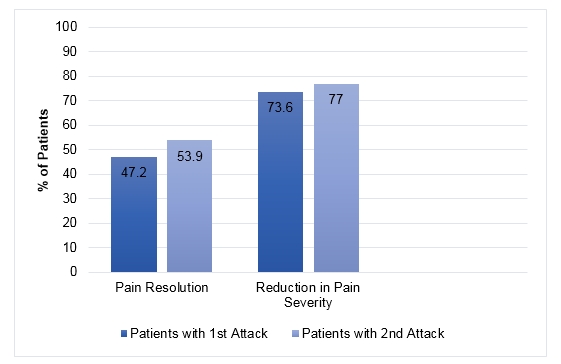
- Complete resolution of pain was seen among 47.2% and 53.9% patients with first and second attack, respectively, and 73.6% and 77.0% patients with first and second attack, respectively reported reduction in pain severity within 2 hours of onset (Fig. 1).
Fig. 1: Patients with pain resolution and reduced pain severity
- There was a significant reduction in pain severity score from the time of onset of migraine attack to end of 120 minutes. (Table 1).
Table 1: Change in the pain severity score
|
Time-period |
Pain Severity Score |
|
At the onset of migraine attack |
2.56 |
|
30 minutes |
1.91 |
|
60 minutes |
1.31 |
|
120 minutes |
0.84 |
- Significant improvements were also evident in the Migraine ACT questionnaire scores.
- There was no incidence of treatment-related serious adverse events. The most frequently reported non-serious adverse events, attributed to the study drug included; dizziness (2.2%), chest discomfort (1.1%), nausea (1.1%), and somnolence (0.8%).
Conclusion
- In a real-life setting, rizatriptan benzoate 10 mg was effective and safe in the treatment of acute migraine headaches amongst patients who did not respond to non-triptan treatment.
Clin Med Insights Ther. 2010 (2); 567-576.
Related Topics
More From Area Of Interest
You may also like
13 May, 26
17 Apr, 26
Our Research
23 Feb, 26
23 Feb, 26
11 Feb, 26
11 Feb, 26
11 Feb, 26
Latest Items

26 Aug, 26
Journal Scans
24 Aug, 26

24 Aug, 26

21 Aug, 26


