

Efficacy and Safety of Preservative-free vs. Preservative-containing Brimonidine-Timolol Fixed Dose Combination in Patients with OAG

Introduction
It is recommended that intraocular pressure (IOP) should be primarily reduced to treat glaucoma. Brimonidine-timolol fixed dose combination (BTFC) is known to effectively lower the IOP in glaucoma patients. Like other glaucoma medications, BTFC generally contains benzalkonium chloride which may cause certain side effects. Preservative-free (PF) ophthalmic solutions are often preferred to reduce or eliminate the preservative-associated side effects.
Aim
To compare the therapeutic efficacy and safety of newly developed PF BTFC ophthalmic solution and a preservative-containing (PC) BTFC ophthalmic solution in patients with open-angle glaucoma (OAG).
Patient Profile
- Adult patients (aged ≥19 years; n=106) with OAG and ocular hypertension (OHT; baseline IOP <35 mmHg)
Methods
Study Design
- Multicenter, randomized, open-label, parallel-group clinical trial
Treatment Strategy
- After a washout period, patients were randomized to PF-BTFC (n=53) or PC-BTFC (n=53)
Assessment
- The study participants were examined at week 4 and 12, after first administration.
- At each follow-up visit, IOP was measured at 9 a.m. and 11 a.m.
Outcomes
Primary Efficacy Outcome
- Change in IOP at 11 a.m. at 12 weeks of treatment initiation
Secondary Efficacy Outcome
- Change in IOP at each time point during each follow-up visit
- Percentage of patients with greater than 10%, 15% and 20% IOP reduction at each visit
Safety and Compliance Outcomes
- Incidence of adverse events (AEs) at each visit
Results
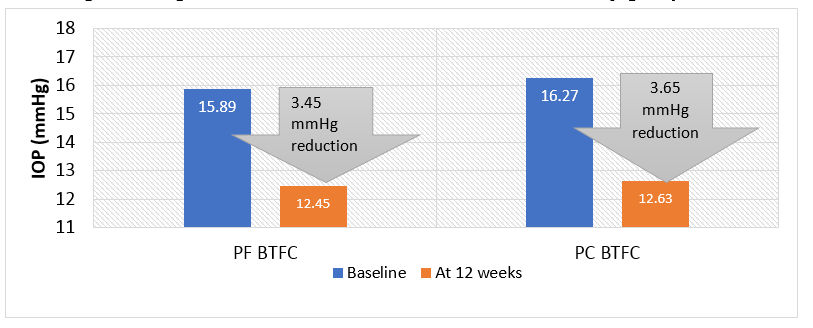
- The mean IOP at baseline did not differ significantly in the PF group (15.8 mmHg) vs. PC group (16.27 mmHg)
- The mean IOP decreased significantly from baseline to week 12 at 11:00 a.m. in both the study groups (Fig. 1), though the between-group difference was insignificant (0.20 mmHg).
Fig 1: Change in IOP from baseline to week 12 in the study groups
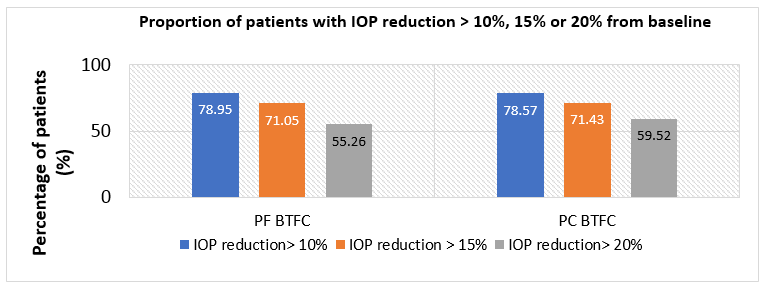
- The proportion of patients achieving IOP reductions of more than 10%, 15% and 20% and IOP reductions at all-time points, and at week 12 at 11.00 a.m. did not differ significantly in the PF vs. PC groups (Fig 2).
Fig 2: Proportion of patients achieving various degrees of IOP reduction at week-12 at 11.00 a.m.
- There incidence of AEs did not differ significantly in both the groups.
Conclusion
- Amongst OAG patients, PF BTFC ophthalmic solution was non-inferior to PC BTFC in terms of efficacy and safety for reducing IOP.
Semin Ophthalmol. 2021 Apr 3;36(3):103-109.