Efficacy and Safety of Pazopanib Monotherapy in Treatment-naive and cytokine-pre-treated Patients with Advanced and/or Metastatic RCC

Introduction
Pazopanib is an oral angiogenesis inhibitor targeting vascular endothelial growth factor receptor, platelet-derived growth factor receptor, and c-Kit.
Aim
This study evaluated efficacy and safety of pazopanib monotherapy in treatment-naive and cytokine-pretreated patients with advanced renal cell carcinoma (RCC).
Patient Profile
- Patients with advanced and/or metastatic RCC who had progressed on one prior cytokine-based systemic therapy
- Treatment Na?ve
Methods
Study Design
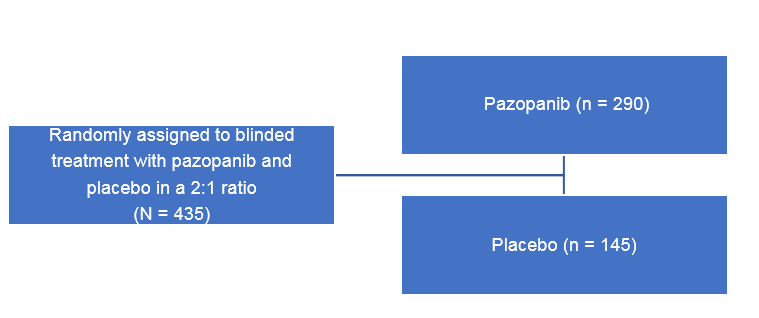
- Randomized, double-blind, placebo-controlled phase III study
- Adult patients with measurable, locally advanced, and/or metastatic RCC were randomly assigned (2:1) to receive oral pazopanib or placebo
Endpoint
- The primary end point was progression-free survival (PFS)
- The secondary endpoint was
- Overall survival (OS), defined as the time interval between the date of random assignment and date of death
- Confirmed objective response rate (complete response [CR] plus partial response [PR])
- Duration of response
- Safety
- Health-related quality of life (HRQoL) was also assessed
Results
- PFS was significantly prolonged with pazopanib compared with placebo in
- Overall study population
- Treatment-naive subpopulation
- cytokine-pretreated subpopulation
-
Figure 1: Pazopanib significantly prolonged PFS compared to placebo
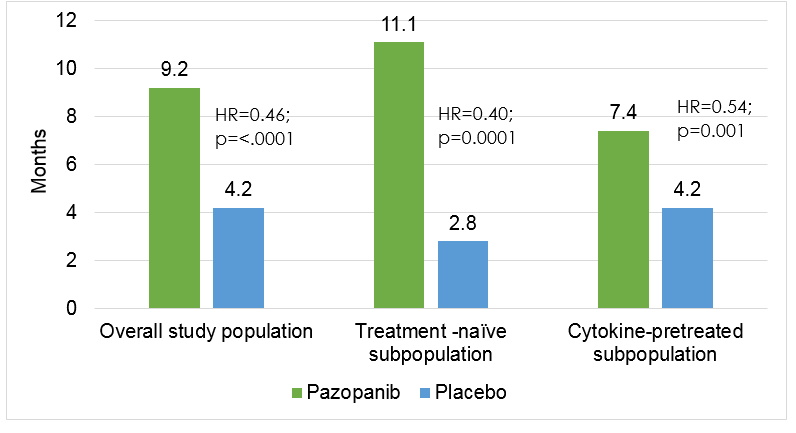
- The prespecified subgroup analyses showed that PFS was improved for patients treated with pazopanib compared with placebo regardless of MSKCC risk category, sex, age, or ECOG PS (HR range,0.40 to 0.52; P<.001)
- The objective response rate was 30% with pazopanib compared with 3% with placebo (P < .001)
- The median duration of response was longer than 1 year
|
|
Pazopanib (n=290) |
Placebo (n=145) | ||
|
Parameter |
No. |
% |
No. |
% |
|
Overall study population |
|
|
|
|
|
Best response |
|
|
|
|
|
Complete response |
1 |
1 |
0 |
|
|
Partial response |
87 |
30 |
5 |
3 |
|
Stable disease |
110 |
38 |
59 |
41 |
|
Progressive disease |
51 |
18 |
58 |
40 |
|
Unknown |
41 |
14 |
23 |
16 |
|
Response rate (CR PR) |
88† |
30 |
5 |
3 |
|
Median duration of response, weeks |
58.7 |
|
|
|
|
Median time to response, weeks |
11.9 |
|
|
|
|
Treatment-naive subgroup |
155 |
|
78 |
|
|
Response rate (CR PR) |
49 |
32 |
3 |
4 |
|
Cytokine-pretreated subgroup |
135 |
|
67 |
|
|
Response rate (CR PR) |
39 |
29 |
2 |
3 |
Abbreviations: CR, complete response; PR, partial response
*A patient was classified as unknown if he or she never had progressive disease and did not have stable disease for at least 12 weeks (the minimum requirement to be classified as stable disease). This includes patients with no follow-up and some patients censored by independent review
†P< .001, based on Fisher’s exact test comparison of treatment arms
- The interim analysis of OS in the overall study population was based on 176 death events, which was 61% of the required 287 death events for the final OS analysis
Safety
- Pazopanib demonstrated acceptable safety and tolerability.
- Diarrhea, hypertension, hair color changes, nausea, anorexia, and vomiting were the most reported AEs (incidence of >20%).
- Most AEs related to pazopanib treatment were grade 1/2 and were clinically manageable.
- The most common grade 3/4
- AEs were hypertension and diarrhea
- Chemistry abnormalities were ALT elevation and AST elevation occurred within the first 4 months of treatment
- No clinically significant differences were reported in quality of life for pazopanib versus placebo
|
|
Grade | |||||||||||
|
Pazopanib (n =290) |
Placebo (n =145) | |||||||||||
|
Any |
3 |
4 |
Any |
3 |
4 | |||||||
|
Parameter |
No. |
% |
No |
% |
No |
% |
No |
% |
No |
% |
No |
% |
|
Adverse event |
|
|
|
|
|
|
|
|
|
|
|
|
|
Diarrhea |
150 |
52 |
9 |
3 |
2 |
<1 |
13 |
9 |
1 |
<1 |
0 |
|
|
Hypertension |
115 |
40 |
13 |
4 |
0 |
|
15 |
10 |
1 |
<1 |
0 |
|
|
Hair color changes |
109 |
38 |
1 |
1 |
0 |
|
4 |
3 |
0 |
|
0 |
|
|
Nausea |
74 |
26 |
2 |
1 |
0 |
|
13 |
9 |
0 |
|
0 |
|
|
Anorexia |
65 |
22 |
6 |
2 |
0 |
|
14 |
10 |
1 |
<1 |
0 |
|
|
Vomiting |
61 |
21 |
6 |
2 |
1 |
<1 |
11 |
8 |
3 |
2 |
0 |
|
|
Fatigue |
55 |
19 |
7 |
2 |
0 |
|
11 |
8 |
2 |
1 |
2 |
1 |
|
Asthenia |
41 |
14 |
8 |
3 |
0 |
|
12 |
8 |
0 |
|
0 |
|
|
Abdominal pain |
32 |
11 |
6 |
2 |
0 |
|
2 |
1 |
0 |
|
0 |
|
|
Headache |
30 |
10 |
0 |
|
0 |
|
7 |
5 |
0 |
|
0 |
|
|
Clinical chemistry |
|
|
|
|
|
|
|
|
|
|
|
|
|
ALT increase |
152 |
53 |
30 |
10 |
5 |
2 |
32 |
22 |
2 |
1 |
0 |
|
|
AST increase |
152 |
53 |
21 |
7 |
2 |
<1 |
27 |
19 |
1 |
<1 |
0 |
|
|
Hyperglycemia |
115 |
41 |
2 |
<1 |
0 |
|
47 |
33 |
2 |
1 |
0 |
|
|
Total bilirubin increase |
102 |
36 |
7 |
3 |
2 |
<1 |
15 |
10 |
2 |
1 |
1 |
<1 |
|
Hypophosphatemia |
95 |
34 |
11 |
4 |
0 |
|
16 |
11 |
0 |
|
0 |
|
|
Hypocalcemia |
91 |
33 |
4 |
1 |
4 |
1 |
35 |
26 |
2 |
1 |
1 |
<1 |
|
Hyponatremia |
86 |
31 |
11 |
4 |
4 |
<1 |
35 |
24 |
6 |
4 |
0 |
|
|
Hypomagnesemia |
31 |
11 |
9 |
3 |
0 |
|
13 |
9 |
3 |
2 |
0 |
|
|
Hypoglycemia |
47 |
17 |
0 |
|
1 |
<1 |
4 |
3 |
0 |
|
0 |
|
|
Hematologic |
|
|
|
|
|
|
|
|
|
|
|
|
|
Leukopenia |
103 |
37 |
0 |
|
0 |
|
9 |
6 |
0 |
|
0 |
|
|
Neutropenia |
94 |
34 |
3 |
1 |
1 |
<1 |
9 |
6 |
0 |
|
0 |
|
|
Thrombocytopenia |
89 |
32 |
2 |
1 |
<1 |
<1 |
7 |
5 |
0 |
|
1 |
<1 |
|
Lymphocytopenia |
86 |
31 |
11 |
4 |
<1 |
<1 |
34 |
24 |
2 |
1 |
0 |
|
*Adverse events with an incidence of >10% in the pazopanib arm are displayed.
†Clinical laboratory abnormalities with an incidence of> 30% in the pazopanib arm or with a 5% increase in incidence in the pazopanib arm compared with the placebo arm are displayed.
Conclusion
- Once-daily oral pazopanib demonstrated significant improvement in PFS and RR in treatment-naive and cytokine-pre-treated patients with advanced and/or metastatic RCC
- Pazopanib demonstrated acceptable safety and tolerability
Reference
J Clin Oncol 28:1061-1068