

Efficacy and Safety of Lenvatinib in Patients with Iodine 131-refractory Thyroid Cancer


Introduction
Lenvatinib is an oral, multitargeted tyrosine kinase inhibitor of the VEGFRs 1, 2, and 3, FGFRs 1 through 4, PDGFR a, RET, and KIT signalling networks
Aim
To assess progression-free survival among patients with iodine-131–refractory thyroid cancer who received lenvatinib as compared with those who received placebo
Patient profile
Patients with progressive thyroid cancer that was refractory to iodine-131
Methods
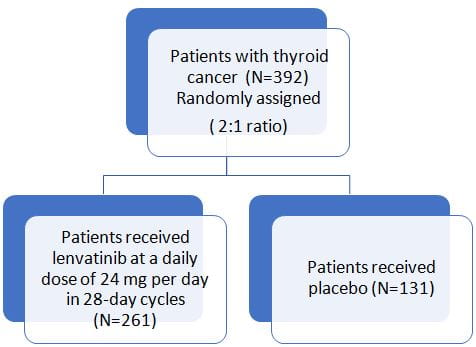
- Phase 3, randomized, double-blind, multicentre study
Endpoints
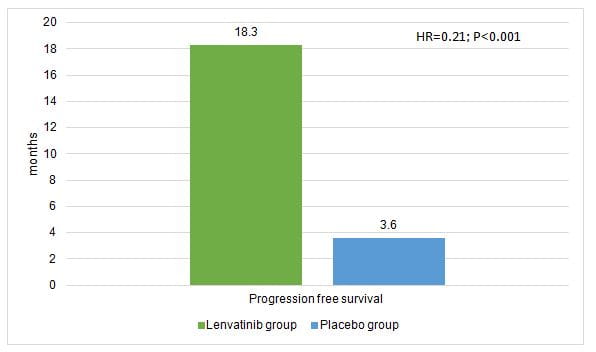
- The primary end point was progression-free survival
- Secondary end points included the response rate, overall survival, and safety
Results
- The baseline characteristics of the patients were similar in the two groups
- A progression-free survival benefit associated with lenvatinib was seen in patients with thyroid cancer of all histologic types examined (papillary, poorly differentiated, follicular, and H?rthle-cell)
- The 6-month progression-free survival rates were 77.5% in the lenvatinib group and 25.4% in the placebo group
Secondary Endpoints
- Lenvatinib was associated with significant improvement in the response rate
- The response rate was 64.8% in the lenvatinib group (4 complete responses and 165 partial responses) and 1.5% in the placebo group (P<0.001)
- The median overall survival was not reached in either group
- The difference in overall survival between the groups was not significant
|
Outcome |
Lenvatinib (N = 261) |
Placebo (N = 131) |
Odds Ratio
|
|
Overall survival |
|
|
|
|
Median— mo |
NE (22.0–NE) |
NE (14.3–NE) |
|
|
Rate, — % |
|
|
|
|
6 mo |
90.7
|
85.3 |
|
|
12 mo |
81.6
|
70.0 |
|
|
18 mo |
72.3 |
63.0 |
|
|
24 mo |
58.2 |
NE |
|
|
Response rate — no. (%) ** |
64.8 |
1.5 |
28.87 |
|
Complete response |
1.5 |
0 |
|
|
Partial response |
63.2 |
1.5 |
|
|
Stable disease |
23.0 |
54.2 |
|
|
Durable stable disease ≥23 wk |
15.3 |
29.8 |
|
|
Progressive disease |
6.9 |
39.7 |
|
|
Could not be evaluated |
5.4 |
4.6 |
|
|
Exploratory efficacy end points |
|
|
|
|
Disease-control rate — no. (%) †† |
87.7 |
55.7 |
5.05 |
|
Clinical-benefit rate — no. (%) |
80.1 |
31.3 |
7.63 |
|
Time to first objective response — mo |
|
|
|
|
Median |
2.0 |
5.6 |
|
NE not estimable
** Tumour responses were assessed with the use of Response Criteria in Solid Tumours (RECIST), version 1.1, and were confirmed by independent centralized radiologic review
†† The disease-control rate was calculated as complete response plus partial response plus stable disease
§§ The clinical-benefit rate was calculated as complete response plus partial response plus durable stable disease
Safety
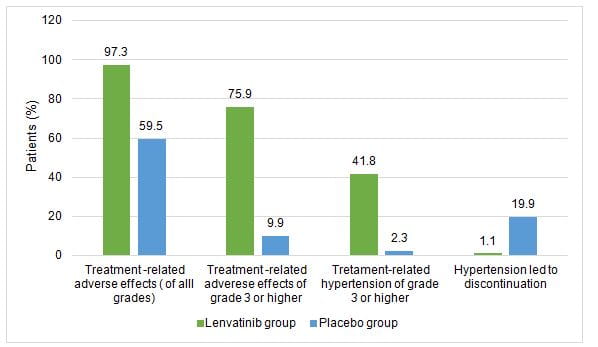
- Toxic effects of therapy were considerable, and most toxic effects were managed with dose modification and medical therapy
Conclusion
- The study demonstrated that compared to placebo, lenvatinib was associated with significant improvements in progression-free survival and the response rate among patients with iodine-131– refractory thyroid cancer.
- Patients who received lenvatinib had more adverse effects.
Reference
N Engl J Med 2015; 372:621-30.