




Efficacy and Safety of Lenvatinib, Everolimus, or their Combination as Second-line Treatment in Patients with Metastatic Renal Cell Carcinoma

30 Aug, 21
Introduction
Lenvatinib is another oral multitarget tyrosine kinase inhibitor of VEGFR1, VEGFR2, and VEGFR3, with inhibitory activity against fibroblast growth factor receptors
Aim
To compare the efficacy and safety of the established maximum tolerated dose of the lenvatinib plus everolimus combination and single-agent lenvatinib with the standard dose of single-agent everolimus in patients with metastatic renal cell carcinoma who had disease progression after one previous VEGF-targeted therapy.
Patient Profile
Patients with advanced or metastatic, clear-cell, renal cell carcinoma who had received treatment with a VEGF-targeted therapy and progressed on or within 9 months of stopping that agent.
Methods
- Randomised, phase 2, open-label, multicentre trial
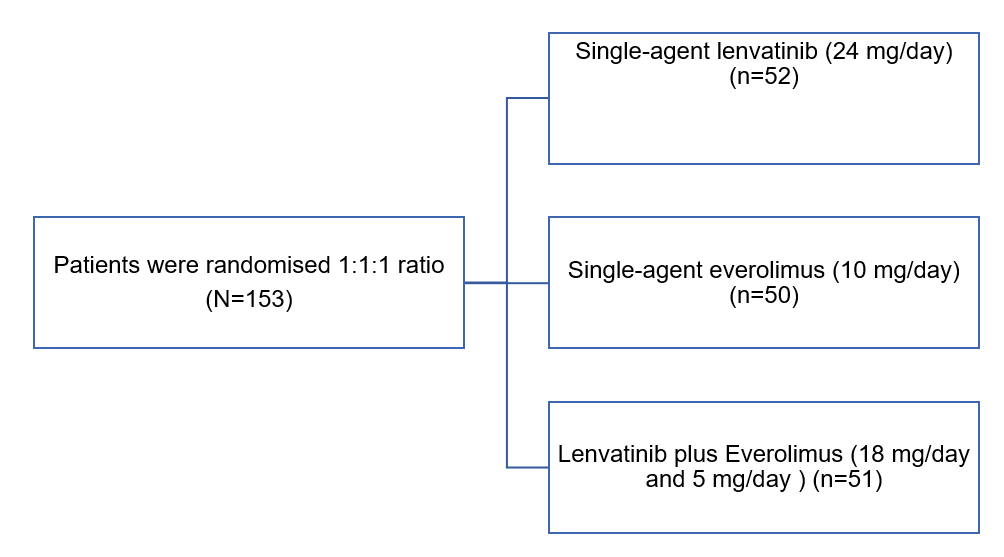
- Administered study treatment until disease progression, unacceptable toxic effects, or withdrawal of consent
Endpoints
- The primary objective was progression-free survival in the intention-to-treat population
- Secondary endpoints included assessments of safety and tolerability, pharmacokinetic profiles of lenvatinib (alone and in combination with everolimus), overall survival, and the proportion of patients with an objective response
Results
- Lenvatinib plus everolimus significantly prolonged progression-free survival compared with everolimus alone (hazard ratio [HR] 0·40; p=0·0005), but not compared with lenvatinib alone (7·4 months; HR 0·66, p=0·12)
Figure 1: Median progression-free survival
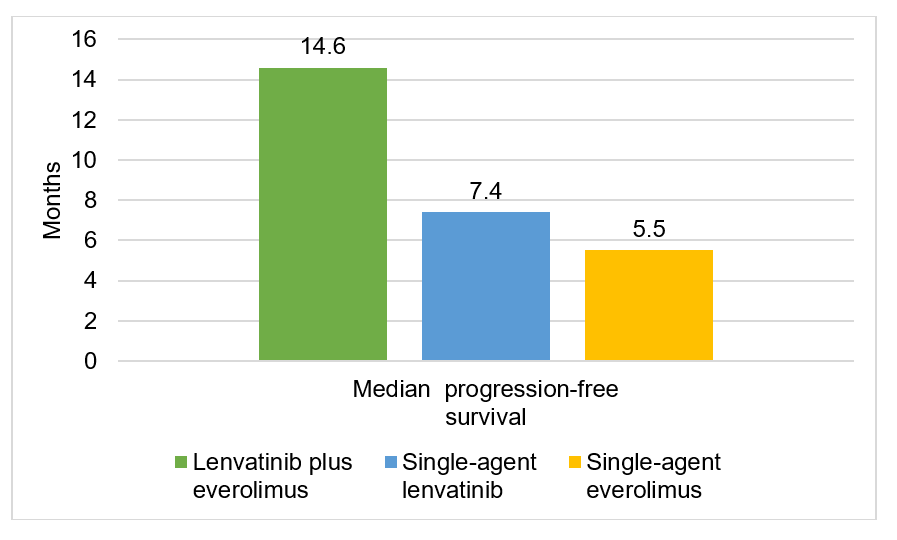
- Single-agent lenvatinib significantly prolonged progression-free survival compared with everolimus alone (HR 0·61; p=0·048)
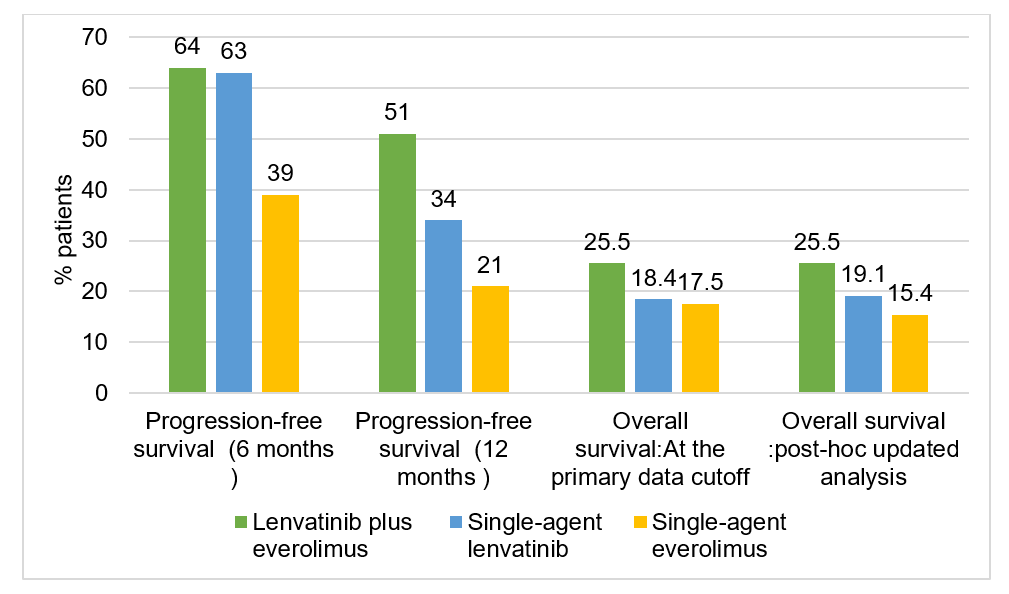
- Median overall survival at extended follow-up was increased with the lenvatinib plus everolimus regimen compared with single-agent everolimus
Figure 2: Proportion of patients achieving progression free survival
Pharmacokinetics
- The population mean value for lenvatinib apparent clearance was estimated to be 7?40 L/h
- Lenvatinib absorption after oral administration was best described by simultaneous first-order absorption with a rate constant of 1?08/h, a zero-order absorption with a duration of 0?83 h, and a lagtime of 0?17 h for patient studies
- Apparent volumes of distribution of the central and two peripheral compartments were estimated to be 51?8 L, 31?2 L, and 43?6 L, respectively
Safety
- Adverse events were greater in the two treatment groups with lenvatinib compared with everolimus, but these were manageable with dose reductions
- The most frequent adverse events in the combination regimen were diarrhoea, decreased appetite, and fatigue
- Grade 3 and 4 events occurred in fewer patients allocated single-agent everolimus (25 [50%]) vs lenvatinib alone (41 [79%]) or lenvatinib plus everolimus (36 [71%])
- The most common grade 3 or 4 treatment-emergent adverse event in patients allocated
- lenvatinib plus everolimus diarrhoea (ten [20%])
- single-agent lenvatinib proteinuria (ten [19%])
- single-agent everolimus anaemia (six [12%])
Conclusion
- Combination regimen of lenvatinib plus everolimus demonstrated highest level of efficacy
- Lenvatinib plus everolimus and lenvatinib alone resulted in a progression-free survival benefit for patients with metastatic renal cell carcinoma who have progressed after one previous VEGF-targeted therapy.
Reference
Lancet Oncol 2015; 16: 1473–82
Related Topics
More From Area Of Interest
You may also like

12 Oct, 26

21 Sep, 26
21 Sep, 26

21 Sep, 26

13 May, 26

17 Apr, 26
Latest Items
12 Oct, 26
12 Oct, 26
Journal Scans
8 Oct, 26

8 Oct, 26


