




Efficacy and Safety of Lacosamide as Adjunctive Therapy for Epilepsy: Evidence form Real-world Setting

18 Nov, 20


Introduction
Following an initial approval in Taiwan as an adjunctive therapy for focal impaired awareness seizures, lacosamide (LCM) was also approved for secondarily generalized seizures (SGS) in patients with epilepsy aged ≥16 years. Though, randomized, placebo-controlled trials have demonstrated the efficacy and tolerability of adjunctive LCM for the treatment of patients with focal seizures there is no clarity on a flexible dose setting.
Aim
- To assess the safety and tolerability of LCM in real-world setting in Taiwan
- To assess the effectiveness of LCM as an exploratory objective
Patient Profile
- Patients (age ≥16 years) with focal impaired awareness seizures and/or SGS (in line with approved indication in Taiwan at the time of the study)
- All patients were taking at least one concomitant antiseizure medication (ASM), and had at least one seizure in the 3 months before baseline.
- Patients were prescribed LCM by their treating physician in the course of routine clinical practice.
Methods
Study Design
- A multicentre, prospective, non-interventional study
Follow-up Period
- 12 months
Follow-up Visits
- Every 3 months
Outcomes
Primary Safety Outcome
- Treatment-emergent adverse events (TEAEs) spontaneously reported to, or observed by, the treating physician
- Drug-related TEAEs, serious TEAEs, serious drug-related TEAEs, TEAEs leading to withdrawal of LCM, and drug-related TEAEs leading to withdrawal of LCM
Primary Efficacy Outcomes
- Improvement in seizures in terms of “Clinical Global Impression of Change” (CGIC)
- Change in 28-day seizure frequency from baseline to 12 months (or final visit)
- Freedom from focal seizures at 12 months
Secondary Outcomes
- Retention rates and 6 and 12 months
- 50% responder rate (≥50% reduction in focal seizure frequency from baseline) at 6 and 12 months/final visit
- Seizure outcomes in a subgroup of patients with SGS during baseline (change in SGS seizure frequency)
- 50% responder rate for SGS
- Freedom from SGS
Results
- Overall, 171 patients were treated with LCM, of these 81.3% (n=139) completed the study. Mean age of the study population was 38.5 years, mean age at epilepsy diagnosis was 21.2 years and 56.1% (n=96) were males.
- The mean dosage of AMSs at baseline was 2.8. Mean duration of LCM treatment was 288.7 days, and the mean daily dosage of LCM was 205.0 mg/day. As per the Kaplan–Meier analysis, the estimated 12-month retention of LCM was 82.9%.
- Overall, 95 (55.6%) patients reported at least one TEAE, most common ones being dizziness (19.3%), headache (7.0%), upper respiratory tract infection (6.4%), and seizure (5.8%).
- Drug-related TEAEs were reported in 74 (43.3%) patients, and drug-related TEAEs leading to discontinuation of LCM were reported in 14 (8.2%) patients.
- Two deaths (1.2%) were recorded during LCM treatment, though they were not related to LCM.
- Two (1.2%) patients had suicidality-related TEAEs; though these TEAEs were considered either not related to LCM or the relationship was not recorded.
- Five patients (2.9%) reported rash-related TEAEs (of these, two were considered LCM-related).
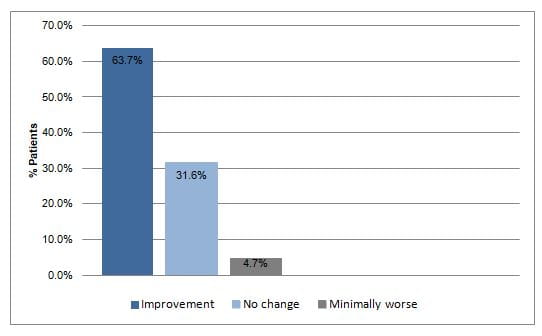
- As per the CGIC findings at 12 months (or final visit), 63.7% (n=109) patients had improvement, 31.6% (n=54) had no change, and the remaining 4.7% (n=8) were minimally worse (Fig. 1).
Fig. 1: Improvement with LCM during study as per CGIC
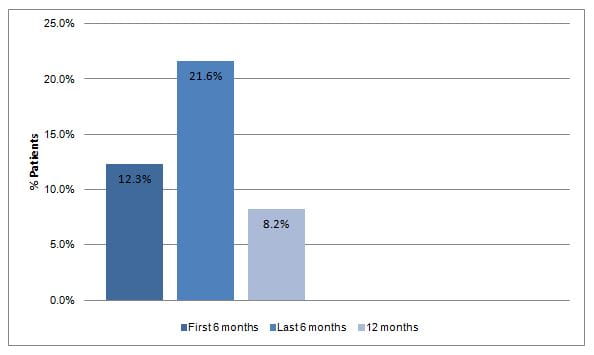
- The median percentage change in focal seizure frequency at 12 months (or final visit), was –50.0. Twenty-one patients (12.3%) were free from focal seizures during the first 6 months of the study, 37 patients (21.6%) were free from focal seizures in the last 6 months of the study. Fourteen patients (8.2%) remained free from focal seizures for the full 12 months of the study (Fig. 2).
Fig. 2: Seizure freedom during 12-month study period
- The median focal seizure frequency/28 days was 0.9 at baseline, it reduced to -0.3 at 6 months (median change; -32.1%). The median focal seizure frequency/28 days at 12 months was -0.3 (the median change –50.0%).
- The 50% responder rate at 6 months and 12 months/final visit was 46.2% and 52.4%, respectively.
- At baseline, 36.3% patients (n=62) reported SGS. As per post hoc analyses for this subgroup, the median 28-day SGS frequency dropped down from 0.6 at baseline to -0.3 at 6 months and remained at -0.3 at 12 months. The median percentage change from baseline in SGS frequency was –100.0 at 6 months and at 12 months/final visit.
- The 50% responder rate was 79.2% (42/53) at 6 months and 82.0% (50/61) at 12 months/final visit.
- Twenty-two patients (35.5%) remained free from SGS during the first 6 months of the study, 29 patients (46.8%) were free from SGS in the last 6 months and 21 patients (33.9%) were free from SGS for the entire 12 months of the study.
Conclusions
- Lacosamide was generally safe and well tolerated in patients with focal impaired awareness seizures and/or SGS in real-world setting in Taiwan.
- Lacosamide exhibited effectiveness with more than 60% of patients considered to be “improved” by their physician at 12 months or final visit.
Epilepsy Behav. Nov 2, 2020 (published Online);113:107464. doi: 10.1016/j.yebeh.2020.107464.
Related Topics
More From Area Of Interest
You may also like
13 May, 26
17 Apr, 26
Our Research
23 Feb, 26
23 Feb, 26
11 Feb, 26
11 Feb, 26
11 Feb, 26
Latest Items
Journal Scans
24 Aug, 26

24 Aug, 26

21 Aug, 26
Journal Scans
18 Aug, 26
18 Aug, 26


