




Efficacy and Safety of Cefixime in Children with Community-acquired Infections


Introduction
Cefixime is a potent broad-spectrum antibiotic with a variety of indications.
Aim
To evaluate the clinical efficacy, bacteriological eradication rates and tolerability of cefixime in children with community-acquired upper respiratory tract infection (URTI), lower RTI (LRTI) and uncomplicated urinary tract infections (UTI)
Patient Profile
- Patients, aged 6 months to 28 years, of both sexes, with a diagnosis of community-acquired URTI, LRTI and UTI
Methods
- Prospective, randomized, open, noncomparative
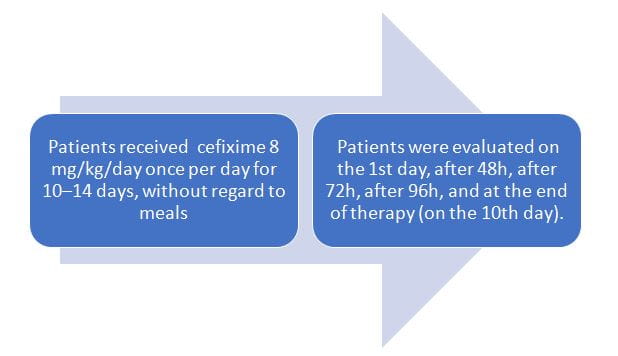
Efficacy Assessment. The primary outcome measures were:
1. Bacteriological and clinical response of signs and symptoms of URTI, LRTI and UTI, determined at the end of therapy
2. Physician Global evaluation of patient condition (using a 5-point scale):
1 = Excellent
2 = Very Good
3 = Good
4 = Fair
5 = Poor.
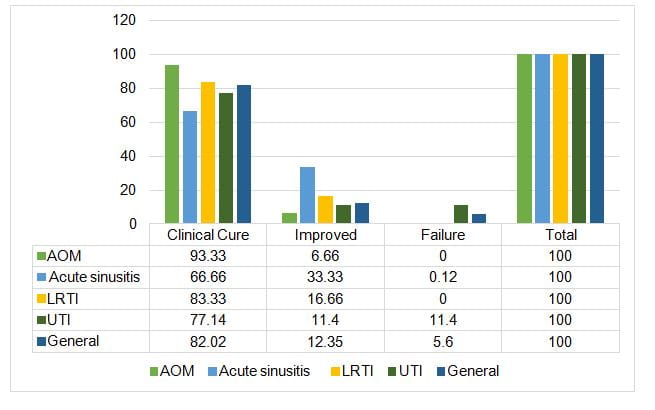
Clinical outcome: Clinical cure (defined as a complete resolution of signs and symptoms); Improved (if clinical signs & symptoms diminished, but did not completely resolve); Failure (if the signs and symptoms worsened, persisted or reappeared).
Safety assessment: Patients were closely monitored for adverse clinical events. The severity of clinically adverse events was categorized as: mild, moderate, or severe. The adverse reactions were classified as: probably drug-related, possibly drug-related, not drug-related, or with an unknown relationship to the study drug
Results
- All isolates were susceptible to cefixime
|
|
Number of patients (%) |
|
AOM |
|
|
Streptococcus pneumonia |
17 (56.66%) |
|
Pseudomonas spp |
4(13.33%) |
|
Staph. aureus |
5 (16.67%) |
|
Moraxella catarrhalis |
2(6.67%) |
|
E. coli |
2(6.67 %) |
|
Acute Sinusitis |
|
|
Streptococcus pneumoniae |
4 (33.33%) |
|
Moraxella catarrhalis |
3 (16.7%) |
|
Staph. aureus |
2 (16.7) |
|
mixed flora with Staph. aureus and Streptococcus pneumoniae |
1 (8.33%) |
|
LRTI |
|
|
Streptococcus pneumoniae |
4 |
|
Haemophilus influenzae |
1 |
|
Uncomplicated UTI |
|
|
E. coli |
17 (48.6%) |
|
Proteus spp. |
7 (20%) |
|
Klebsiela |
3(8.6%) |
|
Staph.aureus |
3(8.6%) |
|
Pseudomonas |
1(2.86%) |
|
Ecoli+Enterobacter |
2(5.7%) |
|
Klebsiela+Enterobac |
2(5.7%) |
- Cefixime treatment was successful in 100% patients suffering from acute otitis media (AOM), in 83.3% patients with acute sinusitis, in 100% patients with pneumonia, in 88.57% patients with uncomplicated UTI
|
|
AOM (%) |
Acute sinusitis (%) |
LRTI (%) |
UTI (%) |
General (%) |
|
Excellent |
30 (83.33) |
12 (58.34) |
12 (66.67) |
35 (71.43) |
89 (73.034) |
|
Very good |
30 (10.0) |
12 (16.67) |
12 (16.67) |
35 (11.42) |
89 (13.48) |
|
Good |
30 (6.67) |
12 (8.33) |
12 (16.67) |
35 (5.71) |
89 (7.86) |
|
Fair |
0 |
12 (8.33) |
0 |
35 (5.71) |
89 (3.37) |
|
Poor |
0 |
12 (8.33) |
0 |
35 (5.71) |
89 (3.37) |
|
Total |
30 (100%) |
12 (100.0) |
12 (100%) |
35 (100.0%) |
89 (100.0) |
Safety
- Cefixime was a well-tolerated and safe drug with general side effects evidenced in 3.48% (3 pts), without severe reactions
- Side-effects were transient and disappeared after finishing therapy in all three of the cases
|
Side-effects |
General |
% |
|
Mild |
89 (2) |
2.25 |
|
Moderate |
89 (1) |
1.23 |
|
Severe |
89 (0) |
0.0 |
|
Total |
89 (3) |
3.48 |
Conclusion
- Cefixime demonstrated
- Good efficiency in patients with community-acquired infections suffering from AOM, LRTI and in UTI
- Excellent compliance from the patients and parents to the protocol of cefixime in the treatment of AOM, LRTI, and UTI.
- Cefixime was well tolerated, and there was no need of therapy discontinuation
- The study suggested that in cases of acute infections where Staphylococcus aureus is a suspected pathogen, cefixime is not recommended as therapy and needs to be replaced with another antibiotic, according to susceptibility at the antibiogram.
Reference
Prilozi. 2011;32(2):143-155.


