Effectiveness of ZOL as a First-line Therapeutic Strategy After Percutaneous Kyphoplasty


Introduction
Zoledronic acid (ZOL) is a 3rd generation nitrogen-containing bisphosphonate.
Aim
To determine the efficacy of annual zoledronic acid (ZOL) administration against previously treated recompression vertebral fractures (RVF) and new vertebral fractures (NVF) in initial percutaneous kyphoplasty (PKP) patients with osteoporotic vertebral compression fractures (OVCF) over a 3-year follow-up period.
Patient Profile
- Primary OVCF in the thoracolumbar or lumbar area within 2 weeks at the single level
- MRI showing T1 hypointense signals and T2 hyperintense signals
- Patients with lower back pain, local spinous process tenderness, and/or corresponding vertebral body pain with percussion
Methods
- Placebo-controlled, double-blind prospective trial
- 154 Patients were randomly assigned to receive a
- 78 patients were assigned single infusion of ZOL (5 mg) at 1 week, 12 and 24 months postoperatively.
- 76 patients were assigned placebo (78 ZOL vs. 76 placebo) at 1 week, 12 months, and 24 months after surgery
- Patients were followed-up for 36 months
- Patients were assessed for radiographic assessments, VAS and ODI scores, BMD and bone turnover markers, safety measurements
Results
- ZOL treatment lowered the risk of RVF by ~ 65% over the 36-month period when compared to placebo controls
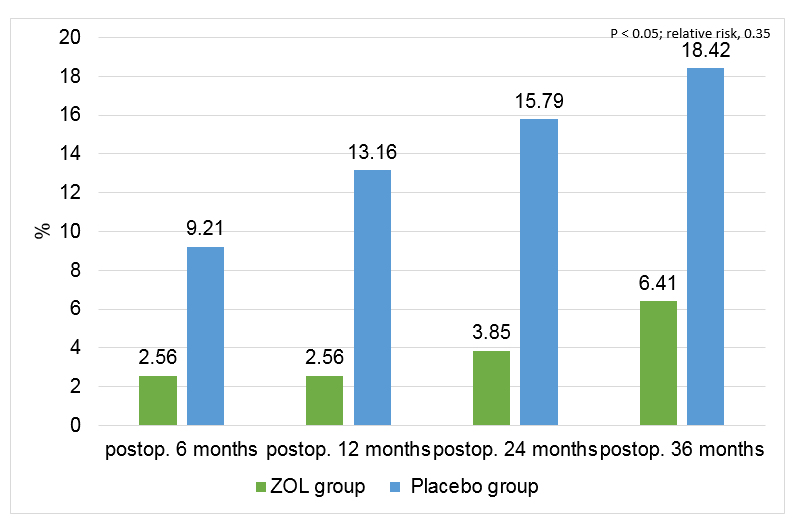
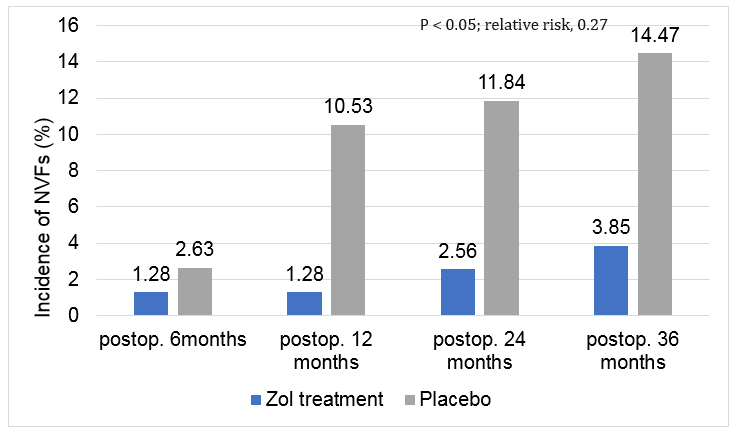
- ZOL also reduced the risk of NVF by ~ 73%
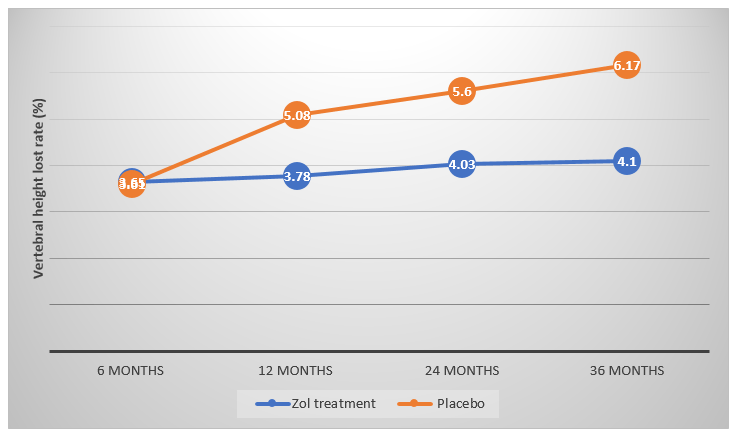
- ZOL significantly reduced the vertebral height lost rate (HLR) at 6, 12, 24, and 36 months
- ZOL improved the visual analog scale (VAS), Oswestry disability index (ODI) scores, and bone mineral density (BMD)
- Both the VAS and ODI scores of the two groups showed significant levels of pain relief after PKP surgery (preop. vs. postop., P < 0.05)
- Compared to the placebo group, the VAS and ODI scores significantly declined in the ZOL group at 6, 12, 24, and 36 months (P < 0.05)
|
Outcomes |
Zoledronic acid (N = 78) |
Placebo (N = 76) |
P value |
|
Oswestry disability index score |
|
|
|
|
Preop. |
39.18 ± 4.78 |
39.32 ± 5.51 |
0.870 |
|
Postop. 1 week |
27.60 ± 8.29 |
27.37 ± 8.38 |
0.862 |
|
Postop. 6 months |
21.18 ± 6.96 |
24.30 ± 10.84 |
0.036* |
|
Postop. 12 months |
15.89 ± 6.61 |
19.42 ± 9.74 |
0.010* |
|
Postop. 24 months |
15.11 ± 6.44 |
19.43 ± 12.12 |
0.007* |
|
Postop. 36 months |
13.53 ± 6.70 |
21.36 ± 13.74 |
< 0.001 |
|
Complications (no., %) |
|
|
|
|
Pyrexia |
36 (46.15) |
2 (2.63) |
< 0.001 |
|
Myalgia |
15 (19.23) |
1 (1.32) |
< 0.001 |
|
Influenza-like symptoms |
15 (19.23) |
0 (0) |
< 0.001 |
|
Headache |
9 (11.54) |
1 (1.32) |
0.024* |
|
Arthralgia |
9 (11.54) |
1 (1.32) |
0.024* |
|
Cement leakage |
6 (7.69) |
5 (6.58) |
0.789 |
Conclusion
3-year follow-up results showed that annual ZOL administration can minimize the risk of recompression vertebral fractures and new vertebral compression fractures, improving the clinical outcomes in initial PKP patients.
Reference
Osteoporosis Int. 2021;32(7):1429-1439