




Effectiveness of Two Levels of Physical Activity Interventions Before and Up to Six and Half Months After Bariatric Surgery

29 Oct, 20


Introduction
Several intensive preoperative and postoperative exercise interventions have increased physical activity among patients undergoing bariatric surgery. Pedometers and wearable devices have increased physical activity in short-term studies; however, their effectiveness in long-term studies patients undergoing bariatric surgery is unknown.
Aim
To evaluate the effectiveness of two levels of physical activity interventions before and up to 6 and half months after bariatric surgery
Patient Profile
- Patients undergoing bariatric surgery
Methods
- Participants completed submaximal exercise testing on a treadmill before surgery
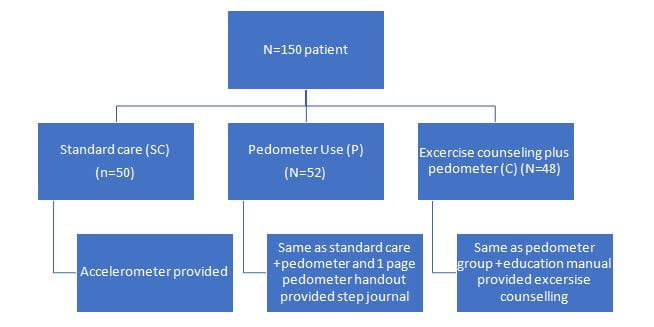
- Patients were randomized in 1:1:1 ratio
Duration: 6 and half months after bariatric surgery
Interventions
- SC group participants received no exercise support by the bariatric centre beyond the educational pamphlet or what was discussed at nonstudy clinic visits
- P group participants were given a pedometer and a one-page information sheet on using the device to increase physical activity
- Exercise counselling group (C) exercise-related counselling method, individualized approaches based on self-determination theory (SDT) and complementary motivational interviewing (MI) techniques
- Participants wore an accelerometer for approximately 2 weeks and returned it to the bariatric centre before surgery and 2, 4, and 6 months postoperatively
Results
- In ITT analysis most patients had primary Roux-en-Y gastric bypass, 9.4% had sleeve gastrectomy, 5.7% gastric banding, 5.7% revision Roux-en-Y gastric bypass, and 3.8% duodenal switch
- On average participants completed 12.6+ 0.2 valid days of accelerometer wear throughout the study
- Mean wear time was 12.4 days for SC, 12.0 days for P, and 13.4 days for C
- Individuals in exercise counselling plus pedometer had higher steps per day and bout minutes of exercise per week than standard care and pedometer use throughout the study
- Step counts differed significantly by treatment group (P=0.01) and time (P < 0.001) with C having greater steps than P and SC (P < 0.05), and no difference between P and SC
- Statistically significant differences in mean steps/day emerged at 4 months with C greater than P and SC; P < 0.05 and were maintained at 6 months after surgery with C greater than P and SC; P < 0.01
- Bout minutes/week also differed significantly by group (P < 0.05) and time
- C had greater bout minutes/week compared with SC (P < 0.05) and a marginally greater bout minutes/week compared with P at 6 months (P=0.056)
- Step counts differed significantly by treatment group (P=0.01) and time (P < 0.001) with C having greater steps than P and SC (P < 0.05), and no difference between P and SC
Table 1: Steps per day and bout minutes per week at the end of the study
|
Physical activity |
C |
SC |
P |
P-value |
|
Step counts (steps /day) |
6,787 |
5,253 |
5,325 |
|
|
Bout-related activity/week (min) |
90 |
40 |
44 |
<0.05 |
- No group differences related to exercise tolerance were observed; however, all groups made significant improvement
- Metabolic equivalents (METs) at ratings of perceived exertion (RPE 13) increased from 3.661.0 to 4.861.2 from baseline to 6 months after surgery among all study completers
- No statistically significant change in sedentary or light activity nor was there a difference between groups was reported
- Participants lost 39.3+1.5 kg (SC:39.5+2.5;P:38.4+2.8;C: 40.0+2.7 kg), reducing weight from 132.1+2.7 to 92.6+2.0 kg, from visit 1 to 61/2 months postsurgery
- BMI decreased from 47.36 0.8 kg/m2 to 33.460.6kg/m2
- There were no significant differences in weight or weight change were found between groups at any time point
Conclusions
- The study demonstrated that patients undergoing bariatric surgery have limited exercise tolerance that improves substantially with weight loss during the first 6 and half months after surgery even without fitness-focused interventions.
- The data suggests that individualized exercise counselling before bariatric surgery and in pairs of sessions every 2 months after surgery can increase physical activity for up to 6 and half months postoperatively.
Reference
Obesity.2016; 24, 1660–1668
Related Topics
More From Area Of Interest
You may also like

13 May, 26
17 Apr, 26
Our Research
23 Feb, 26

23 Feb, 26

11 Feb, 26
11 Feb, 26

11 Feb, 26
Latest Items
Journal Scans
23 Jul, 26

23 Jul, 26

23 Jul, 26

23 Jul, 26


