

Effective Antibiotic for Prevention of Bacteremia Following Dental Extraction

Introduction
The evidence on the efficacy of antibiotic prophylaxis (AP) in the prevention of bacterial endocarditis (BE) related to dental manipulations in patients ‘at risk’ is lacking. The latest AP guidelines recommend amoxicillin (AMX) as the antibiotic of choice in patients at risk of BE or who are to undergo dental procedures. Clindamycin (CLI) remains a choice in case of allergy or intolerance to penicillin (PEN). However, there a very few studies which have assessed the effects of CLI prophylaxis in the prevention of bacteremia following dental procedures. Moxifloxacin (MXF) is a broad-spectrum antibiotic and has demonstrated good in-vitro activity against odontogenic pathogens. The results from an in-vivo study have proven efficacy of MXF in the treatment of submucous layer dental abscesses.
Aim
The efficacies of AMX, CLI and MXF for the prevention of bacteremia following dental extractions (BDE) have been compared in this study.
Study Design
- Prospective, randomized, double-blind study
Patient Profile
- Patients having autism, learning disabilities, phobias etc who underwent dental extractions under general anesthesia
Treatment Strategy
- The cohort of 221 adults who required dental extractions under general anesthesia were randomized into the following groups
- Control group (n = 53)
- AMX group (n = 56) received 2 g of AMX
- CLI group (n = 54) received 600 mg CLI
- MXF group (n = 58) received 400 mg MXF
- The study groups received antibiotics orally 1 to 2 hours before anesthesia induction
- Venous blood samples were collected from each patient at the baseline and 30 secs, 15 min, and 1 hr after the dental extractions
- The samples were inoculated into aerobic and anaerobic blood culture bottles and cultured.
- The isolated bacteria were identified using biochemical tests
Endpoints
- Prevalence of bacteremia at baseline, at 30 secs, 15 min and 1 hr after completion of dental extractions
- Proportion of positive blood cultures
- Proportion of polymicrobial blood cultures
Results
- The comparison of prevalence of BDE in the groups is seen in figure 1.
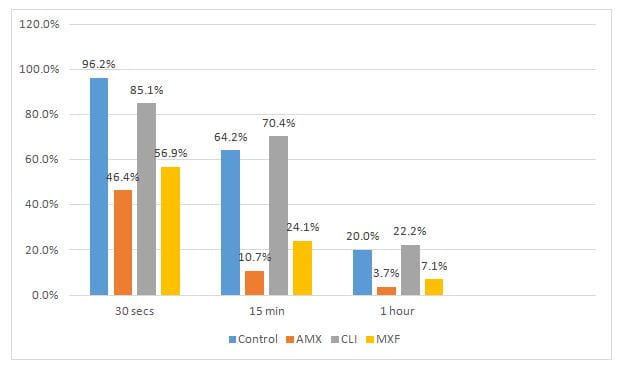
- The efficacies of AMX and MXF were significantly superior to CLI at 30 sec (p<0.001 for both), 15 min (p<0.001 for both) and 1 hr (p<0.001 and p<0.001 respectively)
- The AMX and MXF groups showed significant differences in the percentages of positive blood cultures and polymicrobial blood cultures as compared to control.
- However, the CLI group failed to demonstrate significant differences as seen in figure 2.
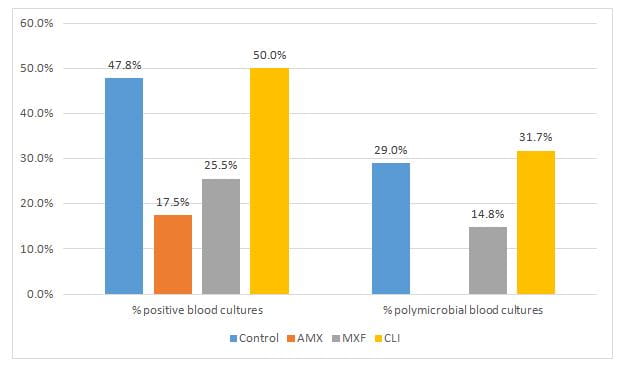
- Streptococcus spp. were the most frequently identified bacteria in all groups; 63.1%, 44.4%, 58.5% and 67.7% in the control, AMX, CLI and MXF groups respectively
- AMX and MXF prophylaxis were highly effective in reducing the prevalence and duration of BDE, but CLI prophylaxis was noneffective
Conclusion
- Amoxicillin is the drug of choice in patients ‘at risk’ of developing bacteremia following dental extractions (BDE)
- Moxifloxacin seems a promising safe alternative for the prevention of BDE when beta-lactams are not indicated.
Antimicrob Agents Chemother.2006 Sep;50(9):2996-3002. Doi: 10.1128/AAC.01550-05.