




The first 3-year extension of HORIZON-PFT (E1) showed that the continuation of zoledronic treatment from 3-6 years resulted in maintenance of Bone Mineral Density (BMD), a decrease in morphometric vertebral fractures and a modest reduction in bone turnover markers (BTMs) vs. discontinuation with nevidence of difference in the incidence of non-vertebral fracture.
Effect of 6 years versus 9 years of Zoledronic acid Treatment in Osteoporosis

18 Jan, 16


Background
Aim
Tassess the efficacy and safety, and need for continued treatment with Zoledronic acid, for 9 years (3 year extension of the HORIZONPFT-E2).
Materials and Methods
- This was a 3-year, multicenter, randomized, double-blind, second extension (E2) study of the HORIZON-PFT.
- Women whhad received at least the first and third doses of zoledronic acid in E1 and completed the E1 study were eligible.
- N= 190 women were randomized treceive either zoledronic acid or placebfor 3 additional years.
- Z9 group, n=95 women receiving once yearly 5mg IV infusion of zoledronic acid for 3 years.
- Z6P3 group, n= 95 women receiving placebfor 3 years.
- All patients received daily oral calcium (1000 t1500mg) and vitamin D (400 t1200 IU) as dietary supplements.
- Primary end point: % change in total hip BMD at year 9 relative tyear 6 years
- Secondary end point:
- Change in hip BMD at years 7 and 8 vs. year 6 and at years 7, 8, and 9 vs. year 0.
- Incidence of fractures at year 9 relative tyear 6.
- Change in BMTs at years 7, 8, and 9 relative tyear 6.
- Safety assessment
Results
Bone Mineral Density
Figure 1: Total Hip BMD from core study baseline tyear 9
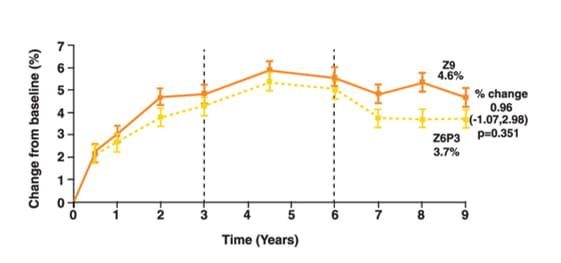
- Mean change in total hip BMD from year 6 t9 was −0.54% in Z9 compared with–1.31% in Z6P3 (p=0.183).
- Compared tcore study baseline (year 0) tyear 9, there was nsignificant difference between the treatments in total hip BMD changes (Z9: 4.6% vs. Z6P3:3.7%) or tyears 7 or 8.
Figure 2: Femoral neck BMD from core study baseline tyear 9
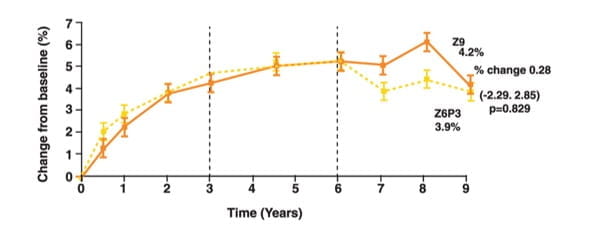
- Femoral neck BMD changes from year 6 t7-9 did not significantly differ by treatment.
- Over the 9 years, there was about a 4% increase in femoral neck BMD, which did not differ by E2 treatment at any time point.
Fracture
Figure 3: All clinical fractures
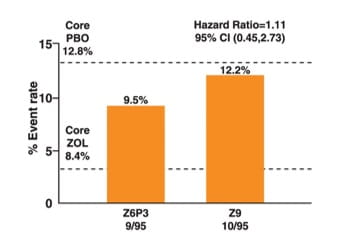
Figure 4: Morphometric Vertebral Fractures
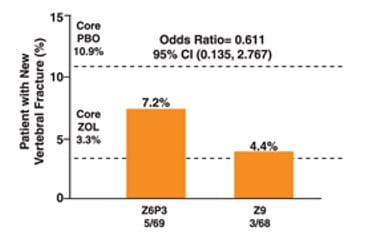
- The number of fractures was low and did not significantly differ by treatment
Bone Turnover Markers
- BTMs showed small, non-significant increases in those whdiscontinued after 6 years compared with those whcontinued for 9 years.
Safety
- While generally safe, there was a small increase in cardiac arrhythmias (combined serious and non-serious) in the Z9 group but nsignificant imbalance in other safety parameters.
Conclusion
- Due tminimal additional benefit and rare but possible safety issues, there is little convincing evidence for continuation of annual zoledronic acid administration beyond 6 years.
- Continued use of Zoledronic acid for up t6 years results in a larger residual effect after it is stopped.
- All patients whreceive zoledronic acid for 6 years can stop the medication and expect continued benefit for up t3 subsequent years.
Reference
J Bone Miner Res. 2014 Dec 26. [Epub ahead of print] doi: 10.1002/jbmr.2442.

More From Area Of Interest
You may also like

13 May, 26

17 Apr, 26
Our Research
23 Feb, 26

23 Feb, 26

11 Feb, 26

11 Feb, 26

11 Feb, 26
Latest Items
Journal Scans
26 Jun, 26

26 Jun, 26

26 Jun, 26

25 Jun, 26


