




EcLiPSE: Levetiracetam May Be Preferred Over Phenytoin as Second-line Treatment for Pediatric Convulsive Status Epilepticus

15 Jul, 19
Background
In UK, phenytoin is the recommended second-line intravenous anticonvulsant for treating pediatric convulsive status epilepticus. Recent studies have suggested that levetiracetam could be an effective and safer alternative to phenytoin. .
Aim
The Emergency treatment with Levetiracetam or Phenytoin in convulsive Status Epilepticus in children (EcLiPSE) compared the efficacy and safety of phenytoin and levetiracetam for emergency management of pediatric convulsive status epilepticus.
Patient Profile
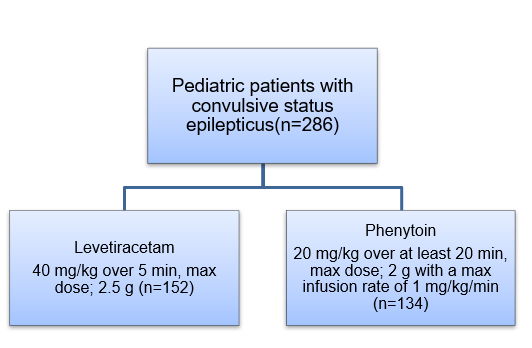
- Children (age; 6 months to less than 18 years) with convulsive status epilepticus (generalized tonic-clonic, generalized clonic, or focal clonic seizure) requiring second-line treatment (n=286)
Methods
Study Design
- Open-label, randomized, multicenter clinical trial (conducted across 30 UK emergency departments of secondary and tertiary care centers)
Treatment Strategy
- Patients were randomized as follows:
Outcomes
Primary Outcome
- Time from randomization to cessation of convulsive status epilepticus (defined as cessation of all continuous rhythmic clonic activity, as judged by the treating clinician)
Secondary Outcomes
- Need for further anticonvulsants to manage the convulsive status epilepticus after administration of the trial treatment
- Need for rapid sequence induction (RSI) because of ongoing convulsive status epilepticus
- Need for admission to critical care (either a high-dependency unit or a PICU)
- Serious adverse reactions (including death, Stevens-Johnson syndrome, rash, airway complications, cardiovascular instability, extravasation injury, and extreme agitation, as well as those listed in the summary product characteristic of each treatment)
Results
- Convulsive status epilepticus was terminated in 70% (n=106) children in the levetiracetam group vs. 64% (n=86) in the phenytoin group.
- Median time from randomization to cessation of convulsive status epilepticus was 35 min in the levetiracetam group and 45 min in the phenytoin group [hazard ratio (HR); 1·20, 95% CI 0·91–1·60, p=0·20).
- Additional anticonvulsants were needed for 38% (n=57) patients treated with levetiracetam vs. 37% (n=50) patients treated with phenytoin.
- 132 participants received levetiracetam only and 130 received phenytoin only. The remaining 24 participants received both treatments sequentially; 17 received levetiracetam followed by phenytoin, and seven received phenytoin followed by levetiracetam.
- Incidence of adverse events was similar in both the treatment groups. Death due to catastrophic cerebral edema unrelated to either treatment was reported in one patient who received levetiracetam followed by phenytoin. Serious adverse reactions related to study treatment (hypotension considered to be immediately life-threatening and increased focal seizures and decreased consciousness considered to be medically significant [a suspected unexpected serious adverse reaction]) were recorded in one patient receiving phenytoin.
Conclusions
- Results for any outcome including cessation of seizure, time for termination of seizure and adverse events did not differ significantly between phenytoin and levetiracetam when used as the second-line treatment for treating pediatric convulsive status epilepticus.
- Although levetiracetam was not superior to phenytoin, it may be an appropriate alternative to phenytoin to treat pediatric convulsive status epilepticus, considering its previously reported safety profiles and comparative ease of administration
Lancet 2019; 393: 2125–34.

More From Area Of Interest
You may also like

12 Oct, 26

21 Sep, 26

21 Sep, 26

21 Sep, 26

13 May, 26

17 Apr, 26
Latest Items

6 Nov, 26
Journal Scans
5 Nov, 26

5 Nov, 26

3 Nov, 26


