DISCOVER Study: Efficacy and Safety of F/TAF with F/TDF for the Prevention of HIV Among Cisgender MSM and Transgender Women Who Have Sex with Men


Introduction
Tenofovir alafenamide shows high antiviral efficacy and improved renal and bone safety compared with tenofovir disoproxil fumarate when used for HIV treatment
Aim
To compare the efficacy and safety of emtricitabine and tenofovir alafenamide (F/TAF) with emtricitabine and tenofovir disoproxil fumarate(F/TDF) for the prevention of HIV among cisgender men who have sex with men (MSM) and transgender women who have sex with men
Patients Profile
- Adult cisgender MSM
- Transgender women who have sex with men
- Tested HIV negative at baseline and with a high risk of acquiring HIV on the basis of their self-reported sexual behaviour
Methods
- DISCOVER study is an ongoing, randomised, double-blind, multicentre, active-controlled, phase 3, non-inferiority trial
Study Design
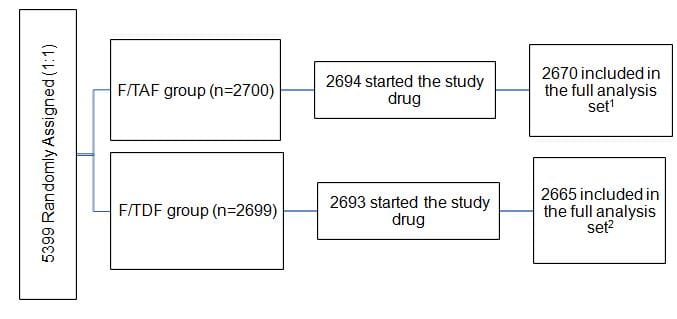
124 participants were excluded for not having undergone a post-baseline HIV test
228 participants were excluded for not having undergone a post-baseline HIV test
Study Drugs
F/TAF group: Once daily tablets of F/TAF FDC (emtricitabine (200 mg) and tenofovir alafenamide (25 mg)) and placebo.
F/TDF group: Once daily tablets of F/TDF FDC (emtricitabine (200 mg) and tenofovir alafenamide (300 mg)) and placebo.
Study Endpoints
- The primary efficacy outcome was incident HIV infection, diagnosed by:
- serological evidence of seroconversion
- virological evidence of HIV infection
- evidence of acute HIV infection
- Secondary safety outcomes, measured as percentage changes from baseline to week 48, included:
- hip bone mineral density
- spine bone mineral density
- urine ?2-microglobulin to creatinine ratio
- retinol-binding protein to creatinine ratio
- changes in the distribution of urine protein to creatine ratio above the clinically significant threshold of 22?6 mg/mmol at 48 weeks)
- change in serum creatinine from baseline
- Additional outcomes
- incidence of treatment-emergent adverse events
- other laboratory abnormalities (changes in blood lipids from baseline; changes in weight from baseline)
- HIV antiretroviral drug resistance in participants who acquired HIV infection.
Results
- Baseline demographic characteristics, clinical characteristics, and risk factors were well balanced between the two groups
|
|
Emtricitabine and tenofovir alafenamide group (n=2694) |
Emtricitabine and tenofovir disoproxil fumarate group (n=2693) |
|
Demographics |
|
|
|
Age, years |
34 (28–43) |
34 (28–44) |
|
Gender or sexual orientation |
|
|
|
Transgender women who have sex with men |
45 (2%) |
29 (1%) |
|
Cisgender men who have sex with men |
2649 (98%) |
2664 (99%) |
|
Sexual orientation |
|
|
|
Gay |
2461 (92%) |
2434 (91%) |
|
Straight |
21 (1%) |
16 (1%) |
|
Bisexual |
171 (6%) |
214 (8%) |
|
Other |
23 (1%) |
13 (<1%) |
|
Median body-mass index, kg/m² |
25 (23–29) |
25 (23–28) |
|
Sexually transmitted infections by laboratory test at baseline visit | ||
|
Rectal gonorrhoea |
123/2668 (5%) |
113/2669 (4%) |
|
Rectal chlamydia |
199/2669 (7%) |
189/2670 (7%) |
|
Syphilis |
7 (<1%) |
4 (<1%) |
|
Self-reported HIV risk factors | ||
|
Two or more of receptive condomless anal sex partners in the past 12 weeks‡ |
1616/2602 (62%) |
1569/2597 (60%) |
|
History of rectal gonorrhoea in the past 24 weeks |
274 (10%) |
262 (10%) |
|
History of rectal chlamydia in the past 24 weeks |
342 (13%) |
333 (12%) |
|
History of syphilis in the past 24 weeks |
230 (9%) |
263 (10%) |
|
Recreational drug use in the past 12 weeks‡ |
1785/2680 (67%) |
1786/2677 (67%) |
|
Binge drinkingठ|
618/2657 (23%) |
599/2680 (22%) |
|
Taking emtricitabine and tenofovir disoproxil fumarate for pre-exposure prophylaxis at baseline |
465 (17%) |
440 (16%) |
‡As reported by use of a computer-assisted self-interview.
§Defined as the consumption of six or more drinks on one or more occasion occurring at least once per month.
- F/TAF was non-inferior to F/TDF for HIV prevention
- Incidence rate ratio (IRR) was less than the prespecified non-inferiority margin of 1·62 (IRR 0·47)
- After 8756 person-years of follow-up, 22 participants were diagnosed with HIV
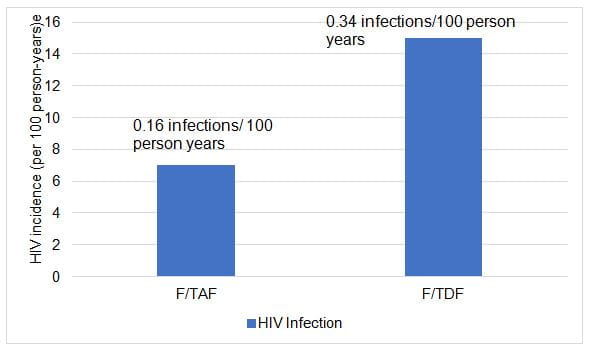
F/TAF=emtricitabine and tenofovir alafenamide
F/TDF=emtricitabine and tenofovir disoproxil fumarate
- F/TAF was superior to F/TDF in all six prespecified secondary safety endpoints
|
|
Baseline |
F/TAF |
Baseline |
F/TDF |
P |
|
Bone Mineral density (mean % change from Baseline) |
|
|
|
|
|
|
Hip BMD |
|
0.18 |
|
-0.99 |
P<0.0001* |
|
Spine BMD |
|
0.50 |
|
-1.12 |
P<0.0001* |
|
? microglobulin to creatinine ratio (Change between baseline and 48 week) |
9·51 µg/mmol |
10.7% reduction |
9·67 µg/mmol |
15.2%increase |
P<0.0001 |
|
RBP to creatinine ratio |
11·40 µg/mmol |
0.2% increase |
11·72 µg/mmol |
19.9%increase |
|
|
Quantitative proteinuria at 48 weeks Proportion of participants (%) |
|
1 |
|
2 |
P=0.005‡ |
|
UPCR elevation >22·6 mg/mmol (Number of participants) |
25 |
25 |
25 |
45 |
|
|
Serum creatinine (µmol/L) |
83·10 µmol/L |
83·10 +0.88 |
83·10 µmol/L |
83·10 - 0.88 |
|
|
Creatinine clearance (eGFRCG) (mL/min) |
123 |
123+1.8 |
121 |
121 -2.3 |
p<0·0001† |
BMD=bone mineral density. RBP=retinol-binding protein. UPCR=urine protein to creatinine ratio. eGFRCG=estimated glomerular filtration rate by Cockcroft-Gault
- Both regimens were well tolerated, with a low number of participants reporting adverse events that led to discontinuation of the study drug
- F/TAF group = 36 [1%] of 2694 participants
- F/TDF group = 49 [2%] of 2693 participants
Conclusions
- F/TAF has non-inferior efficacy to F/TDF for HIV prevention
- F/TAF had more favourable effects on bone mineral density and biomarkers of renal safety than F/TDF
- The number of adverse events for both regimens were low
- Both F/TAF and F/TDF were safe and well-tolerated.
- Daily F/TAF therefore, offers a new option for HIV prevention in these populations
Reference
Lancet 2020; 396: 239–54