Comparative Study of Endoscopic and Surgical Drainage of the Pancreatic Duct in Chronic Pancreatitis


Introduction
Pancreatic duct obstruction is considered an essential etiologic factor in patients with chronic pancreatitis. Hence, ductal decompression is advocated for patients with pain and a markedly dilated duct. Both endoscopic and surgical drainage are treatment options considered in such a scenario.
Aim
To compare endoscopic and surgical drainage concerning the outcomes of pain relief, physical and mental health, morbidity, mortality, length of hospital stay, number of procedures undergone, and changes in pancreatic function in chronic pancreatitis
Patient Profile
Symptomatic patients with chronic pancreatitis and a distal obstruction of the pancreatic duct but without an inflammatory mass
Methods
- N= 39
- Patients were randomized
- 19 patients underwent endoscopic drainage
- 20 patients underwent operative pancreaticojejunostomy
- Patients were followed up for 24 months after surgery
Endpoints
- The primary endpoint was the average Izbicki pain score during 2 years of follow-up
- The secondary endpoints were pain relief at the end of follow-up, physical and mental health, morbidity, mortality, length of hospital stay, number of procedures undergone, and changes in pancreatic function
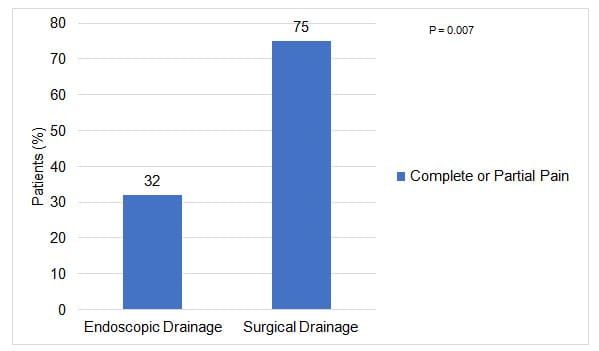
- Pain relief at the end of follow-up was classified as complete (Izbicki pain score, ≤10) or partial (Izbicki pain score, >10 after a decrease of >50%)
Results
|
Characteristic |
Endoscopy (N = 19) |
Surgery (N = 20) |
P-Value |
|
Age — yr |
52 |
46 |
0.07 |
|
Male sex — no. (%) |
11 (58) |
15 (75) |
0.26 |
|
Cause of pancreatitis — no. (%) |
|
|
0.43 |
|
Alcohol abuse |
9 (47) |
12 (60) |
|
|
Idiopathic |
7 (37) |
5 (25) |
|
|
Hereditary |
1 (5) |
1 (5) |
|
|
Pancreas divisum |
2 (11) |
0 |
|
|
Other |
0 |
2 (10) |
|
|
Pain pattern — no. (%) |
|
|
0.61 |
|
Continuous |
12 (63) |
11 (55) |
|
|
Intermittent |
7 (37) |
9 (45) |
|
|
Izbicki pain score† |
73 |
69 |
0.33 |
|
Duration of symptoms — mo |
16 |
21 |
0.45 |
|
Ongoing alcohol abuse — no. (%) |
0 |
5 (25) |
0.05 |
|
Current smoker — no. (%) |
15 (79) |
17 (85) |
0.94 |
|
SF-36 quality-of-life scores‡ |
|
|
|
|
Physical health component |
31 |
35 |
0.11 |
|
Mental health component |
33 |
37 |
0.43 |
|
Exocrine function |
|
|
|
|
Insufficiency — no. (%) |
13 (68) |
16 (80) |
0.65 |
|
Faecal elastase — μg/g |
125 |
139 |
|
|
Endocrine function |
|
|
|
|
Insufficiency — no. (%) |
4 (21) |
4 (20) |
0.75 |
|
Serum glucose — mmol/litre |
6.5 |
6.1 |
|
|
Glycated haemoglobin — % |
6.3 |
6.2 |
|
† The Izbicki pain score ranges from 0 to 100, with higher scores indicating more severe pain
‡ Scores on the physical and mental health components of the Medical Outcomes Study 36-Item Short-Form General Health Survey (SF-36) questionnaire range from 0 to 100, with higher scores indicating better quality of life
- Patients who underwent surgical treatment had lower Izbicki pain scores and better physical health summary scores on the Medical Outcomes Study 36-Item Short-Form General Health Survey questionnaire compared with those who were treated endoscopically (see Table 2)
|
Variable |
Endoscopy (N = 19) |
Surgery (N = 20) |
Endoscopic Results vs Surgical Results |
P-Value |
|
Izbicki pain score† |
51±23 |
25±15 |
24 |
<0.001 |
|
Conversion to surgery — no. (%) |
21 |
NA |
|
|
|
Technical success — no. (%) |
53 |
100 |
−47 |
<0.001 |
|
Complications — no. (%) |
58 |
35 |
23 |
0.15 |
|
Major |
0 |
5 |
|
|
|
Minor |
58 |
30 |
|
|
|
Death — no. (%) |
1 |
0 |
5 |
0.49 |
|
Hospital stay — median no. of days |
8 |
11 |
−3 |
0.13 |
|
Hospital readmittance — median no. of patients |
1 |
0 |
|
|
|
Procedures — median no. |
8 |
3 |
5 |
<0.001 |
|
Diagnostic |
3 |
2 |
|
|
|
Therapeutic** |
5 |
1 |
|
|
|
SF-36 quality-of-life scores†† |
|
|
|
|
|
Physical health component |
38±9 |
47±7 |
−8 |
0.003 |
|
Mental health component |
40±9 |
45±9 |
−3 |
0.15 |
|
Exocrine function |
|
|
|
0.05 |
|
Insufficiency persisted — no. (%) |
11 (61) |
13 (65) |
|
|
|
Insufficiency developed — no. (%) |
6 (33) |
1(5) |
|
|
|
Insufficiency resolved — no. (%) |
1 (6) |
3 (15) |
|
|
|
Sufficiency persisted — no. (%) |
0 |
3 (15) |
|
|
|
Faecal elastase — μg/g |
56±74 |
145±189 |
|
|
|
Endocrine function |
|
|
|
0.48 |
|
Insufficiency persisted — no. (%) |
3 (17) |
4 (20) |
|
|
|
Insufficiency developed — no. (%) |
3 (17) |
1 (5) |
|
|
|
Insufficiency resolved — no. (%) |
1 (6) |
0 |
|
|
|
Sufficiency persisted — no. (%) |
11 (60) |
15 (75) |
|
|
|
Serum glucose — mmol/litre |
6.8±3.2 |
5.9±1.6 |
|
|
|
Glycated haemoglobin — % |
6.4±1.2 |
6.2±1.3 |
|
|
† The Izbicki pain score ranges from 0 to 100, with higher scores indicating more severe pain
†† The scores on the SF-36 physical and mental health components range from 0 to 100, with higher scores indicating better quality of life
- Rates of complications, length of hospital stay, and changes in pancreatic function were similar in both treatment groups
- Patients receiving endoscopic treatment required more procedures than did patients in the surgery group (a median of eight vs three, P<0.001)
Conclusion
The findings suggested that surgical drainage of the pancreatic duct was more effective than endoscopic treatment in patients with obstruction of the pancreatic duct due to chronic pancreatitis
Reference
N Engl J Med 2007;356:676-84.