




Clinical Efficacy of Lapatinib Combined with Letrozole Versus Letrozole and Placebo As First-Line Therapy for Postmenopausal Hormone Receptor-Positive Metastatic Breast Cancer

3 Dec, 20
Introduction
Lapatinib is a potent, orally active, dual tyrosine kinase inhibitor (TKI) against epidermal growth factor receptor (EGFR) and human epidermal growth factor receptor 2 (HER2). It has demonstrated activity in both trastuzumab-na?ve and pretreated HER2-positive metastatic breast cancer (MBC)
Aim
To evaluate the effect of adding lapatinib, a dual TKI blocking EGFR and HER2, to the aromatase inhibitor letrozole as first-line treatment of hormone receptor (HR) –positive MBC
Patient Profile
Postmenopausal women with HR-positive MBC
Methods
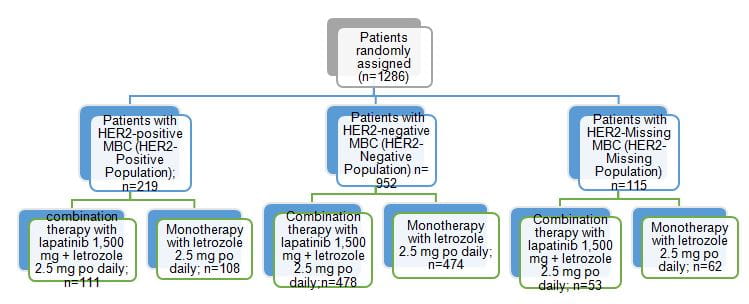
- Randomized, double-blind, controlled, parallel-group, multicenter, phase III study
Study Drugs
- The combination regimen consisted of lapatinib 1,500 mg orally and letrozole 2.5 mg orally daily
- The control arm consisted of letrozole 2.5 mg daily with matching lapatinib placebo pill
Study Endpoint
- The primary endpoint was progression-free survival (PFS) in the HER2-positive population
- PFS was defined as the time from random assignment until the earliest date of disease progression or death as a result of any cause in the HER2-positive population.
- Secondary endpoints included overall response rate (ORR); clinical benefit rate (CBR), which was defined as complete response, partial response, or stable disease for > 6 months; overall survival (OS); safety; and PFS for the intent-to-treat (ITT) HR-positive population. Disease progression and response evaluations were determined according to Response Evaluation Criteria in Solid Tumors (RECIST)
Results
Clinical efficacy after a median follow-up time of 1.8 years
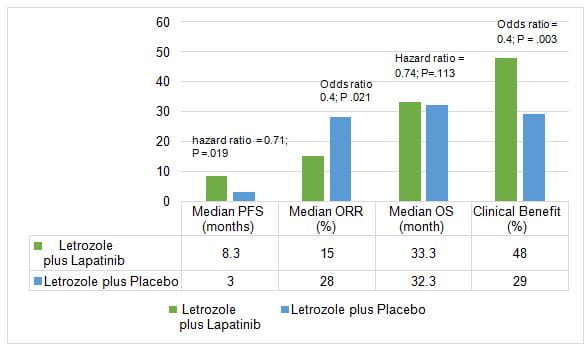
- In HR-positive HER2-positive patients, the addition of lapatinib to letrozole
- Significantly reduced the risk of disease progression versus letrozole-placebo
- median PFS was 8.2 v 3.0 months, representing a statistically significant 29% reduction in the risk of disease progression.
- ORR was significantly improved from for patients treated with letrozole-lapatinib
- Clinical benefit (responsive or stable disease 6 months) was significantly greater for lapatinib-letrozole versus letrozole-placebo
Figure 1: Clinical efficacy of lapatinib-letrozole versus letrozole-placebo in the HER2-positive population
- No improvement in PFS was reported in patients with centrally confirmed HR-positive, HER2-negative tumours
- In the HER2-negative population, the number of metastatic sites (< three sites) and prior antiestrogen therapy was identified as a significant factor
- A nonsignificant trend toward prolonged PFS for lapatinib-letrozole was seen n patients who experienced relapse less than 6 months since prior tamoxifen discontinuation (HR = 0.78; P = .117)
Safety
- Grade 3 or 4 adverse events were more common in the lapatinib-letrozole arm versus letrozole-placebo arm
- diarrhea, 10% v 1%;rash, 1% v 0%, respectively, but they were manageable
- There were a total of 16 fatalities related to serious adverse events (eight deaths in each arm), of which only three were deemed related to study drug (one in letrozole-lapatinib arm [hepatobiliary] and two in letrozole-placeboarm[one cardiac, one dyspnea])
- No new or unexpected safety signals for either drug were identified
Conclusion
- The study demonstrated that combined targeted strategy with letrozole and lapatinib significantly enhances PFS and clinical benefit rates in patients with MBC that co-expresses HR and HER2
- The letrozole-lapatinib combination was well tolerated and produced a clinically meaningful improvement in several efficacy endpoints
- The data suggest that combination therapy with lapatinib and letrozole could be considered an effective treatment option for patients with known HR-positive, HER2- positive MBC
Reference
J Clin Oncol. 2009; 27:5538-5546.
Related Topics
More From Area Of Interest
You may also like

12 Oct, 26

21 Sep, 26

21 Sep, 26

21 Sep, 26

13 May, 26

17 Apr, 26
Latest Items

6 Nov, 26
Journal Scans
5 Nov, 26

5 Nov, 26

3 Nov, 26


