CANTREAT-Extension Study: Long-term Efficacy of a Treat-and-Extend Regimen of Ranibizumab in Patients With nAMD


Introduction
Several trials have demonstrated the long-term efficacy of anti-vascular endothelial growth factor (anti-VEGF) therapy in maintaining the visual acuity (VA) in patients with neovascular age-related macular degeneration (nAMD). Nevertheless, reductions in the number of anti-VEGF injections over time, were associated with incremental loss of the VA gains originally achieved. Retina specialists are increasingly using the treat-and-extend (T&E) strategy for the management of nAMD patients.
Aim
The 12-month extension of the 2-year CANTREAT (Canadian Treat and Extend Analysis Trial with Ranibizumab) trial evaluated the long-term effectiveness of a T&E anti-VEGF regimen in patients with nAMD who remained on T&E and also in those switched from once-monthly (OM) dosing to T&E (OM-T&E).
Patient Profile
- Treatment-na?ve patients with nAMD who had completed the CANTREAT study treatment period (n=139)
Methods
Study Design
- A 12-month extension of the 2-year CANTREAT study
- CANTREAT was a prospective, randomized and multicenter study
Treatment Strategy
- Patients received intravitreal ranibizumab 0.5 mg in a T&E regimen
Outcomes
- Mean change in best-corrected visual acuity (BCVA) from baseline and from month 24 to month 36
- Percentages of patients who gained ≥5, ≥10, or ≥15 Early Treatment of Diabetic Retinopathy Study (ETDRS) letters or lost ≥5, ≥10, or ≥15 letters from baseline and from month 24 to month 36
- Number of injections administered from baseline and from month 24 to month 36 for both study groups
Results
- Of the 139 CANTREAT patients (73 T&E, 66 OM-T&E) who participated in the extension phase, 121 (68 T&E, 53 OM-T&E) completed 36 months. The mean age of the study population was 79.1 years.
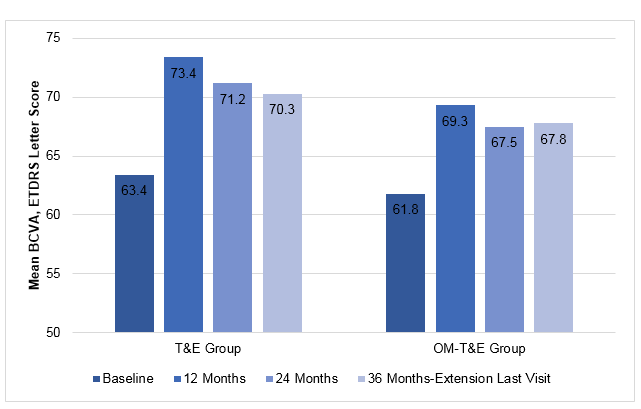
- The mean BCVA changes from baseline to the extension last visit (month 33-36) were +6.6 letters in the T&E group and +4.8 letters in the OM-T&E group, representing maintenance of 24-month gains (Fig. 1).
- Slightly more patients in the T&E group vs. OM-T&E group gained ≥15, ≥10, and ≥5 letters, and percentages were nearly similar (P=1.00) for ≥15- and ≥10-letter gains. Fewer T&E patients lost ≥15, ≥10, and ≥5 letters; but none of these differences were statistically significant.
- The mean numbers of injections during the extension for T&E and OM-T&E groups were 7.3 and 7.1, respectively.
- Nearly 47.9% patients in the T&E group and 48.5% patients in the OM-T&E group achieved a maximum treatment interval of 12 weeks, while 16.4% of T&E patients and 15.2% of OM-T&E patients achieved a maximum interval of <6 weeks.
- There was a significant reduction in percentages of patients with any macular fluid from baseline to the last extension visit in both the study groups, the same being comparable with the 24-month results (Table 1).
|
Study Group |
Baseline |
Last Extension Visit |
|
T&E Group |
100% |
28.2% |
|
OM-T&E Group |
100% |
29.8% |
Conclusions
- The 12- and 24-month CANTREAT results demonstrated the effectiveness of a T&E ranibizumab regimen compared to an OM regimen with patients requiring significantly fewer injections.
- This 12-month extension further demonstrated that these clinical benefits could be maintained up to 36 months, for patients on a continuous T&E regimen as well as for patients in OM switching to a T&E regimen.
Ophthalmology. Dec 30, 2021 (Published Online); DOI: 10.1159/000521517