Are Improved Pharmacokinetic / Pharmacodynamic Parameters and Patient Outcomes Associated with Prolonged Infusion of Piperacillin/Tazobactam and Meropenem in Critically Ill Patients? : DALI Study Report

Introduction
Beta-Lactam antibiotics are the most preferred antibiotics for severe infections in the ICU. Variations in pharmacokinetic and pharmacodynamics (PK/PD) is widely reported among ICU patients when ‘standard’ b-lactam dosing is applied leading to suboptimal antibiotic exposure.
Aim
To compare the pharmacokinetic/pharmacodynamic and clinical outcomes between prolonged-infusion and intermittent-bolus(IB) dosing of piperacillin/tazobactam and meropenem in critically ill patients.
Patient Profile
- N=182
- Critically ill patients from 68 ICUs across 10 countries enrolled in Defining Antibiotic Levels in Intensive care unit patients (DALI) study
- Patients receiving either piperacillin/tazobactam or meropenem, which were administered by prolonged infusion (either continuous or extended infusion) or IB dosing were included in analysis
Methods
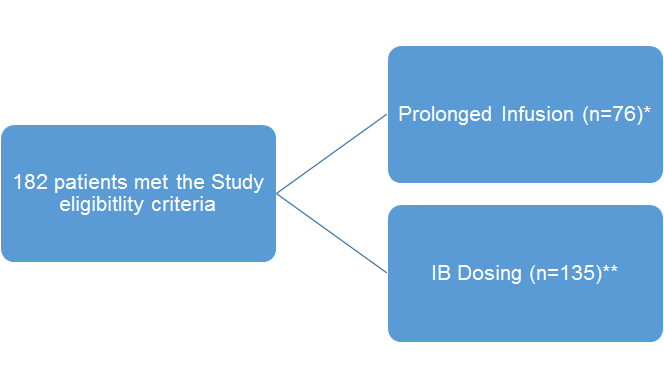
- Post-Hoc analysis of Defining Antibiotic Levels in Intensive care unit patients (DALI) study
|
Primary PK/PD Endpoints a ,b |
Definition |
|
50% fT>MIC |
free drug concentration maintained above the MIC for the pathogen for at least 50% of the dosing interval |
|
50% fT.4>MIC |
free drug concentration maintained .4×the MIC for the pathogen for at least 50% of the dosing interval |
|
100% fT>MIC |
free drug concentration maintained above the MIC for the pathogen throughout the dosing interval |
|
100% fT.4>MIC |
free drug concentration maintained .4×the MIC for the pathogen throughout the dosing interval |
|
Secondary Endpoints |
Definition and Description |
|
Clinical response clinical cure |
completion of treatment course without change or addition of antibiotic therapy, and with no additional antibiotics commenced within 48 h of cessation |
|
Clinical failure 30 day survival |
any clinical outcome other than clinical cure survival at day 30 following entry to the study |
|
aThe PK/PD exposure targets have all been identified in clinical studies recruiting critically ill patients in which achieving these targets would increase the probability of clinical efficacy. bActual MIC values, provided by the local microbiology laboratory, were used when available. Where a pathogen was isolated, but the MIC was unavailable, the ‘surrogate’ MIC was defined by EUCAST MIC90 data. Where no pathogen was formally identified, the MIC breakpoints for Pseudomonas aeruginosa (16 mg/L for piperacillin/tazobactam and 2 mg/L for meropenem) were inferred as the surrogate MIC, which reflects the least susceptible pathogen that could be encountered during b-lactam therapy. | |
Results
- The most common administration method was IB dosing observed in 63.2% of patients receiving beta-lactams
- The most conservative target of 50% fT>MIC (time over which unbound or free drug concentration remains above the MIC) was achieved in 89.0% (162/182)
- Decreasing creatinine clearance and the use of prolonged infusion significantly increased the probability of target attainment for most PK/PD targets
- The clinical cure and 30 day survival rate was observed in 73.1% (106/145) and 73.1% (106/145), patients who received antibiotics for treatment of infection
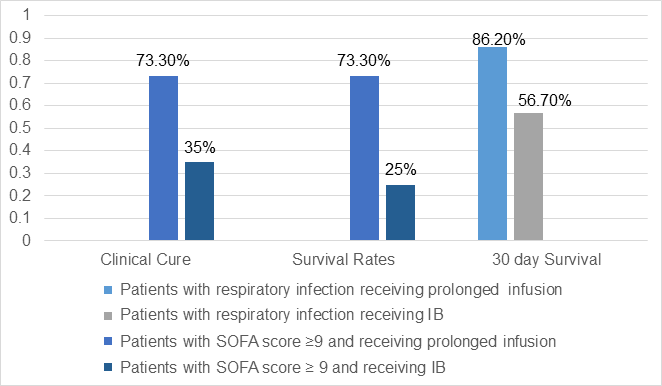
* p=0.02
**p=0.025
Conclusion
The result of this study support the prolonged infusion method of administration of piperacillin/tazobactam and meropenem in critically ill patients, particularly for patients with respiratory infections.
J Antimicrob Chemother. 2016 Jan;71(1):196-207.