

Antiandrogen Therapy with Daily Bicalutamide and Radiation Therapy Improves Survival in Recurrent Prostate Cancer


Introduction
Radical prostatectomy is a common treatment for patients with localized prostatic cancer but more than 30% of such patients will subsequently have a recurrence. Studies suggest that salvage radiation therapy after recurrence may be associated with long-term freedom from cancer recurrence. However, 50% of the patients treated with salvage radiation therapy will have further disease progression, particularly when there are aggressive disease features.
Aim
To compare the effectiveness of radiation therapy (RT) with or without bicalutamide in treating patients who have stage II, stage III, or recurrent prostate cancer and elevated PSA levels following radical prostatectomy.
Patient Profile
- Eligible patients had all undergone radical prostatectomy with lymphadenectomy and had disease that was originally assessed based on pathological testing, as tumor stage T2 or T3 without nodal involvement
- Karnofsky performance status Score: 80-100%
- A detectable prostate-specific antigen (PSA) level at least 8 weeks after surgery that was 0.2 to 4.0 ng per milliliter
- No previous chemotherapy or radiation therapy for prostate cancer, and no previous hormone therapy other than preoperative short-term hormonal therapy for 2 to 6 months in some patients
- All the patients had a life expectancy of more than 10 years.
Methods
Study Design
- Randomized, Double-blind, Placebo-controlled trial
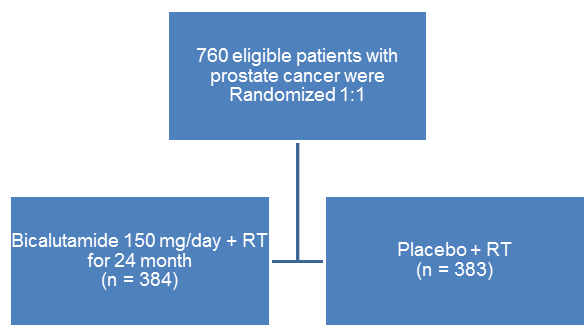
- The median follow-up was 13 years
Treatment
Radiation therapy (RT)
- Salvage radiation therapy was initiated within 12 weeks after randomization using photon energies of 6 to 10 MV to the original prostatic site, the tumor resection bed, and the membranous urethra.
- A total dose of 64.8 Gy was given in 36 daily fractions of 1.8 Gy at five sessions per week.
Drug
- One 150-mg tablet of bicalutamide or one placebo tablet administered daily, beginning at the initiation of radiation therapy and continuing for 24 months.
Study Endpoints
Primary Endpoint
- Rate of overall survival
Secondary Endpoints
- Disease-specific death
- Distant metastases (metastatic prostate cancer)
- Local disease progression
- Non–disease-specific death
- Any prostate cancer progression including a second biochemical recurrence
- Adverse events
Results
- The median age of the patients was 65 years
- The median PSA level at trial entry was 0.6 ng per milliliter
- The median follow-up of the surviving patients was 13 years
- The median interval between surgery and the first detectable PSA level was 1.4 years
- The median interval between surgery and trial entry was 2.1 years
|
Outcomes at 12 year |
Bicalutamide Group |
Placebo Group |
Hazard Ratio |
P value |
|
Overall survival |
76.3% |
71.3% |
0.77 |
0.04 |
|
Incidence of death from prostate cancer |
5.8% |
13.4% |
|
0.001 |
|
Incidence of metastatic prostate cancer |
14.5% |
23.0% |
|
0.005 |
- The cumulative incidence of a second biochemical recurrence at 12 years was 44.0% in the bicalutamide group, as compared with 67.9% in the placebo group (hazard ratio, 0.48; P<0.001)
- A total of 21 patients in the bicalutamide group died from prostate cancer, as compared with 46 in the placebo group
Adverse Events
- The incidence of late adverse events associated with radiation therapy was similar in the two groups.
- Gynecomastia was recorded in 69.7% of the patients in the bicalutamide group, as compared with 10.9% of those in the placebo group (P<0.001).
Conclusions
The addition of antiandrogen therapy with daily bicalutamide to salvage radiation therapy resulted in significantly higher rates of long-term overall survival and lower incidences of metastatic prostate cancer and death from prostate cancer than radiation therapy plus placebo.
N Engl J Med 2017; 376:417-28.