ANACO Study: Preoperative and Intraoperative Risk factors Contributing to AL and Postoperative Morbidity and Mortality After Colon Resection for Cancer

Introduction
Anastomotic leak (AL) is the most feared complication in colorectal surgery. Risk factors for AL have been shown to be different between right colonic resection with ileocolic anastomosis and left colonic resection with colorectal anastomosis
Aim
ANACO study determine pre-/intraoperative risk factors for anastomotic leak, postoperative morbidity and mortality after elective right colon resection for cancer
Patient Profile
- Patients with right colon cancer, treated with elective colectomy, with local curative intention, in whom primary anastomosis with no protective stoma was performed
Methods
- Prospective, observational study
- Fifty-two hospitals participated including 1102 patients that underwent elective right colectomy
- Forty-two pre-/intraoperative variables, related to patient, tumor, surgical procedure, and hospital, were analysed as potential independent risk factors for anastomotic leak and postoperative morbidity and mortality
- Demographic, preoperative, operative, and short-term outcome data was collected
Outcomes
- Primary outcome of interest was presence of AL during the first 60 postoperative days
- Secondary outcomes were morbidity, mortality, and wound infection rate during the first 60 postoperative days
Results
- 93 patients were diagnosed with AL and 72 (6.5 %) of them needed radiological or surgical intervention
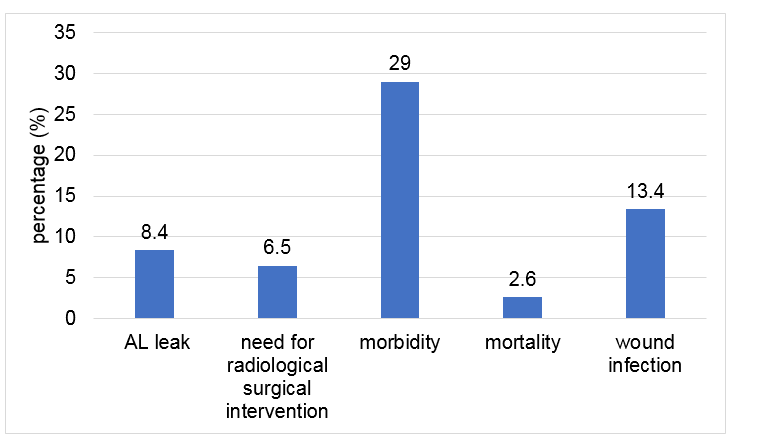
- Following table list the independent risk factors identified for AL, postoperative mortality and morbidity
|
|
Risk factors |
OR |
P value |
|
Anastomotic leak |
Preoperative serum protein concentration |
0.6 per g/dL |
p<0.0001 |
|
Clinically relevant anastomotic leaks |
Stapled technique
preoperative serum protein concentration |
2.1
0.6 g/dL |
p=0.03
p=0.004 |
|
Postoperative mortality |
Age and preoperative
Serum albumin concentration |
2.0 per 10 years
0.3 per g/dL |
p=0.04
p=0.001 |
|
Postoperative morbidity |
Male gender
Pulmonary disease
Hepatic disease
Open surgical approach |
1.7
2.3
1.5
0.7 |
p<0.0001
p=0.01
p=0.04
p=0.03 |
|
Wound Infection |
Male gender,
obesity
intraoperative complication,
End-to-end anastomosis |
1.5
2.1
3.1
OR 1.5 |
p=0.03
p=0.04
p=0.01
p=0.03 |
- No variable related to the hospital characteristics (number of beds, public vs. private hospital, teaching hospital, existence of a dedicated colorectal unit) was identified as an independent risk factor for anastomotic leak or postoperative morbidity or mortality
Conclusion
- The study showed that
- Preoperative nutritional status and the stapled technique are the only independent risk factors for clinically relevant AL after right elective colectomy for cancer
- Preoperative nutritional status, along with the age of the patient, determines the risk of mortality, while the laparoscopic approach seems to reduce the postoperative morbidity
Reference
Int J Colorectal Dis. 2016 ;31;1:105-14