




Amantadine for Management of Dyskinesias in Parkinson’s Disease

16 Jun, 22


Introduction
Dyskinesias, the major motor complications associated with long-term treatment in Parkinson’s disease (PD) patients have an adverse impact on the patients’ quality of life. Amantadine ameliorates dyskinesias, but studies have also suggested that the anti-dyskinetic effect of amantadine is attenuated within 8 months of treatment.
Aim
To evaluate the efficacy of amantadine in PD patients suffering from dyskinesias and to determine the clinical features associated with the anti-dyskinetic effect.
Patient Profile
- PD patients (age; 20-75 years) with dyskinesia of limbs or trunk and na?ve to amantadine treatment (n=36)
Methods
Study Design
A multi-center, double-blind, randomized, placebo-controlled, cross-over trial
Treatment Strategy
- Study subjects were randomized to ‘Arm 1’ or ‘Arm 2’, treatments were crossed over after 15 days of washout period
- Intervention in Arm 1 consisted of:
- An observation period (2–3 weeks)
- Amantadine hydrochloride treatment period (27 days; 300 mg/day)
- Washout period (15 days)
- Placebo treatment period (27 days)
- Intervention in Arm 2 consisted of:
- An observation period
- Placebo period
- A washout period
- An amantadine treatment period
- Dose of amantadine was increased in a step-wise manner (100 mg for 7 days, 200 mg for 7 days, and 300 mg for 7 days), followed by a decreased treatment regimen (200 mg for 3 days and 100 mg for 3 days)
Outcomes
Primary Outcome
- The changes in the Rush Dyskinesia Rating Scale (RDRS) during each treatment period (0; dyskinesia absent, 4; violent dyskinesia)
Secondary Outcomes
- Changes in the Unified Parkinson’s Disease Rating Scale part IVa (UPDRS-IVa, dyskinesias) (0; absent to 13; worst)
- Part IVb (motor fluctuations) (0; best to 7; worst)
- Part III (motor function) (0; best to 116; worst)
Results
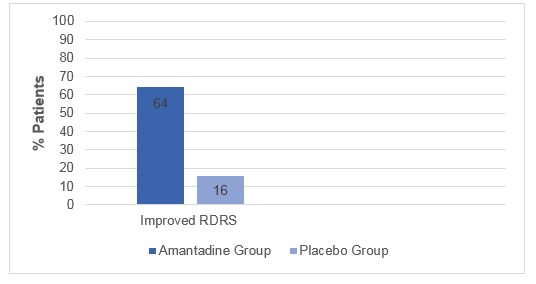
- Significantly greater proportion of patients treated with amantadine vs. placebos had improved RDRS (Fig. 1). The adjusted odds-ratio (OR) for improvement by amantadine was 6.7 (95% confidence interval, 1.4-31.5).
Fig. 1: Improvement in the RDRS during the study period
- Significantly greater improvement for UPDRS-IVa was also evident with amantadine vs. placebo (1.83 vs. 0.03, mean difference; 2.02, p<0.001). The UPDRS-IVb or III scores did not differ significantly between amantadine and placebo.
- Of the 30 patients who completed the study, 20 responded to amantadine. As per multivariate regression analysis, patients with higher age at onset of PD (OR per 10 years; 5.9, p=0.04) and higher dose of dopamine agonist [L-Dopa, entacapone, and Dopamine agonist (LDED)] (OR per 100 mg LDED; 10.0) were more likely to respond to amantadine.
Conclusions
- Amantadine was effective against dyskinesias, with 60–70% of PD patients achieving improved RDRS.
- Higher age of PD-onset and use of dopamine agonists were positively associated with the response to amantadine.
PLoS One. 2010 Dec 31;5(12):e15298.
Related Topics
More From Area Of Interest
You may also like

13 May, 26

17 Apr, 26
Our Research
23 Feb, 26

23 Feb, 26
11 Feb, 26
11 Feb, 26

11 Feb, 26
Latest Items

28 Jul, 26
Journal Scans
28 Jul, 26

28 Jul, 26
Journal Scans
27 Jul, 26
27 Jul, 26


