




Adjunctive Brivaracetam for the Treatment of Uncontrolled Partial-onset Seizures in Adults

15 Dec, 21


Introduction
Currently, there is an unmet medical need to treat epilepsy effectively. Brivaracetam (BRV) is a new selective and high-affinity synaptic vesicle protein 2A ligand, that has shown promising results for the treatment of uncontrolled epilepsy in adult patients.
Aim
To determine the efficacy and safety/tolerability of BRV in epilepsy patients with uncontrolled partial-onset seizure (POS)
Patient Profile
- Adult patients (age ≥16-80 years) with well characterized focal epilepsy or epileptic syndrome and having uncontrolled POS despite receiving treatment with 1–2 antiepileptic drugs (AEDs)
Methods
Study Design
- Phase III, randomized, double-blind, placebo-controlled, multicenter trial
- The study comprised of 8-week prospective baseline period, 12-week treatment period, and a 4-week down-titration period followed by a 2-week drug-free period, or entry into a long-term follow-up study
Treatment Strategy
- Patients exposed to levetiracetam ≤90 days before visit 1 were excluded.
- During the 12-week treatment period, patients were randomized 1:1:1 to placebo (PBO), BRV 100 mg/day, or BRV 200 mg/day, initiated without up-titration.
Outcomes
Primary Efficacy Outcomes
- Percent reduction over placebo in 28-day adjusted POS frequency
- ≥50% responder rate based on percent reduction in POS frequency from baseline to the treatment period
Secondary Efficacy Outcomes
- Percent reduction in seizure frequency from baseline to the treatment period
- Categorized percent reduction from baseline in seizure frequency over the treatment period, and seizure freedom rate (all seizures)
Safety and Tolerability Outcomes
- Incidence of adverse events (AEs)
Results
- The study population comprised 768 patients; of which; 760 were included in the efficacy analysis: (PBO [n=259], BRV 100 mg/day [n=252], and BRV 200 mg/day [n=249]).
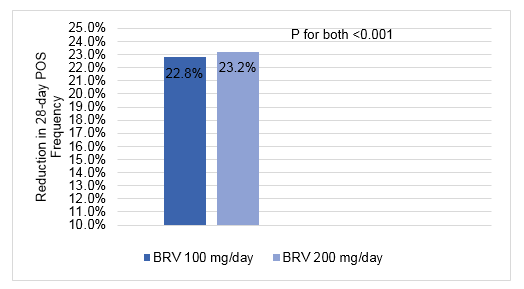
- Both the BRV dosages were associated with a greater percent reduction in 28-day adjusted seizure frequency as compared with PBO (Fig. 1).
Fig. 1: Percent reduction in 28-day seizure frequency with BRV vs. PBO
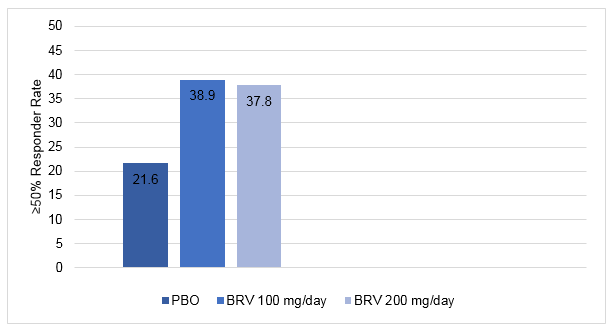
- The ≥50% responder rate for both the BRV dosages was higher as compared with PBO (Fig. 2) (odds ratio [OR] vs. PBO for BRV 100 mg/day: 2.39; p<0.001, OR for BRV 200 mg/day: 2.19; p<0.001).
Fig. 2: ≥50% responder rate for POS frequency from baseline to treatment-end
- BRV treatment was associated with a greater mean percent reduction from baseline to treatment end, in overall seizure frequency, simple POS (type IA), complex POS (IB) and POS evolving from secondary generalized seizures (type IC) from baseline (Table 1).
Table 1: Median percent reduction in seizure frequency
|
Seizure Type |
PBO |
BRV 100 mg/day |
BRV 200 mg/day |
|
Overall Seizure |
17.6% |
37.2% |
35.6% |
|
POS IA |
14.9% |
25.4% |
31.5% |
|
POS IB |
21.4% |
39.3% |
41.5% |
|
POS IC |
24.7% |
62.5% |
82.1% |
- Treatment-emergent adverse events (TEAEs) were observed in 59.4% PBO patients vs. 67.6% BRV-treated patients (safety population).
- Discontinuation due to TEAEs was reported in 3.8%, 8.3%, and 6.8% for PBO-, BRV 100 mg/day-, and BRV 200 mg/day-treated patients.
- Most frequent TEAEs (PBO versus BRV) comprised somnolence (7.7% vs. 18.1%), dizziness (5.0% vs. 12.3%), and fatigue (3.8% vs. 9.5%).
Conclusions
- Adjunctive BRV 100 and 200 mg/day effectively reduced POS in adults without concomitant levetiracetam.
- BRV was safe and well tolerated in the study subjects.
Epilepsia. 2015;56(12):1890–1898.

More From Area Of Interest
You may also like

13 May, 26

17 Apr, 26
Our Research
23 Feb, 26
23 Feb, 26

11 Feb, 26
11 Feb, 26
11 Feb, 26
Latest Items
Journal Scans
23 Jul, 26

23 Jul, 26

23 Jul, 26

23 Jul, 26


