




A New Urine DNA mutation Detection Test Offers Promise in Detecting Recurrence in Non-Muscle-Invasive Bladder Cancer

6 Nov, 20


Introduction
- High recurrence rate and risk for disease progression makes frequent follow-up vital in the patients with non-muscle-invasive bladder cancer (NMIBC).
- Current standard of care (SOC) involves:
- Regular surveillance cystoscopies which are invasive in nature
- Urine cytology which has low sensitivity, wide inter and intra-observer variability, long turnaround time
- Also, cystoscopies in combination with urine cytology leads to high costs.
- Moreover, the long-drawn and sometimes lifelong duration as well as the frequency of follow-up makes this regime even more cumbersome, posing a threat of losing patients to follow-up, leading to worse outcomes and increased treatment costs in the long run.
- These drawbacks necessitate the development of cost-effective and non-invasive follow-up methods with the additional advantages of achieving best detection rates and reducing loss of patients to follow-up.
- Recently, one such candidate test – a new urine test, which evaluates a subset of hotspot alterations in three different genes (TERT, FGFR3, and KRAS) using real-time qPCR was developed. These targeted alterations represent some of the most common genetic events and are key drivers in NMIBC.
Aim
- This study evaluated the performance of this new urine-based test in detecting NMIBC recurrence and compared it with urine cytology.
Method
Study Design
- Prospective, blinded, single-visit, case-enriched cohort study
Patient Profile
- Study subjects were consenting patients ≥ 18 years old under follow-up at a university-based medical facility in the Netherlands
Treatment Strategy
- The cohort underwent a standard-of-care (SOC) cystoscopy, either as part of their follow-up for NMIBC or for a nonmalignant urological pathology
- Urine cytology was performed in NMIBC patients
- Out of the 97 enrolled patients, 29 had NMIBC with recurrence, 20 patients had non-malignant lesions and 49 had a history of NMIBC without recurrence
Endpoints
- Sensitivity
- Specificity
- Positive predictive value (PPV)
- Negative predictive value (NPV)
- Area under the receiver operating characteristic (ROC) curve (AUC)
Ethical Aspects
- The study was carried out in accordance with National & Institutional ethical standards and the Declaration of Helsinki and was approved by the local ethics committee
Results
- Out of the 105 patients enrolled, 97 were eligible for the study. Twenty patients presented nonmalignant lesions, 29 had a history of NMIBC with disease recurrence, and 49 had a history of NMIBC without recurrence
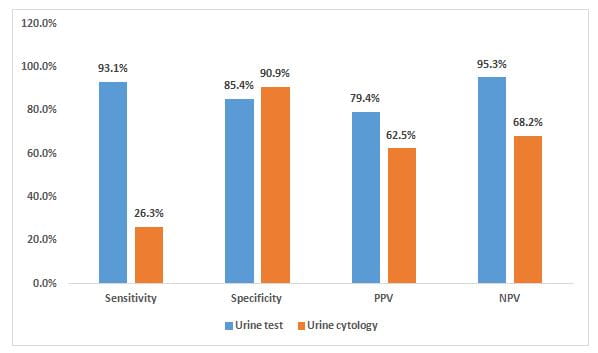
- The comparison of endpoints of the new test and urine cytology has been shown in Figure 1.
- The AUC values of the new test and urine cytology were 0.893 and 0.586 respectively.
Figure 1. Comparison of endpoints
Advantages of The New Test
- High sensitivity, specificity, positive predictive value and importantly negative predictive value (NPV – of 95.3%) making it a strong non-invasive and less cumbersome candidate to replace the invasive and more cumbersome cystoscopic examination
- Based on real-time q-polymerase chain reaction (RT-qPCR) – a methodology well-implemented in most labs allowing in-house testing
- Affordable test
- Has easy to use components
- It requires a urine sample of only 10 mL
- Quick turnaround time of 6 hours with a Yes / No binary, easy-to-read result
- Retains its high NPV at almost same value, viz., 96.7% in patients having and free of NMIBC and thus shows no loss of usefulness in a picture of mixed malignant and non-malignant pathologies and hence, useful even in a general urology set-up.
Conclusion
- As per the results of this diagnostic study, the new urine-based DNA mutation detecting test is a promising alternative for the detection of recurrence in patients with non-muscle-invasive bladder cancer.
Diagnostic (Basel). 2020 Sep 24;10(10):745. Doi: 10.3390/diagnostics10100745.

More From Area Of Interest
You may also like

13 May, 26

17 Apr, 26
Our Research
23 Feb, 26

23 Feb, 26

11 Feb, 26

11 Feb, 26

11 Feb, 26
Latest Items
Journal Scans
26 Jun, 26

26 Jun, 26

26 Jun, 26

25 Jun, 26


