Pressurized metered dose inhalers (pMDIs), first introduced in 1956, are considered an effective delivery method
for many important drugs used to treat obstructive airway diseases such as asthma and chronic obstructive
pulmonary disease (COPD). Today, the pMDI remains the most popular delivery device because of the number of
advantages that it offers, including reliability, accurate dosing, convenience and low cost, making it the most
widely used inhaler device in the world.
Although patients may be educated in proper technique of inhaler administration, instructions on how to determine
when to replace their inhaler with a new pMDI is often overlooked. Thus, one of the most difficult challenges
for patients using a pMDI is keeping track of the number of doses taken and when to replace the pMDI, i.e., the
device does not indicate how much medicine remains inside the canister once a patient starts using it. Lacking
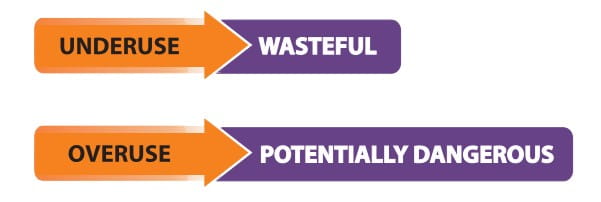
this information, patients are at a risk of taking sub-therapeutic doses; also, they may either discard the
inhaler before it has been fully used or continue to use the inhaler beyond its labelled number of doses, at
which point the quality of each puff is no longer guaranteed by the manufacturer.
Studies have shown that over 74% of patients do not know how many puffs were in their pMDI and 62% of patients
feel anxious about not knowing the quantity of medication remaining in their pMDI.
Patients rely on inaccurate methods of determining whether a pMDI canister is depleted, such as by shaking the
inhaler or estimating the weight of the canister. If patients are not taught to recognize when a pMDI is empty,
they may continue to use the medication canister long past its intended duration of use.
Sander et al. conducted a study in which 500 patients were telephonically interviewed. Respondents were asked
several questions regarding their asthma and inhaler use. It was reported by 64% of respondents that they were
not instructed to keep track of the pMDI doses used. Moreover, 53.8% refilled their prescriptions more
frequently than required.
Almost 20% of respondents reported refilling their bronchodilator inhalers at least once per month. This may
reflect a number of possibilities: the patient's asthma is poorly managed; patients do not know that
bronchodilators should not be used daily; or that patients are throwing away partially used inhalers, perhaps to
prevent finding their inhaler empty during an attack.
- 25% found their pMDI empty during an asthma exacerbation.
- 8% of them required emergency service.
- 21% considered their pMDI empty when absolutely nothing came out.
Another study investigated how patients assess inhaler fullness and the accuracy of their assessment.
Accordingly, 98 patients were interviewed.
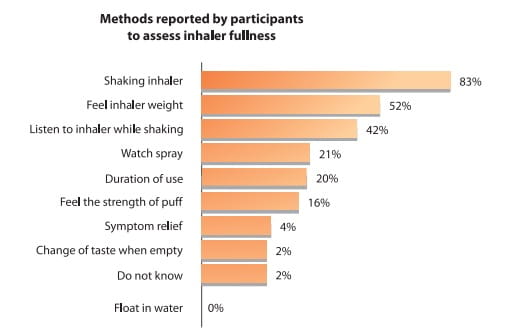
Testing the inhaler by shaking or test firing is misleading because the propellants and other inert contents
remain in the canister even after all the medicine has been consumed. Also, the floating method can cause
problems in valve mechanism.
Only 8% reported counting the number of puffs used. In another study, it was found that the lack of dose
counter was the main reason that subjects were not satisfied with their previous inhaler.
This suggests that patients are rarely instructed that it is important to count the number of doses used
throughout the life of a pMDI and to discard the inhaler once the stated number of puffs are used. Also,
patients rely on inaccurate methods of determining whether a pMDI is depleted. The only reliable method for
determining the number of doses remaining in a canister is to subtract the number of doses used from the
number available.
A reliable dose counter can help patients tract their medicine use, determine when to replace their inhaler
and prevent them from actuating their inhaler beyond the labelled number of doses.
In March 2003, the US FDA issued guidance on 'Integration of Dose-Counting Mechanisms into MDI Drug
Products', recommending that integration of dose counter should indicate the number of doses remaining in a
pMDI.
A survey conducted in 268 patients, >4 years and above, with asthma and COPD, has shown that the
integration of dose counter in a pMDI leads to improved patient satisfaction.
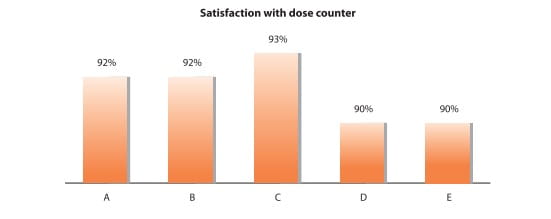
At baseline, 62% of patients reported anxiety about not knowing the quantity of medication remaining in their
inhalers.
- 92% of patients expressed satisfaction with the dose counter.
- 92% of patients agreed that the dose counter would help prevent them from running out of medication.
- 93% of patients agreed that the dose counter would let them know when to refill their medication.
- 90% of patients agreed that dose counter would help them to monitor medication use.
- 90% of patients agreed that dose counter would give them added reassurance about the medication supply.
This indicates that the addition of a dose counter with pMDIs provides patients with a reliable indication on
how many recommended doses are left in their inhalers and increases assurances by clinicians that patients
are not using their inhalers beyond the recommended number of doses.
Another study analysed the patient satisfaction with the integrated dose counter in patients with asthma and
COPD in 272 patients (aged 12?92 years).
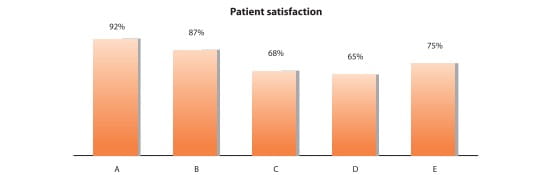
- 92% of patients agreed that the dose counter helped them to keep a track of the doses remaining in their
inhaler.
- 87% agreed that the inhaler with dose counter was easy to use.
- 68% agreed that it helped them relieve their anxiety about running out of their medication.
- 65% agreed that it helped them relieve their anxiety about taking a sub-therapeutic dose.
- 75% agreed that they would recommend it to a friend.
This suggests that an integrated dose counter is an important contributor to patient satisfaction.
Integration of dose counters in pMDIs would provide patients a reliable means of monitoring their medication
and can have a great impact on the effectiveness of aerosol drug delivery.
The dose counter will also provide reassurance and will add confidence that the medication can be relied
upon, as well as reduce the risks of taking sub-therapeutic doses by using the inhaler past the number of
doses guaranteed on the product label.
Inclusion of an integrated dose counter would provide patients a reliable method for determining the number
of doses in the pMDIs and may enhance patient satisfaction, compliance and treatment adherence. It will also
provide clinicians an objective means of assessing patient adherence to medication.
Dose counters may help to improve the cost effectiveness of asthma management by regulating refill rates and
reducing hospital visits, and most importantly, a dose tracking mechanism can also eliminate the possibility
of sub-therapeutic dosing.
As an ongoing commitment towards respiratory medicine, Cipla introduces the US FDA
approved dose counter in MAXIFLO Inhaler.
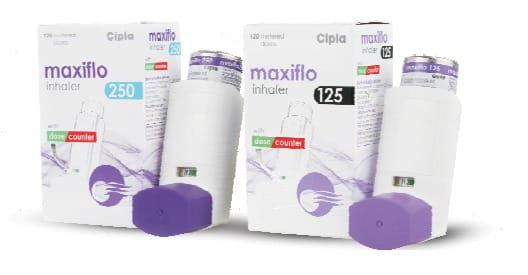
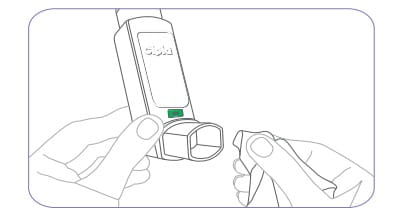
- As the patient uses the inhaler, the number on the dose counter counts down, indicating the remaining
doses left in the inhaler. E.g., dose counter counts downwards and, hence, will show the numbers, 120,
100, 80, 60, 40...etc.

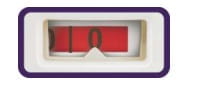
- When there are 40 puff s remaining, the colour on the dose counter will change from green to red. This
indicates that fewer doses are remaining in the inhaler and the patient should consider getting a new
inhaler.
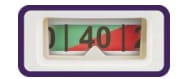
- When the dose counter displays ‘0’, this means that there is no more medicine left in the
inhaler and the inhaler should be discarded.
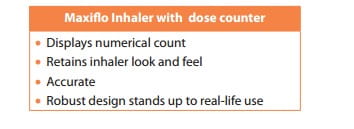
Accuracy of count is a critical parameter for dose counters. The MAXIFLO Inhaler dose counter is
designed to reliably track the doses to avoid undercounting,(i.e. pMDI sprays, but the dose counter does not
move on). Undercounting could result in patients assuming they have medication left in their inhaler when they
do not, a circumstance that is potentially dangerous.
Minimal/no additional force is required to use the MAXIFLO Inhaler dose counter.
The familiar look and clear display of the MAXIFLO Inhaler dose counter is similar to the
original MAXIFLO pMDI and requires no additional training in usage for patients.