The Impact of Empagliflozin on Uric Acid Level and Gout Outcomes in Diabetes-The EMPA-REG OUTCOME Analysis


Introduction
Patients with type-2 diabetes mellitus (T2DM) frequently have elevated levels of uric acid (UA). Elevated UA levels are not only associated with increased risk of cardiovascular diseases, but also with the risk of gouty arthritis, nephrolithiasis, tubule-interstitial fibrosis, and progression of kidney disease. Sodium glucose con-transporter (SGLT)-2 inhibitors are known to reduce the UA levels. The UA-lowering potential of SGLT-2 inhibitors expands their role beyond glucose lowering, improving cardio-renal outcomes to improving gout related outcomes].
Aim
To evaluate the impact of empagliflozin on UA levels, antigout medication prescription and gout episodes in the participants of the EMPA-REG OUTCOME trial.
Patient Profile
- Patients with T2DM and established atherosclerotic cardiovascular disease (n=7020)
- Glycated hemoglobin (HbA1c) was in the range of 7.0%-9.0% for drug-na?ve patients and in the range of 7.0%-10.0% for patients on glucose lowering therapy
- The estimated glomerular filtration rate (eGFR) was ≥30 ml/min/1.73 m2.
Methods
Study Design
- A post hoc analysis of EMPA-REG OUTCOME trial
- EMPA-REG OUTCOME was a randomized, double-blind, multi-center clinical trial conducted across Europe, North America and Asia
Treatment Strategy
- Study participants were randomized to either empagliflozin (10 or 25 mg) or placebo.
Outcomes
- Composite of the time to first occurrence of either an adverse event (AE) contributing to the gout episode or the “de novo” initiation on antigout medication
- The impact of empagliflozin on serum UA concentration over time
Results
- Of the 7020 study participants, 5.9% (n=413) were taking antigout medication while 94.1% (n=6607) were not taking any antigout medication.
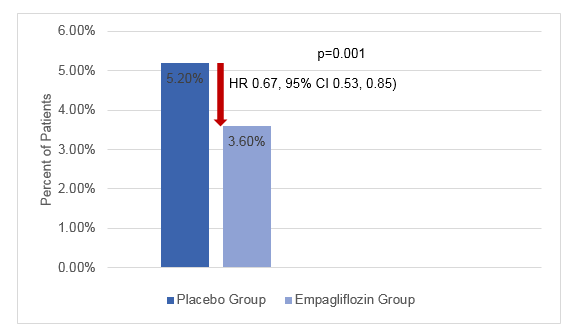
- Among the patients who were not taking antigout medications at baseline, empagliflozin treatment vs. placebo, was associated with a significant 33% reduction in the risk of a gout episode, or initiation of antigout treatment [3.6% vs. 5.2%; hazard ratio: 0.67; 95% confidence interval (CI): 0.53, 0.85; P=0.001]. The treatment effect did not differ significantly for both the doses of empagliflozin (Fig. 1).
- At 12 weeks, patients treated with empagliflozin had modestly lower serum UA levels, compared with those treated with placebo. At week 52, the adjusted mean treatment difference was -0.37 mg/dL (95% CI: -0.42, -0.31).
- Throughout the study period, until 3 years, the adjusted mean treatment difference in serum UA level was somewhat more pronounced among patients with baseline serum UA ≥6.0 mg/dL than in patients with baseline serum UA level <6.0 mg/dL (at week 52: -0.46 mg/dL vs. -0.28 mg/dL).
- The impact of empagliflozin was more pronounced in patients with baseline UA ≥7.0 mg/dL versus those with UA <7.0 mg/dL (week 52 adjusted mean treatment difference: -0.56 mg/dL [95% CI: -0.68, -0.43] vs.-0.30 [95% CI: -0.37, -0.24] mg/dL).
- Greater proportion of patients treated with empagliflozin vs. placebo had serum UA level <6.0 mg/dL at all time points during the trial. At week 52, 21.8% patients treated with empagliflozin vs. 11.1% patients in the placebo group had reached UA level <6.0 mg/dL [odds ratio (OR): 2.36; 95% CI: 1.89, 2.95]. A similar pattern was evident for reaching UA level <7.0 mg/dL at week 52 in empagliflozin-treated (28.5%) and placebo-treated (15.8%) patients (OR: 2.22; 95% CI: 1.69, 2.92)
Conclusions
- This analysis of the EMPA-REG OUTCOME trial demonstrated that treatment with empagliflozin in T2DM patients was associated with reduced UA levels.
- Treatment with empagliflozin was also associated with reduced risk of gout episodes or prescription of antigout medication.
- These findings may have an important role in expanding the clinical utility of empagliflozin as a potential antigout treatment in patients with T2DM, beyond its well-established cardio-renal benefits.
Diabetes Obes Metab. 2021 Sep 24 (Published Online); doi: 10.1111/dom.14559.