




Attaining lipid and BP goals yields additive risk reduction in recurrent stroke and major CV events in patients with stroke or TIA: Analysis of SPARCL trial
SPARCL: Subanalysis to Determine Lipid & BP Goal Achievement

12 Dec, 10


SPARCL Subanalysis to Determine Lipid & BP Goal Achievement
Introduction
Aim
To evaluate the benefits of lipid and blood pressure (BP) control in patients with stroke or transient ischemic attack (TIA).
Methods
Analysis of Stroke Prevention by Aggressive Reduction in Cholesterol Levels (SPARCL) trial
Patients
Stroke or TIA (N=4731)
Outcome measure
Attainment of lipid and BP goals, defined as:
- LDL cholesterol <70 mg/dl
- HDL cholesterol >50 mg/dl
- Triglycerides <150 mg/dl
- BP 120/80 mm Hg
Mean Follow-up Period
4.9 years
Results
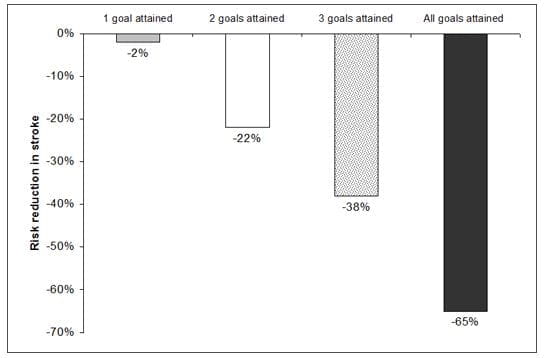
- Attainment of each goal yielded additional risk reduction in stroke; with 65% risk reduction observed in those who attained all goals vs. those who did not achieve any goal (Figure)
Figure. Risk reduction in stroke with attainment of lipid and BP goals
- Patients attaining all the four goals also experienced 75% reduction in risk of major CV events
Conclusion
Optimal control of lipids and BP yields stepwise reduction in risk of stroke and major CV events in patients with stroke or TIA.
"The take-home message for the clinician is that better control of LDL cholesterol, triglycerides, and blood pressure, and higher levels of HDL cholesterol, especially when in combination, results in much-reduced recurrent stroke risk and major cardiovascular event rates in patients with a history of recent stroke."
-Dr Philip B Gorelick, University of Illinois College of Medicine, Chicago
Adapted from http://www.theheart.org/article/965381.do#bib_1. As accessed on May 4, 2009

More From Area Of Interest
You may also like

13 May, 26

17 Apr, 26
Our Research
23 Feb, 26

23 Feb, 26
11 Feb, 26

11 Feb, 26
11 Feb, 26
Latest Items
Journal Scans
26 Jun, 26

26 Jun, 26

26 Jun, 26

25 Jun, 26


