Short-term Clinical and Bacteriological Efficacy and Safety of Ciprofloxacin for 7 Days versus 14 Days in Women with Acute Pyelonephritis


Background
Acute pyelonephritis is a common and potentially serious infection affecting women of all ages.
Aim
To compare the efficacy of ciprofloxacin for 7 days and 14 days in women with community-acquired acute pyelonephritis
Patient Profile
Women (aged ≥18 years) who were not pregnant and had a presumptive diagnosis of acute pyelonephritis
Methods
- A prospective, randomised, double-blind, non-inferiority trial
Study Design
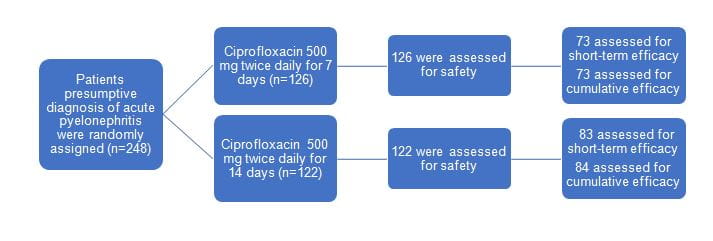
Study endpoints
- The primary endpoint was the clinical and bacteriological outcome 10–14 days after completion of treatment with active drug.
- Clinical cure was defined as complete resolution of symptoms during treatment with no recurrence of symptoms or signs of urinary tract infection during follow-up
- Bacteriological cure was defined as eradication of the infecting strain with no recurrence of bacteriuria (<10? cfu per mL) during follow-up.
- The secondary outcome was the long-term cumulative efficacy of ciprofloxacin.
Results
|
|
Ciprofloxacin for 7 days (n=73) |
Ciprofloxacin for 14 days (n=83) |
|
Age (years) |
46 |
41 |
|
Recurrent urinary tract infections |
11 (15%) |
10 (12%) |
|
Complicated urinary tract infections |
4 (5%) |
10 (12%) |
|
Diabetes mellitus |
2 (3%) |
7 (8%) |
|
Temperature (°C) |
39·2 |
39·0 |
|
Flank pain or costovertebral angle tenderness |
69 |
79 |
|
Serum CRP concentrations (mg/L) |
100 |
125 |
|
Pyuria |
70 (96%) |
78 (94%) |
|
Bacteria isolated from pretreatment urine cultures |
|
|
|
Escherichia coli |
64 (88%) |
79 (95%) |
|
Staphylococcus saprophyticus |
3 (4%) |
1 (1%) |
|
Klebsiella pneumoniae |
3 (4%) |
0 |
|
Others |
3 (4%) |
3 (4%) |
|
Positive blood culture |
16 (22%) |
26 (32%) * |
|
Initial intravenous dose(s) of ciprofloxacin |
14 (19%) |
11 (13%) |
Data are number (%) or median (IQR). All blood cultures grew Escherichia coli. *Blood cultures missing for one patient.
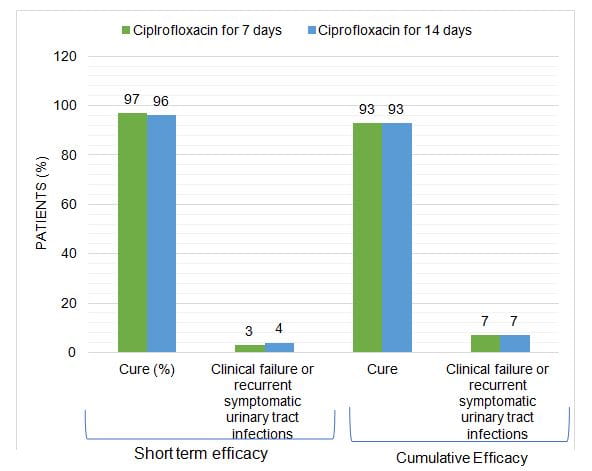
- Both treatment regimens resulted in high clinical cure rates at short-term follow-up
- The short-term efficacy of 7 days of ciprofloxacin was not inferior to that of 14 days
- In patients treated for 7 days and 14 days, the cumulative cure rates were similarly high
- Both treatment regimens were well tolerated
- Treatment discontinuation because of myalgia was reported in 2 patients with 7 days of treatment and itching exanthema with 14 days
- Adverse event after the first week of treatment that was possibly or probably related to the study drug was reported in
- Four (5%) of 86 patients assigned to 7 days of treatment
- Six (6%) of 93 assigned to 14 days
- No mucosal candida was reported after the first week in patients assigned to days versus 5 patients assigned to 14 days (p=0·036)
Conclusion
- The study showed that 7 days of ciprofloxacin was not inferior to 14 days of treatment.
- The clinical and bacteriological cure rates were high for both regimens at short-term and long-term follow-up
- The findings suggested that community-acquired acute pyelonephritis in women can be treated successfully and safely with oral ciprofloxacin for 7 days and even in older patients and those with a more severe infection
Reference
Lancet 2012; 380: 484–90