Sacubitril/Valsartan Treatment in Patients with HFrEF with and without Diabetes-Impact on Reverse Cardiac Remodeling


Introduction
Patients with heart failure with reduced ejection fraction (HFrEF) and type-2 diabetes mellitus (T2DM) may exhibit similar benefits in terms of clinical outcomes as compared with those without T2DM, but they do not achieve similar benefits in terms of cardiac geometry and functioning. The role of sacubitril/valsartan in promoting reverse cardiac remodeling and improving outcomes in patients with HFrEF has already been established. Beneficial impact of sacubitril/valsartan on cardiac remodeling has not been evaluated in HFrEF patients with co-existing T2DM patients; these patients have worse prognosis than those without T2DM.
Aim
To determine whether patients with HFrEF with T2DM have similar reverse cardiac remodeling with sacubitril/valsartan as patients without T2DM
Patient Profile
- Patients with HFrEF with left ventricular ejection fraction (LVEF) ≤40%, New York Heart Association (NYHA) class II to IV within past 6 months (age ≤18 years; n=794)
- Based on diabetes status, patients were categorized as
- Patients with HFrEF with T2DM
- Patients with HFrEF without T2DM
Methods
Study Design
- A post hoc analysis of PROVE-HF trial
- PROVE-HF was a phase 4, open-label, single-group study conducted across 78 sites in the United States
Treatment Strategy
- Along with the standard treatment patients received sacubitril/valsartan twice daily (dose was increased every 2 to 4 weeks to achieve the target dose of 97/103 mg)
Outcomes
- N-terminal pro–b-type natriuretic peptide (NT-proBNP)
- Measures of cardiac remodelling
- Kansas City Cardiomyopathy-23 overall summary Questionnaire (KCCQ 23-OS)
Results
- Of the 794 patients enrolled, 361 (45.5%) had T2DM. The final longitudinal analysis included 309 patients with T2DM and 369 patients without T2DM. Mean age of the study population was 65.1 years, and 28.5% of them were females.
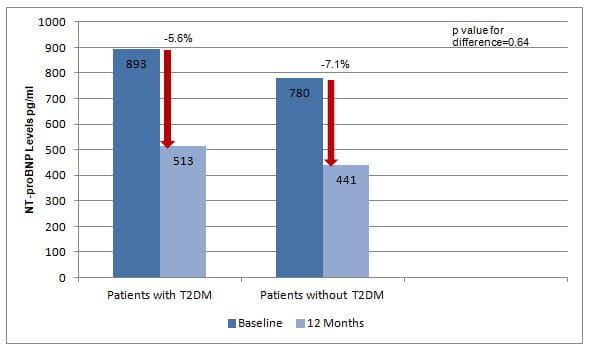
- At baseline, patients with T2DM had modestly higher NT-proBNP as compared with those without T2DM (854 pg/ml vs. 706 pg/ml), but the same were reduced when treatment with sacubitril/valsartan was initiated.
- Longitudinal analyses revealed similar changes in the average NT-proBNP levels in patients with T2DM vs. those without T2DM (Fig 1)
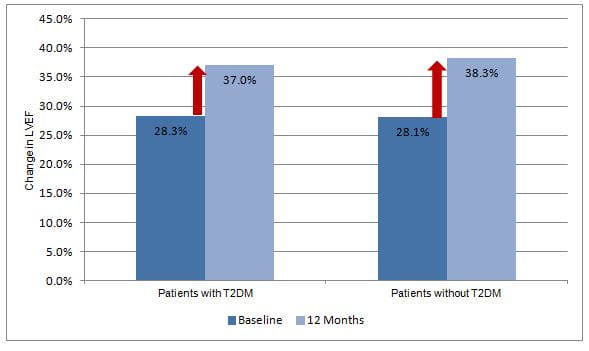
- Cross-sectional improvement was observed in LVEF, following sacubitril/valsartan initiation in both study groups, importantly, patients in the T2DM group also exhibited improvement in LV and left atrial indexed volumes along with improved diastolic function (Fig 2)
- KCCQ 23-OS improved significantly in both the groups, following the initiation of sacubitril/valsartan treatment (Table 1)
|
Study Group |
Baseline |
12 Months |
|
Patients with T2DM |
71 |
83 |
|
Patients without T2DM |
76 |
88 |
Conclusions
- Sacubitril/valsartan had a favorable impact on natriuretic peptide levels, reverse cardiac remodeling, and health status in patients with HFrEF with and without T2DM.
- Considering the broad range of HFrEF therapies now available, these findings lend a strong support for the use of sacubitril/valsartan in patients with and without T2DM.
JACC Heart Fail. 2020 Dec 9; S2213-1779(20)30578-3.