Sacubitril/Valsartan Enhances Glycemic Control in Heart Failure Patients with Diabetes


Background
Diabetes is a well-established independent risk factor for heart failure (HF) progression. Use of sacubitril/valsartan (an angiotensin receptor-neprilysin inhibitor) as compared to enalapril (angiotensin-converting enzyme inhibitor [ACE inhibitor]) is associated with superior improvement in morbidity and mortality in patients with HF with reduced ejection fraction (HFrEF). Moreover, this drug also improves peripheral insulin sensitivity in obese hypertensive patients.
Aim
To determine the effect of sacubitril/ valsartan vs. enalapril on glycosylated hemoglobin (HbA1c) and time to first initiation of insulin or oral antihyperglycemic agents in HFrEF patients with co-existing diabetes.
Patient Profile
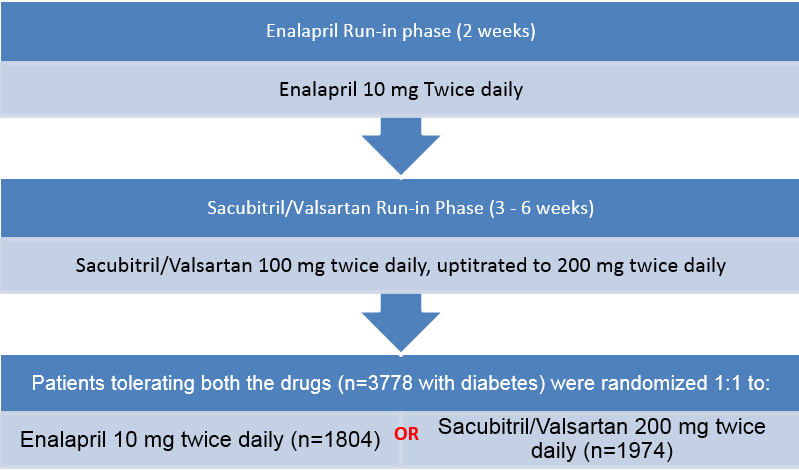
- Patients (age ≥18 years; 3778 [with diabetes]/8399 patients, mean age; 64 years, males; 79%) with New York Heart Association (NYHA) class II to IV symptoms having an ejection fraction of ≤40% (changed to ≤35% by protocol amendment) and plasma B-type natriuretic peptide (BNP) ≥150 pg/mL (or N-terminal pro-BNP [NTproBNP] ≥600 pg/mL)
- Patients with lower levels of natriuretic peptides were eligible only if they had been hospitalized for HF within 12 months.
- Patients on ongoing therapy were required to tolerate ACE-inhibitor or angiotensin receptor blocker (ARB) equivalent to at least enalapril 10 mg daily for at least 4 weeks before screening along with stable doses of a ?-blocker (unless contraindicated or not tolerated) and a mineralocorticoid antagonist (if indicated).
- Patients either had a history of diabetes (diagnosis based on hyperglycemia as per the American Diabetes Association criteria or initiation of oral hypoglycemic agents, insulin sensitizers, insulin therapy (98% patients had type-2 diabetes mellitus) or HbA1c ≥6.5%
Methods
Study Design
- Post hoc analysis of PARADIGM-HF; a multicentre, double-blind, parallel group, randomized, active-controlled trial
Treatment Strategy
Outcomes
- Changes in HbA1c, triglycerides, high density lipoprotein cholesterol (HDL-C) and body mass index (BMI) at 1-year, 2-year, and 3-year visits using a mixed effects longitudinal analysis model
- Time to oral hypoglycemic agents and insulin therapy initiation during follow-up in subjects previously not treated with these agents
Results
- The HbA1c concentrations between randomised groups did not differ significantly at screening.
- There was a significantly greater decrease in the HbA1c in the sacubitril/valsartan group vs. the enalapril group during the first year of follow-up (0·16% decrease vs. 0·26% in the sacubitril/valsartan group (between-group reduction 0·13%, p=0·0023) (Figure 1).
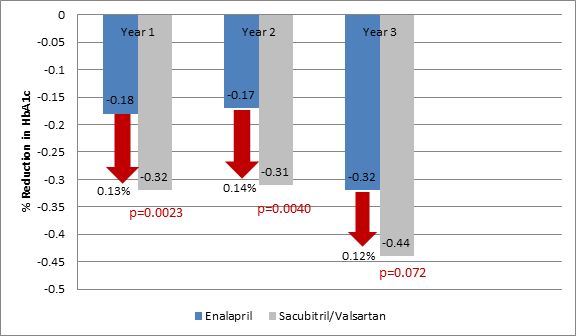
- The HbA1c concentrations remained persistently lower in the sacubitril/valsartan group vs. the enalapril group over the 3-year follow-up (between-group reduction 0·14%, p=0·0055).
- No consistent differences in the triglyceride levels were evident for the study groups throughout the study period. Patients treated with sacubitril/valsartan had a significant 0.02 mmol/L increase in the HDL-C vs. those treated with enalapril (p=0.043).
- Fewer cases of new insulin initiation were reported in the sacubitril/valsartan group vs. patients in the enalapril group (114 [7%] patients vs. 153 [10%]; hazard ratio [HR]; 0·71; p=0·0052, relative risk reduction [RRR] 29%) (Table 1).
|
Visit |
Enalapril |
Sacubitril/Valsartan |
P value |
|
1st Year |
5.5% |
3.8% |
0.025 |
|
2nd Year |
9.3% |
7.2% |
0.057 |
|
3rd Year |
13.3% |
9.1% |
0.0037 |
|
Overall |
10% |
7% |
0.0052 |
Conclusions
- Sacubitril/valsartan treatment was associated with greater long-term reductions in HbA1c concentrations as compared to enalapril.
- Fewer patients receiving sacubitril/valsartan vs. those receiving enalapril required initiation of insulin therapy over a period of 3 years.
- Sacubitril/valsartan might thus enhance glycemic control in HFrEF patients with diabetes.
Lancet Diabetes Endocrinol 2017, 5 (5): 333-340.