Role of Entecavir in HBV-Related Cirrhosis

calendar
14 Apr, 11

Reversal of Cirrhosis/Fibrosis in Chronic Hepatitis B (CHB) ............is it Possible?

The liver is a rapidly regenerating organ, and persistent liver injury leads to a process of healing and scar tissue formation resulting in fibrosis, and eventually cirrhosis. The transformation of hepatic stellate cells from vitamin A storage cells to activated hepatic stellate cells which secrete fibrillar collagens is responsible for liver fibrosis following liver injury. Although fibrosis was previously thought to be irreversible and relentlessly progressive, recent studies have challenged these ideas. Treatment of the underlying cause of inflammation has been shown clinically to result in reversal of fibrosis and cirrhosis in patients with liver disease from both viral and non-viral causes.

Antiviral therapy for CHB results in the suppression of viral replication, and has been associated with improvement of liver histology in randomized clinical trials. Entecavir is a potent HBV antiviral which demonstrated superior virologic, histologic and biochemical outcomes after 48 weeks of therapy compared to either lamivudine or adefovir in nucleoside-naive patients. The aim of the present study was to determine if long-term treatment with entecavir is associated with continued histologic improvement and reversal of fibrosis or cirrhosis and evaluated nucleoside-naive patients from two Phase III entecavir studies (hepatitis B e antigen (HBeAg)-positive [ETV-022] and HBeAg-negative [ETV-027]) who subsequently entered an open-label rollover study (ETV-901) and received entecavir for a total duration of at least 3 years.
Aim

To determine if long-term entecavir treatment continued to provide histologic improvement and reversal of fibrosis or cirrhosis in patients with chronic HBV infection.

Study Design

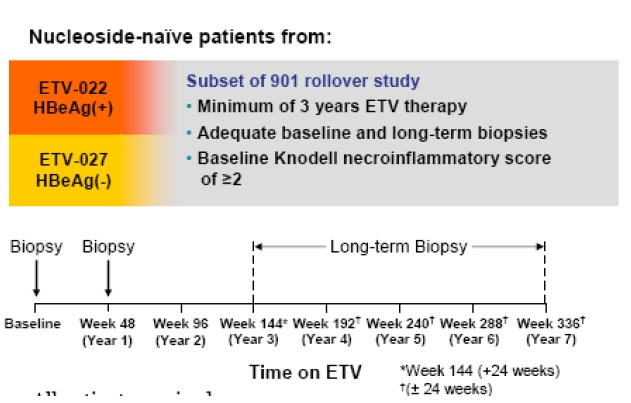
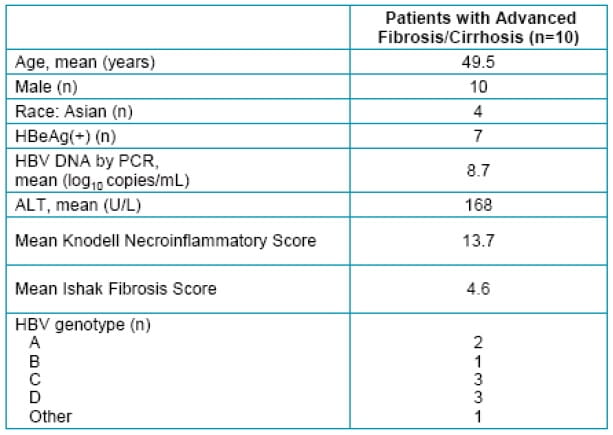
  • This study included a subset of 10 patients from phase III and long-term rollover studies, who received entecavir for at least 3 years, had advanced fibrosis or cirrhosis( Ishak Fibrosis score ≥4 at baseline) and evaluable biopsies at baseline and after long-term treatment
Fig. 1 Subset of the Long-Term Histology Cohort with Ishak Fibrosis score ≥ at baseline (n=10)

role_of_entecavir


Median exposure time on ETV treatment from phase 3 baseline to the long-term biopsy was 277 weeks (min 267, max 297).Due to the ongoing blinding of Phase 2-3 studies, 8/10 patients received a brief period of concurrent ETV plus lamivudine early in study ETV-901 for a median of 30 weeks. All patients in the subset with advanced fibrosis or cirrhosis (n=10) had long-term biopsy samples obtained at the Week 288 window.

Key Inclusion Criteria

  • Age ≥16 years; serologic diagnosis of CHB; compensated liver function
  • Absence of co-infection with hepatitis C, hepatitis D, or HIV; ≤12 weeks of prior lamivudine therapy; and no use of interferon-alfa, thymosin-α, or antiviral agents with anti-hepatitis B activity within 24 weeks of randomization
Table 1: Baseline Characteristics in Subset with Advanced Fibrosis or Cirrhosis
Table20120role20of20enetcavir20

Analysis Endpoints

  • Histologic improvement: ≥2-point decrease in Knodell necroinflammatory score and no worsening of Knodell fibrosis score compared to baseline
  • Improvement in Ishak fibrosis score: ≥1-point decrease compared to baseline
  • Change from baseline in:
    • Ishak fibrosis score
    • Knodell necroinflammatory score
    • Histologic activity index (HAI)
  • Proportions with:
    • HBV DNA <300 copies/mL by PCR
    • ALT ≤1 x ULN

Results

    • At the time of the long-term biopsy, all patients had undetectable HBV DNA levels of (< 300 copies/mL), and 90% had normalized ALT levels
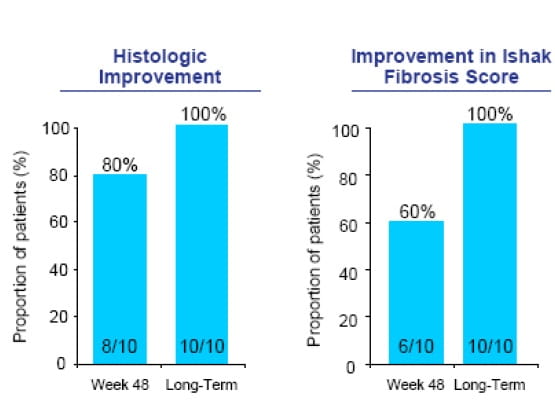
    • Majority (8/10) of patients achieved histologic improvement at week 48 which increased to 10/10 at Week 288 (6 years)
    • Improvement in Ishak Fibrosis score was observed in 6/10 of patients at week 48 which increased to 10/10 at Week 288 (6 years)
    Fig. 2: Long-Term Histologic Response at Year 1 and Long-Term in Patients with Advanced Fibrosis/Cirrhosis
    Fig20220role20of20enetcavir_0
     
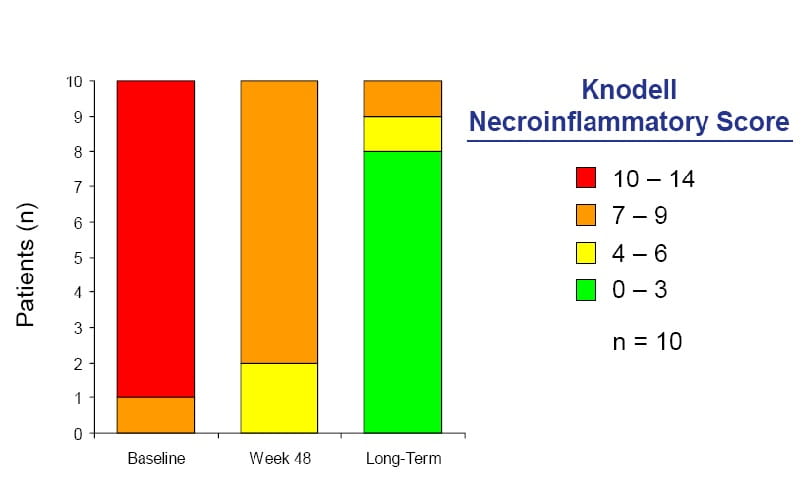
    Fig .3: Distribution of Knodell Necroinflammatory Scores at Baseline, Year 1, and Year 6
    Fig20320role20of20enetcavir

    Figure 3 above shows the distribution of Knodell necroinflammatory scores at baseline, at Week 48, and at the time of the long-term biopsy (6 years; Week 288).

    • After long-term entecavir therapy, the majority of patients in the subset with advanced fibrosis/cirrhosis at baseline (8/10) achieved a Knodell score of between 0 and 3 (Mean change in Knodell necroinflammatory and HAI scores were -7.6 and -8.9, respectively)
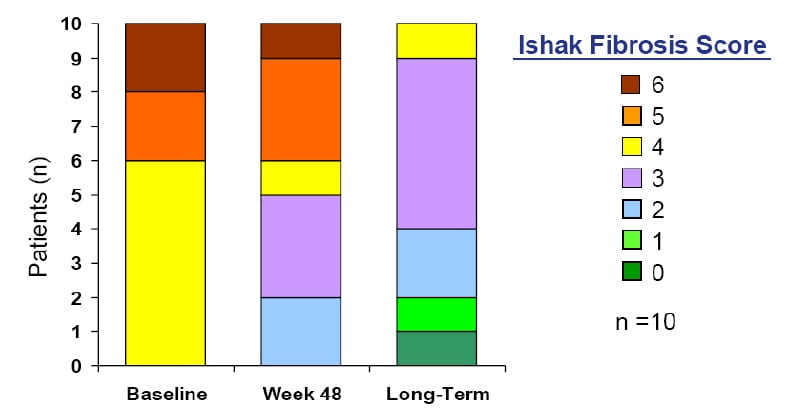
    Fig. 4: Distribution of Ishak Fibrosis Scores at Baseline, Year 1, and Year 6
    Untitled

      The figures 4 above shows the distribution of Ishak fibrosis scores at baseline, at Week 48 and at the time of the long-term biopsy (6 years; Week 288±24 weeks).

      • All 10 patients in the subset with advanced fibrosis/cirrhosis at baseline achieved an improvement in Ishak fibrosis score (Mean change in Ishak fibrosis score was -2.2)
      • For the four patients with cirrhosis at baseline (Ishak score ≥5), median change in Ishak fibrosis score was a 3-point decrease (range: -1 to -4)

      Safety

      • Serious adverse events occurred in 25% of patients although no patient stopped entecavir because of adverse events

      Study Limitations

      • Changes to the long-term rollover study, made it impossible to evaluate the effect of the increased dose of entecavir or concurrent lamivudine on the results
      • In patients with cirrhosis, there might be a sampling error using histology alone

      Conclusion

      Chronic hepatitis B nucleoside-naive patients with advanced fibrosis/cirrhosis treated with entecavir achieved substantial histological improvement and regression of fibrosis or cirrhosis.

      1. Clinical Gastroenterology and Hepatology 2011; 9(3):274-276.
      2. Hepatology.2010; 52(3):886-93.