




Rizatriptan-Effective and Safe for Treating Acute Migraine Attacks in Patients treated with Topiramate for Migraine Prophylaxis

21 Apr, 21


Introduction
Patients who experience continued migraine attacks while on prophylactic treatment are often prescribed triptans. Nevertheless, there is limited evidence on the benefits of triptans in patients who experience migraine attacks while on prophylactic medications.
Aim
To assess efficacy and tolerability of orally disintegrating tablet (ODT) of rizatriptan for treating acute migraine in patients already receiving topiramate for migraine prophylaxis
Patient Profile
- Adults with a >1-year history of migraine (with or without aura), maintained on a stable dose of topiramate for migraine prophylaxis (n=108)
- All the patients experienced ≥2 moderate/severe attacks per month during the 3 months before randomisation despite migraine prophylaxis
Methods
Study Design
- A worldwide, randomized, placebo-controlled, double-blind, cross-over, multiple-attack trial
Treatment Strategy
- For each patient 2 migraine attacks were treated with rizatriptan ODT-10 mg and 1 was treated with placebo.
- Participants administered a single dose of medication when they experienced moderate to severe headache.
- Patients were allowed to take their own migraine medication if the headache persisted 2 hours post dose, or if migraine re-occurred
Assessments
- During the 48 hours following the administration of the study medication, the following subjective parameters were recorded:
- Pain severity
- The presence or absence of associated symptoms
- The degree of functional disability at specified time intervals
- Use of rescue medication and migraine headache recurrence up to 48 hours following the administration of the study medication.
Outcomes
Efficacy Outcome
- Pain relief at 2 hours post dose
- Migraine-associated symptoms and functional disability
- Time and severity of headache return/recurrence within 24-48 hours post dose
- Use of rescue medication
Safety Outcomes
- The incidence of spontaneously reported adverse events (AEs)
Results
- Of the 108 patients included in the study, 100 treated at least 1 migraine attack and 93 completed the study. Furthermore, of these 93 patients, 91 treated all 3 migraine attacks.
- Overall, 99 participants treated 193 migraine attacks with rizatriptan 10-mg ODT, and 93 participants treated 93 migraine attacks with placebo.
- Majority of patients were women (median age; 44 years) with an average of 4 attacks per month during the 3 months before the randomisation.
- The baseline migraine characteristics for all attacks were generally comparable in the treatment groups.
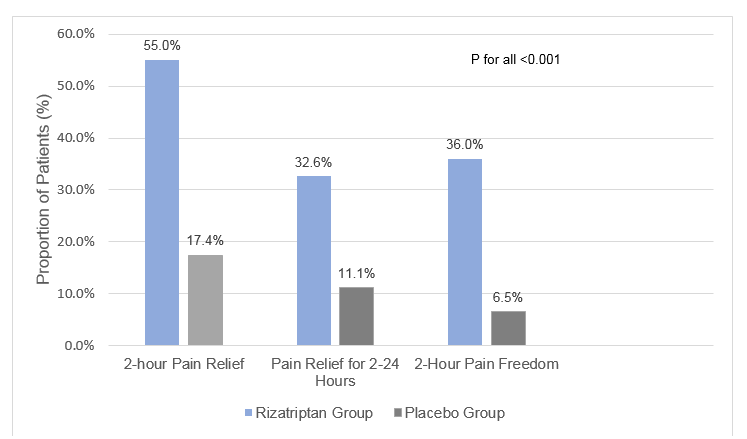
- Patients treated with rizatriptan had significantly greater pain relief at 2 hours as compared with placebo [55.0% vs. 17.4%, odds ratio (OR); 5.80, P < 0.001] (Fig 1).
Fig. 1: Various pain relief parameters in the study groups
|
P for all <0.001 |
- Response rates were in favour of rizatriptan with greater proportion of patients treated with rizatriptan having sustained pain relief from 2-24 hours (32.6% vs 11.1%, P < 0.001) and 2-hour pain freedom (36.0% vs 6.5%, P < 0.001).
- Greater proportion of patients treated with rizatriptan had normal functional ability at 2 hours along with overall treatment satisfaction at 24 hours. Significantly greater proportion of patients treated with rizatriptan reported absence and elimination of photophobia and phonophobia at 2 hours post dose (Table).
Table 1: Additional outcomes in the study groups
|
Outcomes |
Rizatriptan |
Placebo |
P value |
|
Normal functional ability |
42.2% |
12.7% |
<0.001 |
|
Overall treatment satisfaction at 24 hours |
60.8% |
33.6% |
<0.001 |
|
Elimination of photophobia at 2 hours |
39% |
16% |
<0.001 |
|
Elimination of phonophobia at 2 hours |
42% |
17% |
<0.001 |
- The incidence of AEs was lower in the patients treated with rizatriptan vs. placebo (15.8% vs. 3.2%), with none of them being serious.
Conclusion
- Rizatriptan 10-mg ODT was superior to placebo with respect to all pain outcomes for treating acute migraine in patients already on topiramate for migraine prophylaxis.
- Rizatriptan was generally well tolerated in this population with fewer AEs reported.
- The findings of this study were comparable with those from the clinical trials wherein patients were not using prophylaxis, thus indicating that the use of topiramate did not impact the efficacy or tolerability of rizatriptan for the treatment of acute migraine.
Headache.2012;52:57-67

More From Area Of Interest
You may also like

13 May, 26
17 Apr, 26
Our Research
23 Feb, 26
23 Feb, 26
11 Feb, 26
11 Feb, 26
11 Feb, 26
Latest Items
Journal Scans
26 Jun, 26

26 Jun, 26

26 Jun, 26

25 Jun, 26


