




REGEN-COV Reduces Risk of Hospitalization and Shortens Time to Resolution of Symptoms in Symptomatic COVID-19 Patients

16 Feb, 22


Introduction
Invitro studies have shown that the combination of combination of the monoclonal antibodies casirivimab and imdevimab, REGEN-COV, retain their efficacy against the emerging variants of severe acute respiratory syndrome coronavirus 2 (SARS-COV2). In the phase 1–2 portion of this phase 1-3 adaptive trial, administration of REGEN-COV reduced the viral load and number of medical visits in symptomatic outpatients with coronavirus disease 2019 (Covid-19).
Aim
The results of the primary analysis of the phase 3 portion of this trial have been presented here.
Method
Study Design
- Randomized, double-blind, placebo-controlled, adaptive, multicentre, phase 3 trial.
Patient Profile
- Symptomatic patients aged >18 years with confirmed SARS-CoV-2 positive test no more than 72 hours before randomization
- Atleast 1 risk factor for severe Covid-19
Treatment Strategy
- The enrolled patients were randomised to receive 2400 mg or 1200 mg of intravenous REGEN-COV or intravenous placebo.
- Nasopharyngeal swabs and serum samples were analysed to estimate the antibody level.
- The cohort was followed through day 29.
- A prespecified hierarchical analysis was used to evaluate the outcomes.
Endpoints
Primary Endpoint
- Covid-19-related hospitalization or death from any cause through day 29.
Secondary Endpoints
- Covid-19-related hospitalization or death from any cause from day 4 through day 29.
- Time to resolution of Covid-19 symptoms
- Incidence of serious adverse events (SAEs)
Results
- The full analysis set comprised 4057 patients with comparable demographics and clinical characteristics at baseline in study and control groups.
- The most common risk factors were
- Obesity (58%)
- Age >50 years (52%)
- Cardiovascular disease (36%)
- Immunocompromised (3%)
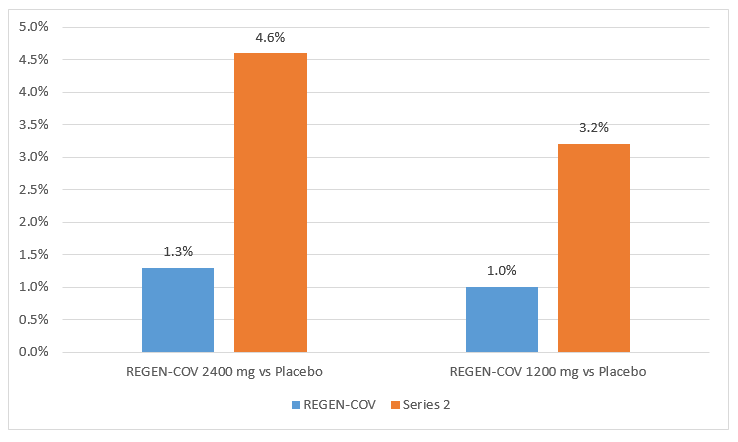
- The Covid-19–related hospitalization or death from any cause was lower in the REGEN-COV groups as compared to placebo with a relative risk reduction of 71.3% (p<0.001) and 70.4% (p=0.002) in REGEN-COV 2400 mg vs placebo and REGEN-COV 1200 mg vs placebo groups respectively.
Figure 1. Rate of Covid-19-related hospitalization or death from any cause
- The effects of REGEN-COV in reducing the risk of Covid-19-related hospitalization or death from any cause was evident in days 1-3.
- This risk was seen in 0.4% vs 3.4% in the REGEN-COV 2400 mg vs the concurrent placebo group and in 0.7% vs 2.4% in the REGEN-COV 1200 mg vs concurrent placebo groups respectively.
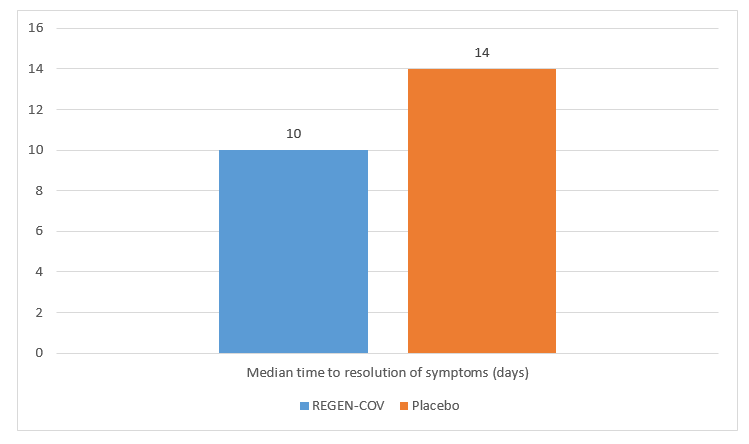
- Administration of REGEN-COV resulted in faster resolution of symptoms as seen in Figure 2; p<0.001 for both comparisons.
Figure 2. Median time to resolution of symptoms
- REGEN-COV was efficacious across various subgroups, including patients who were SARS-CoV-2 serum antibody–positive at baseline.
- Both REGEN-COV doses were associated with more rapid declines in the viral load than placebo; the least-squares mean difference in viral load from baseline through day 7 was −0.71 log10 copies per ml in the 1200-mg group and −0.86 log10 copies per ml in the 2400-mg group.
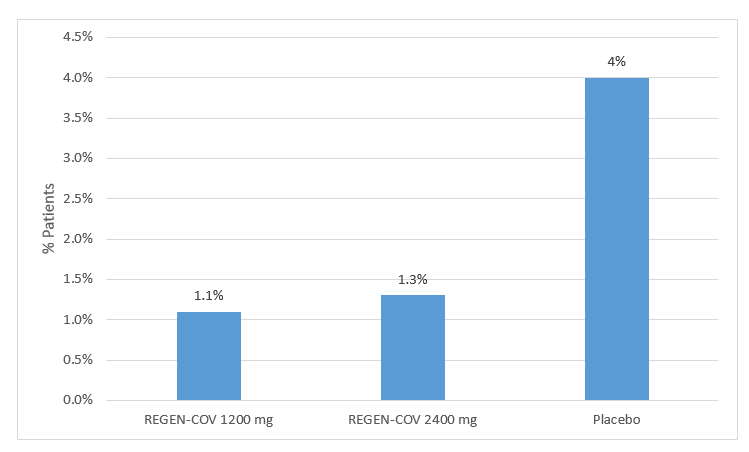
- The REGEN-COV groups had lower incidence of SAEs as seen in Figure 3.
Figure 3. Incidence of SAEs
- Infusion-related reactions of grade 2 or higher were reported in less than 0.3% of the patients in all groups.
Conclusion
- As per the results of this phase 3, administration of REGEN-COV decreased the risk of Covid-19–related hospitalization or death from any cause.
- REGEN-COV administration led to faster resolution of Covid-19 symptoms and more rapid decline of SARS-CoV-2 viral load than placebo.
N Engl J Med 2021; 385:e81. Doi: 10.1056/NEJMoa2108163.

More From Area Of Interest
You may also like

13 May, 26

17 Apr, 26
Our Research
23 Feb, 26
23 Feb, 26
11 Feb, 26
11 Feb, 26
11 Feb, 26
Latest Items
Journal Scans
26 Jun, 26

26 Jun, 26

26 Jun, 26

25 Jun, 26


