Poorly Controlled Diabetes - Strongest Predictor for Mortality Due to Renal Failure Among Indians: Insights from The Million Death Study


Introduction
Renal disease has emerged as one of the prime causes of mortality in recent years with renal failure claiming an increasing number of premature deaths in adults. Middle-income countries such as India are burdened with a double risk of constant high prevalence of infectious causes of renal disease as well as escalating rates of non-communicable diseases such as hypertension and untreated diabetes, also known to cause renal disease. Recent studies suggest that morbidity and mortality attributed to renal failure is likely to become a growing public health concern for India. Yet, renal disease is frequently undocumented; particularly in low-income and middle-income countries such as India.
Aim
To estimate the number of adult Indian deaths from renal failure during two study periods, 2001-03 and 2010-13. The study also determined the contribution of diabetes, hypertension and cardiovascular disease, and changes over time in each period.
Method
Study Design
A cross-sectional analysis of a nationally representative mortality data – Million Death Study (MDS) conducted in India. From 2001 onwards, this study monitored deaths in 1.3 million households.
Outcomes/Endpoints
- Age-specific and age-standardized death rates attributed to renal failure
- Comparison of prevalence of diabetes, hypertension, cardiovascular disease, and tuberculosis, as well as smoking and drinking and urban vs. rural residence among renal failure deaths (cases) with prevalence of deaths in people who died from injuries (controls)
Results
- The total deaths attributed to renal failure among adults (15–69 years) in 2001-03 were 2.1%. The proportion rose to 2.9% by 2010–13 and corresponded to 1,36,000 renal failure deaths
- In 2010-13, the age-standardized renal death rates were highest in the southern and eastern states, especially among adults aged 45–69 years
- The prevalence of diabetes among renal failure deaths rose from 26% in 2001–03 to 34% in 2010–13 whereas the prevalence of hypertension among renal failure deaths declined from 28% in 2001-03 to 23% in 2010-13
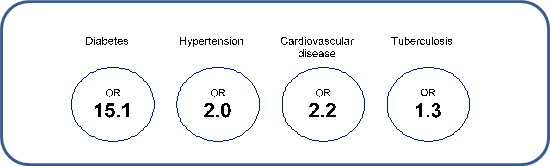
- In 2010-13, diabetes was the most robust predictor of death due to renal failure (Figure 1)
- In 2010-13, the OR for diabetes vs. non-diabetes was twice as large in adults born in the 1970s vs. those born during or before the 1950s (25.5 vs. 11·7) – indicating higher risk due to diabetes in recently born adults.
Conclusions
- In India, renal failure is a rising and substantial cause of adult premature deaths, occurring before the age of 70 years
- Diabetes is the most important risk factor associated with death due to renal failure among adults at all ages
- The risk of death due to renal failure associated with diabetes has amplified in the last decade and was particularly higher amongst the more recently born adults
- Mortality attributed to renal failure can be cut down with improved glycemic control among patients with diabetes, earlier diagnosis and prevention of diabetes along with the control of other key risk factors.
Lancet Glob Health 2017; 5: e89–95