Pirfenidone - A Promising Option in the treatment of IPF


Introduction
Idiopathic pulmonary fibrosis (IPF) is a chronic, progressive and ultimately fatal disease, resulting in gradual decline of lung function for which there is no known cause or cure. It is characterized by dyspnea. IPF is associated with a poor prognosis with paucity of treatments. The estimated median survival is 2-5 years. Hence, there is a need for the development of novel drugs which can arrest the loss of lung function. The CAPACITY (Clinical Studies Assessing Pirfenidone in Idiopathic Pulmonary Fibrosis) program is a combination of 2 multinational trials done to assess the effect of pirfenidone in IPF.
Aim
To evaluate whether pirfenidone reduces deterioration in lung function in IPF patients.
Patient Profile
Patients having a mean age of 40-80 years diagnosed with IPF over 48 months with no improvement in the disease.
Inclusion Criteria
- Predicted FVC (forced vital capacity) of at least 50%
- Predicted carbon monoxide diffusing capacity (DLCO) of at least 35%
- Either predicted FVC or predicted DLCO of 90% or less
- 6 min walk test distance of at least 150 m
- Patients <50 years and not meeting the protocol criteria of IPF by high-resolution CT were required to have a lung biopsy sample showing usual interstitial pneumonia
Exclusion Criteria
- Obstructive airway disease
- Connective tissue disease
- Alternative explanation for interstitial lung disease
- Awaiting lung transplant
Method
Study Design
Multinational, double-blind, placebo-controlled phase-3 study.
Treatment Strategy
Study 004
Group 1 – n = 87 pirfenidone 1197 mg/day
Group 2 – n = 174 pirfenidone 2403 mg/day
Group 3 – n = 174 placebo
Study 006
Group 1 – n = 171 pirfenidone 2403 mg/day
Group 2 – n = 173 placebo
Primary End-point
- Change in percentage of predicted FVC from baseline to week 72
Secondary End-points
- Categorical FVC
- Progression-free survival
- Worsening IPF
- Dyspnea
- 6 min walk test (MWT) distance
- Worst peripheral oxygen saturation during 6 MWT
- Percentage predicted DLCO
- Fibrosis by use of high resolution CT
- Overall deaths
- Deaths due to IPF
Results
- In study 004, mean FVC change at week 72 was -8% in pirfenidone group vs -12.4% in placebo
- In study 006, mean FVC change at week 72 was -9% in pirfenidone group vs -9.6% in placebo
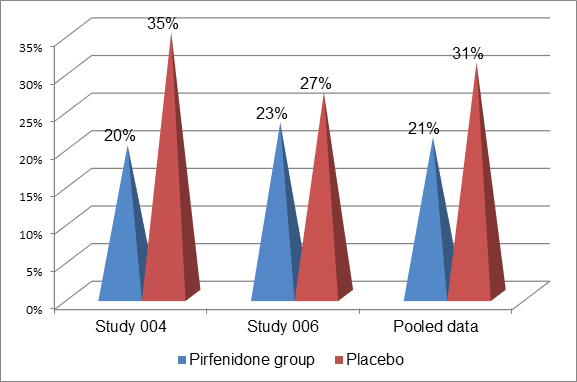
- Categorical change in FVC >10% is shown in Figure 1
Adverse Events
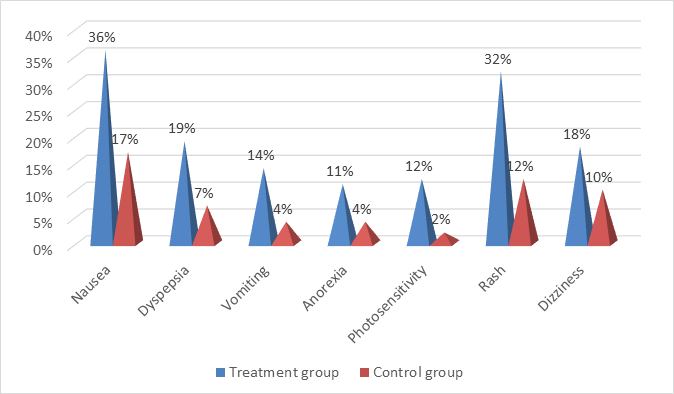
- The incidence of adverse events was higher in the pirfenidone group as compared to the placebo group
- Figure 2 shows the comparison in adverse events between the treatment and the control group
- The overall deaths were lower in the treatment group vs control (6% vs 8%)
- Deaths due to IPF were lower in the pirfenidone group vs control (3% vs 7%)
Conclusions
- Treatment with pirfenidone in IPF patients was associated with a better clinical outcome and a good safety profile.
- Pirfenidone represents a suitable treatment option in patients diagnosed with IPF.
Lancet 2011; 377: 1760–69