Perception of Doctors about Diagnosis, Management and Facing the Challenges with their Patients with Asthma: An Observation-Based Survey in Nepal


Introduction
- The Global Initiative for Asthma (GINA) recommends use of inhaled corticosteroids (ICS) and ICS combined with long-acting beta2-agonist (LABA) as a controller therapy; short-acting beta2-agonist (SABA) for reliever therapy for the treatment of asthma to control the symptoms and prevention of future exacerbations (1).
- According to GINA, the use of lung function measuring tools such as the spirometer and the peak flow meter should be used for diagnosis and monitoring of asthma symptoms in clinic and at home (1).
- Regular home-monitoring can help to assess the improvement/worsening of symptoms after medication and diurnal variation in the symptoms (1).
- However, in clinical practice, the use of lung function measuring tools to diagnose and monitor asthma is not always followed as per the guidelines. The use of diagnostic tools and treatment strategy is mostly dependent on the doctors’ knowledge and experience (2,3,4). As asthma is an atopic disease and can be triggered by external agents, management of asthma through exposure avoidance and smoking cessation is also recommended in the guidelines (1).
- According to the latest data from WHO published in 2017, asthma deaths in Nepal reached 3317 or 2.03% of total deaths. Nepal ranks 26th in the world in Asthma-related deaths.
- A recent analysis from Nepal reported that asthma was associated with cigarette smoking by two or more family members and with the domestic use of smoky fuels.
Aim
- This study aimed to understand the practice patterns of doctors and the challenges faced by them while treating their patients with asthma in Nepal.
Methods
- We conducted a questionnaire-based survey with 17 questions divided into categories of demographics, prevalence, management and adherence to inhalation therapy.
- Data was collected from spectra of doctors like general physicians, chest physicians and pediatricians practicing in private setting or hospitals, in 135 different locations across Nepal.
- This study was carried out for a period of 1 month (November 2017) and the total number of doctors targeted was 200.
Results
- A total of 129 doctors responded to the survey totally or partially
- More than 44% doctors see at least 5 patients every day. Approximately 37% doctors said most of their patients were under 12 years of age, whereas, around 34% of the doctors practiced majorly with patients >25 years of age with asthma.
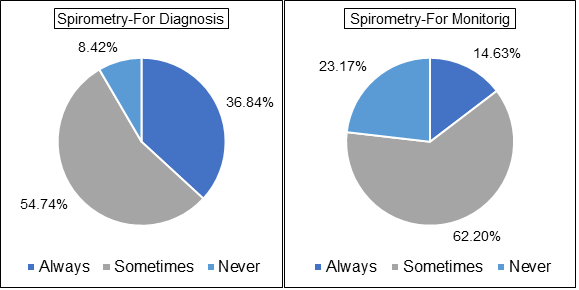
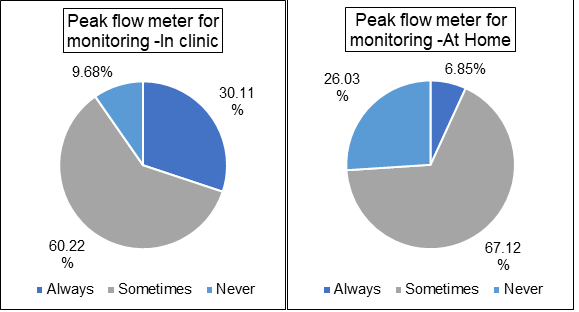
- Only 36.8% of the doctors preferred regular use of spirometry for diagnosis of asthma and 14.6% of the doctors use it for monitoring the asthma [Figure 1a]. Either always or sometimes, peak flow meter is used by approximately 90% of the doctors for monitoring asthma in the clinic, whereas, around 74% doctors advised using the peak flow meter for home monitoring of asthma [Figure 1b]
Q: What is your approach towards using lung function measuring tools?
Q: What is your approach towards using lung function measuring tools?
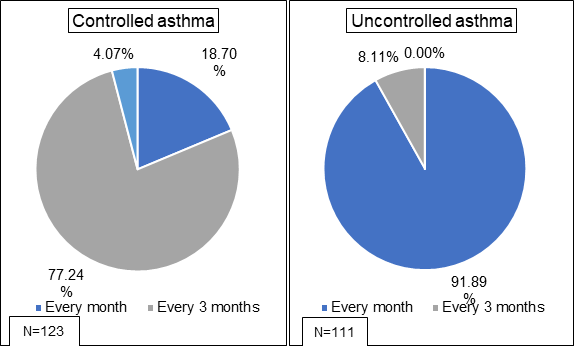
- Doctors preferred calling their patients more frequently (every month) for follow-up when their asthma was uncontrolled. For patients with controlled asthma, a period of 3 months was mostly preferred for follow-up [Figure 2].
Q: How often do you suggest a follow-up for your asthma patients, based on control?
- 39% of the prefer budesonide only, 30% prescribe both fluticasone or budesonide, 11% doctors prefer fluticasone only and 5% doctors prescribed SABA only for management of asthma [Figure 3]
- 37% of the doctors prescribe only salmeterol/fluticasone combination for ICS/LABA, 29% doctors prescribe only formoterol/budesonide combination. 28% doctors prefer either of the two-formoterol/budesonide or salmeterol/fluticasone [Figure 4]
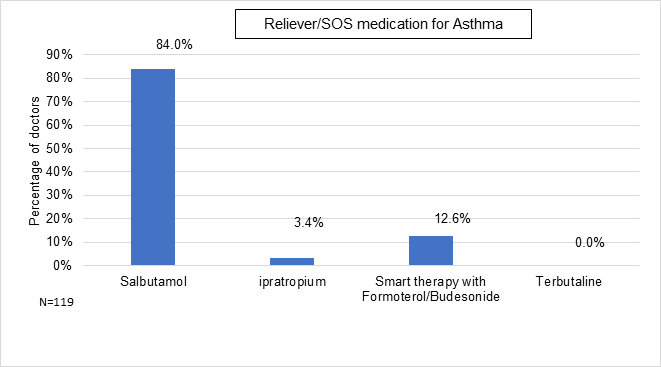
- Salbutamol is prescribed by 84% of the doctors and only 17% doctors prefer SMART therapy with formoterol/budesonide [Figure 5]
Q: If you prescribe an ICS, what is your preferred choice, or do you prescribe a SABA only?
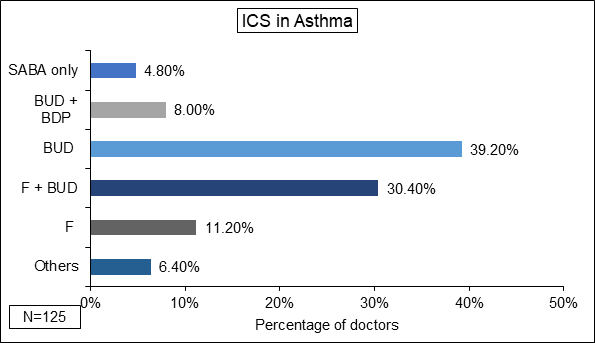
BDP = Beclomethasone dipropionate; BUD = Budesonide; F = Fluticasone; O = Others which include BDP, BUD + SABA only, F + SABA only, F + BDP
Q: Which ICS/LABA combination do you generally prescribe the most?
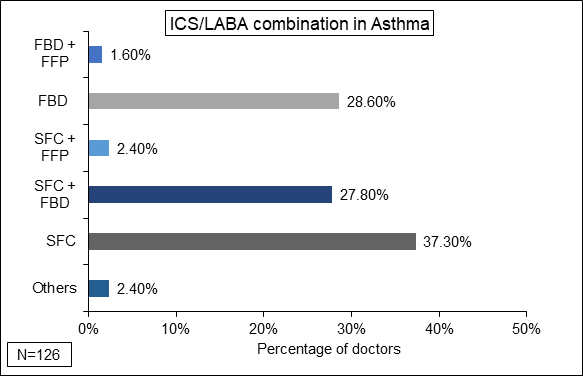
SFC=Salmeterol/Fluticasone combination; FBD=Formoterol/Budesonide combination; FBC=Formoterol/Beclomethasone combination; VFC = Vilanterol/Fluticasone combination; FFP=Formoterol/Fluticasone; *Others which also include SFC + Other, VFC + SFC + FBC.
Q: Which reliever/SOS medications do you prefer to prescribe?
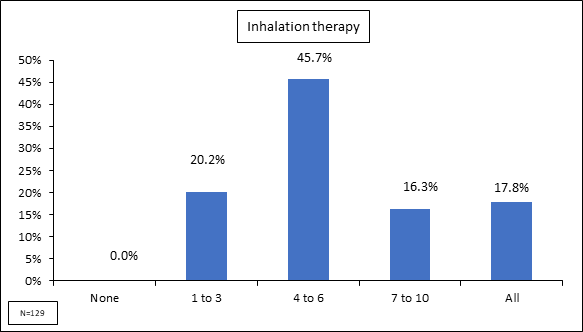
- It was observed that approximately only 18% doctors prescribed inhalation therapy to all their asthma patients [Figure 6]
- Almost 52% of the doctors believed that more than 40% of their patients were apprehensive to use inhalers
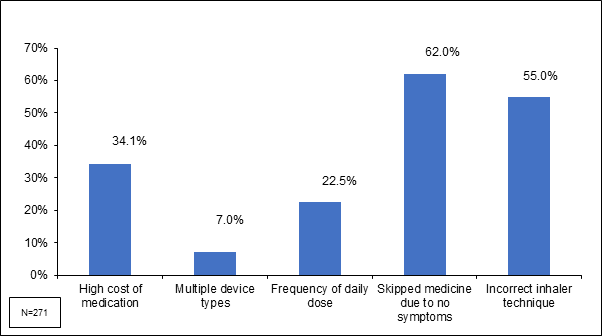
- Skipping medicine in absence of symptoms was thought to be major factor for patients’ non-adherence by maximum doctors (62%) followed by incorrect inhaler technique (55%) [Figure 7].
Q: For every 10 patients that visit you, to how many do you prescribe inhalation therapy?
Q: In your experience, what do you think are the major factors for patients’ non-adherence to the prescribed treatment? (can select more than one)
- pMDI and DPI were almost equally preferred by the doctors
- 83% doctors believed it would be easier for patients to use a similar device for both reliever and controller.
- 40% of the doctors check the inhalation technique of their patients at every visit, whereas, 58% doctors checked it on suspecting a wrong technique.
- Only, 16% of the doctors said that >70% of their patients show good adherence (>80%).
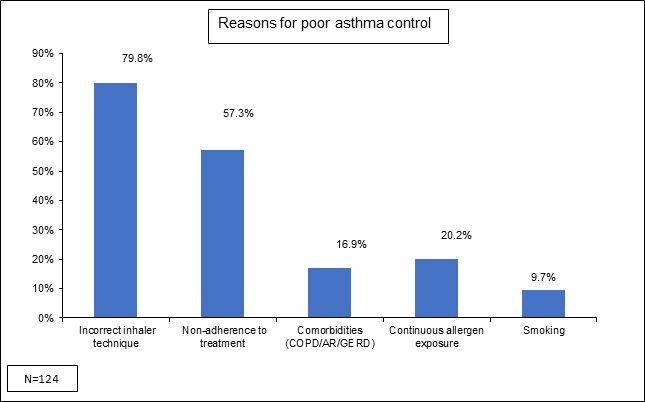
- A large number of doctors perceived incorrect inhaler technique and non-adherence to treatment as major reasons for poor asthma control [Figure 8].
Q: In your experience, what are the major reasons for poor control of asthma symptoms even after being prescribed the adequate treatment? (Can select more than one)
Conclusions
- In Nepal, the use of lung function measuring tools such as spirometry could be increased for diagnosis of asthma and use of peak flow meter can be encouraged to use for monitoring symptoms at home.
- Budesonide is the most preferred inhaled corticosteroid; Salmeterol/fluticasone and formoterol/budesonide are the most preferred ICS/LABA combinations. Salbutamol is the most preferred reliever therapy.
- pMDIs are widely prescribed, either with or without a spacer. DPI and pMDIs are equally preferred by the doctors. Doctors believe that a similar device type for both controller and reliever will benefit the patients largely.
- Practice for inhalation therapy is limited for asthma patients and can be encouraged.
- Adherence to inhalation therapy is low and remains a challenge.
References
- Global Initiative for Asthma (GINA). Global strategy for asthma management, updated 2018
- Kotwani A, et al. Indian J Med Res. 2012; 135: 184-92
- Abramson MJ, et al. Prim Care Respir J. 2012; 21(2): 167-73
- Boulet FP, et al. Can Respir J. 2013; 20(4): 256-69
- Melsom T, et al. Thorax 2001; 56: 477–481