

Patients with Uncontrolled Persistent Asthma despite GINA Step 4 Therapy Might Benefit with Addition of Omalizumab in their Treatment Regimen


Introduction
Uncontrolled asthma remains an unmet challenge even today. About 5% of the asthmatic patients have severe asthma which is poorly controlled, increasing the risk of severe exacerbations as well as adding to the overall cost of the treatment. Patients with persistent severe asthma are inadequately controlled despite Global Initiative for Asthma (GINA) 2002 step 4 therapy, comprising of high-dose ICS, long-acting ?2-agonists (LABA) and additional controller medication, if required. This group of patients have the greatest medical need among the asthmatic population today and represent the greatest economic burden (> 50% of total asthma related health care costs). Studies have demonstrated the role of omalizumab, a monoclonal anti-immunoglobulin (anti-IgE) antibody in allergic asthma. It has been associated with reduction in exacerbations leading to hospitalizations, emergency treatment or unscheduled visits and decrease in the use of inhaled and oral corticosteroids.
Aim
The primary objective of the INNOVATE study was to assess the effect of add-on Omalizumab on asthma exacerbations in patients with severe persistent uncontrolled asthma despite GINA step 4 therapy.
Methods
Study design
- Randomized, double-blind, placebo-controlled trial
- Study comprised of 4 phases – a 7-day screening period, an 8-week run-in phase, 28-week drug add-on treatment phase and 16-week follow up phase (The study did not report the follow up phase)
- The patients were randomized to receive omalizumab or placebo for 28 weeks
- Patients made study visits at screening, every 2 weeks during the run-in, at weeks 0,1,2,4,12, 20 and 28 of the treatment phase, and at weeks 4 and 16 at follow up.
Inclusion Criteria
- Patients aged between 12-75 years with severe persistent allergic asthma
- Positive skin prick test to >1 perennial aeroallergen and total serum IgE level of >30 to <700 IU/ml
- Patients requiring regular treatment with >1000 µg/day beclomethasone dipropionate or equivalent and LABA
- Forced expiratory volume in 1 sec (FEV1) 40-80% of predicted normal value
- Despite GINA step 4 therapy, patients with atleast 2 exacerbations requiring systemic corticosteroids or one severe exacerbation requiring hospitalization or emergency room treatment, in the past 12 months
- Additional asthma medications taken from >4 weeks of randomization
- Patients with at least 1 exacerbation in the previous 12 months while on oral corticosteroids with a maximum dose of 20 mg/day
Exclusion Criteria
- Smoking history of >10 pack-years
- Treatment for an exacerbation within 4 weeks of randomization
- Use of methotrexate, gold salts, troleandomycin or cyclosporine within 3 months of the first visit
- Prior omalizumab treatment
Endpoints
Primary endpoint
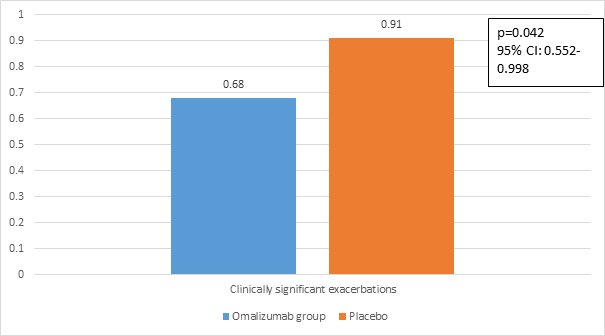
- Rate of clinically significant asthma exacerbations during the 28-week treatment phase
Secondary endpoints
- Frequency of emergency visits
- Asthma-related quality of life
- Symptoms, morning peak expiratory flow (PEF) and FEV1
- Safety and tolerability
Results
- The study enrolled 482 patients, out of which 10.8% discontinued the treatment (12.2% in omalizumab group vs 9.3% in placebo group)
- The cohort comprised of 419 primary intent-to-treat (PITT) population
- 97% had severe asthma as per the GINA 2002 guidelines
- After adjustment, the omalizumab group had a significantly reduced rate of clinically significant exacerbation rate of 0.68 vs 0.91 in placebo (p=0.042) as shown in figure 1.
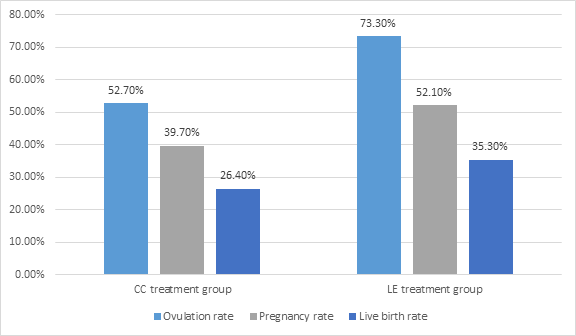
- The rate of severe exacerbations (PEF or FEV1 <60% of personal best, requiring treatment with systemic corticosteroids) was halved in the omalizumab group (0.24 vs 0.48; p=0.002 as shown in Figure 2.
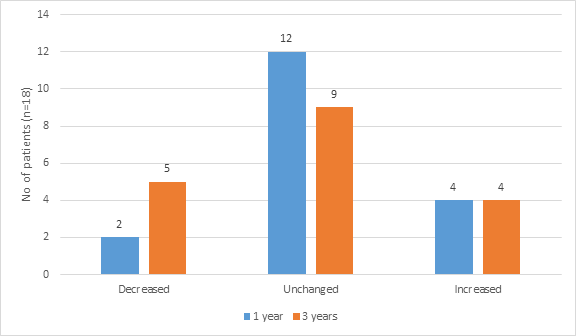
- Total emergency visits were significantly reduced in the omalizumab group (0.24 vs 0.43; p=0.038) as shown in figure 3.
- 60.8% of the patients in omalizumab group reported a significant improvement in asthma-related quality of life from baseline as compared to 47.8% in placebo (p=0.008).
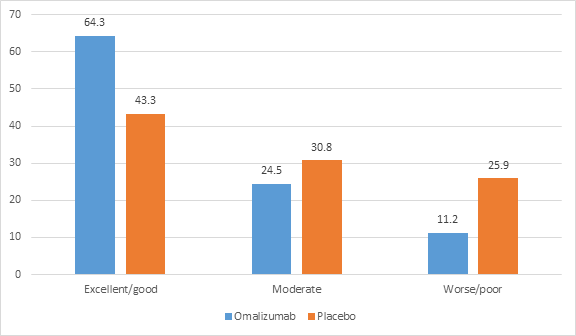
- Global evaluations of treatment effectiveness (GETE) was reported at the end of treatment, in which the investigators and patients evaluated the effectiveness of the treatment
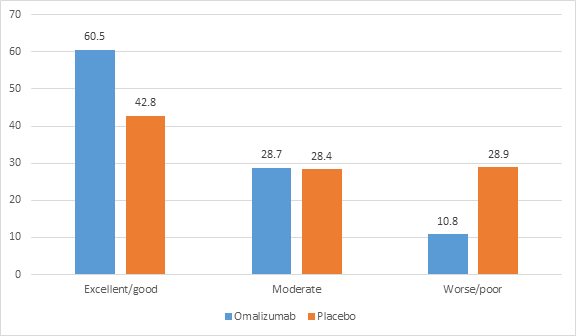
- Omalizumab was evaluated more favorably than placebo to a similar degree by both patients and investigators with a statistically significant overall difference for both evaluations (p<0.001) as shown in figure 4 and 5.
- Excellent treatment efficacy was found in 60.5% in omalizumab group as compared to 42.8%, according to the investigators
- 64.3% of the patients in omalizumab group reported excellent treatment efficacy as compared to 43.3%
- Omalizumab resulted in significant improvements from baseline in morning PEF (p=0.042), FEV1 (p=0.043) and overall symptom scores (p=0.039).
Safety and Tolerability
- The incidence of adverse events were similar in both the groups (72.2% vs 75.5%), most were mild or moderate in severity.
- Lower respiratory tract infections and nasopharyngitis were the most common adverse events.
Conclusion
- Omalizumab significantly decreased the rate of exacerbations in the difficult to treat patients with severe persistent asthma despite GINA step 4 therapy
- Severe exacerbation rate as well as emergency medical interventions reduced with omalizumab
- The asthma-related quality of life was improved with omalizumab as an add-on therapy
- There was an overall improvement in the symptoms and lung function with omalizumab
- Omalizumab was well-tolerated with no severe adverse events
Allergy. 2005 Mar; 60(3):309-16.