Oncological and Functional Outcomes with High-Intensity Focused Ultrasound in the Treatment of Prostate Cancer


Introduction
The standard treatments for prostate cancer (PCa) include radical prostatectomy and radiotherapy. However, they are associated with possibility of intraoperative bleeding, or intraoperative/radiation injury to surrounding tissues, and poor repeatability of results. High-intensity focused ultrasound (HIFU) seems to be promising as it is almost non-invasive, can be performed repeatedly, can be monitored in real-time and can evaluate the border of necrosis postoperatively through contrast-enhanced ultrasound. Despite these benefits, the current guidelines do not regard HIFU as the first-line treatment for PCa.
Aim
This meta-analysis assessed the oncological and functional outcomes of HIFU as the primary treatment for localized PCa.
Method
Study Design
- Systematic review and meta-analysis.
Treatment Strategy
- A systematic review was conducted using Medline, Embase, and the Cochrane Library databases.
- The review evaluated the oncological and functional outcomes of HIFU in the treatment of PCa.
- Incidence of complications was analyzed using the RevMan 5.3 software.
Endpoints
- Incidence of complications
- Biochemical recurrence (BCR) was defined according to the Stuttgart definition (a rise of ?1.2 ng/mL above the nadir prostate-specific antigen [PSA]), Phoenix definition (a rise ?2 ng/mL above the nadir PSA), or the Horwitz definition (2 consecutive increases of at least 0.5 ng/mL, backdated).
- Treatment failure was defined as BCR, positive biopsy post-ablation, or requirement for salvage treatment.
Results
- The meta-analysis included 27 articles with a total of 7393 patients.
- A total of 18 studies investigated the whole-gland HIFU, and the duration of follow-up ranged from 2 to 168 months.
- Partial-gland HIFU was investigated in 9 studies, and the duration of follow-up was 1 to 131 months.
- The oncological and functional outcomes after whole-gland HIFU and partial-gland HIFU is summarized in Table 1.
|
Outcomes |
Whole-gland HIFU |
Partial-gland HIFU |
|
Mean PSA nadir |
0.4 to 1.95 ng/mL |
1.9 to 2.7 ng/mL |
|
Mean time to PSA nadir |
2.4 to 5.4 months |
5.7 to 7.3 months |
|
Rate of positive biopsy after HIFU |
4.5% to 91.1%. |
14% to 37.5% |
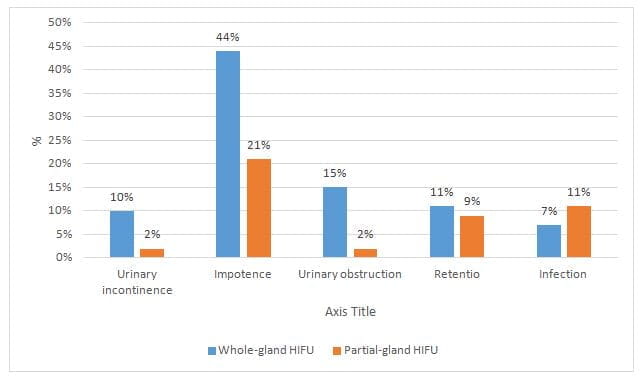
- Comparison of the incidences of urinary incontinence, impotence, urinary obstruction, retention, and infection is shown in Figure 1.
Conclusion
- Partial-gland high-intensity focused ultrasound (HIFU) was safer than whole-gland HIFU, and they had similar oncological outcomes.
- More prospective randomized controlled trials are warranted to assess the benefits of HIFU for the treatment of prostate cancer.
Medicine. 2020 Oct; 99(41), e22610.