

Macitentan and Riociguat Upfront Combination Therapy Improves Hemodynamics and Clinical Outcomes in Patients with PAH


Introduction
Endothelin, nitric oxide and prostacyclin pathways play a key role in the pathogenesis of pulmonary arterial hypertension (PAH). The dysfunction in these pathways have been targeted with endothelin receptor antagonists (ERAs), phosphodiesterase type 5 (PDE-5) inhibitors, soluble guanylate cyclase (sGC) stimulators, prostacyclin analogues and prostacyclin receptor agonists. US Food and drug administration (FDA) has approved 14 PAH targeted medications. However, the mortality due to PAH remains significant. Recent evidence suggests improvement in the clinical outcomes with dual or triple upfront combination therapy in PAH. The Ambrisentan and Tadalafil in Patients with PAH (AMBITION) trial demonstrated the clinical efficacy of upfront dual therapy. However, the effects of the therapy on hemodynamic variables is not known.
Aim
The clinical and hemodynamic effect of combination of macitentan, an ERA, and riociguat, a sGC stimulator as the first-line treatment was evaluated in newly diagnosed patients with PAH.
Methods
Study design
- Retrospective chart review
- Patients diagnosed with idiopathic PAH (IPAH) or associated PAH (APAH)
- Consecutive patients received upfront macitentan-riociguat combination as per the discretion of the treating physician
- The data on clinical outcomes and hemodynamics was collected at baseline, visit 1 and visit 2
- Visit 1 was done at a median time interval of 4 months and a mean of 4.9 months
- Visit 2 was done at a median of 12 months and a mean of 13.7 months
- Data on survival and transplantation status was assessed over 36 months
Endpoints
- WHO functional class (WHO FC)
- 6-min walk distance (6MWD)
- Borg score
- Levels of brain natriuretic peptide (BNP)
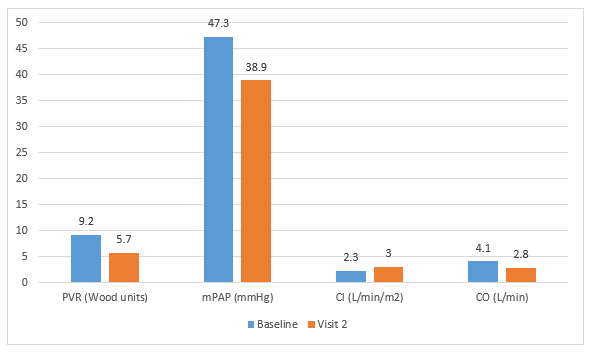
- Right heart catherization (RHC) data
- Pulmonary vascular resistance (PVR)
- Mean pulmonary arterial pressure (mPAP)
- Cardiac index (CI)
- Cardiac output (CO)
- Transplant-free survival rate
Results
- The overall cohort comprised of 15 patients predominantly females (73.3%)
- All but 1 had WHO FC III at baseline, one patient belonged to WHO FC IV
- 40% had IPAH and 60% had APAH
- Changes in endpoints at visits 1 and 2 from baseline are shown in table 1.
|
Parameter |
Baseline Mean |
Visit 1 |
Visit 2 | ||||
|
|
|
Mean |
Change from baseline |
P value |
Mean |
Change from baseline |
P value |
|
6-MWD |
281.6 |
315.7 |
34 |
<0.05 |
313.9 |
32 |
<0.05 |
|
Borg score |
3.0 |
1.7 |
-1.3 |
0.029 |
2.0 |
-1.0 |
0.208 |
|
BNP |
318.2 |
122.0 |
-196.2 |
0.0566 |
98.6 |
-219.7 |
0.0204 |
- WHO FC improved in 53%
- The improvement in the RHC parameters are shown in figure 1.
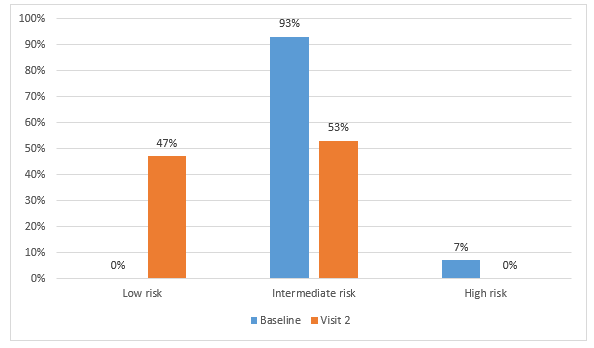
- There was an improvement in the risk score at visit 2 as shown in figure 2.
- Transplant free survival rate was 85%
- No serious side effects were reported
Conclusion
- Upfront combination therapy with macitentan and riociguat demonstrated improvement in exercise capacity, functional class, degree of dyspnea on exertion, right ventricular function biomarkers and hemodynamic variables in patients with pulmonary arterial hypertension
- This was the first ever study to show that a low risk status could be attained at 4 months and maintained at 12 months by approximately 50% patients, without the addition of a third drug
Pulm Circ. 2019 Jan-Mar;9(1):2045894019826944. Doi: 10.1177/2045894019826944.