




Long-term Safety and Efficacy Data of Brivaracetam for the Treatment of Patients with Uncontrolled Epilepsy

10 May, 21


Introduction
Epilepsy generally requires long-term treatment with antiepileptic drugs (AEDs). It is therefore essential to evaluate the long-term safety of AEDs. Brivaracetam (BRV), an AED is indicated in patients aged ≥ 16 years focal seizures.
Aim
- To evaluate the long-term safety and tolerability of BRV
- To evaluate the maintenance of efficacy of BRV (including quality of life) over time
Patient Profile
- Adult patients with focal or generalized-onset seizures (age ≥16 years, n=766)
- All the study subjects had previously participated in one of the two placebo (PBO)-controlled trials of adjunctive BRV and had uncontrolled epilepsy despite treatment with one to two concomitant AEDs.
Methods
Study Design
- An open-label, long-term follow-up (LTFU), multicenter, flexible-dose, single arm trial
Treatment Strategy
- During LTFU, patients started on an oral BRV dose of 200 mg/day or 150 mg/day (as per the dosage during the previous placebo-controlled trial)
- The dosage was maintained for at least 2 weeks unless the treatment was not tolerated.
- The BRV dose could be adjusted subsequently based on each patient’s seizure control and tolerability, without exceeding 200 mg/day. Patients followed a flexible concomitant AED regimen.
Outcomes
Safety Outcomes
- Treatment emergent adverse event (TEAE)
- Withdrawal due to TEAE
- Occurrence of serious TEAEs
Efficacy Outcomes
- Percentage reduction in focal seizure frequency/28 days from ‘baseline’ of the previous trial to the evaluation period
- Responder rate for the evaluation period’ (defined as ≥50% reduction in focal seizure frequency from baseline’ of the previous trial)
- Percentage of patients remaining seizure-free continuously (all seizure types) for 6- or 12-month interval during the evaluation period’
- Change in ‘Patient Weighted Quality of Life in Epilepsy Questionnaire 31’ (QOLIE-31-P) scores from baseline of the previous trial during the first 2 years of the evaluation period (scores range from 0 to 100 with higher scores corresponding to better functioning/health status)
Follow-up visits
- One visit per month for first 3 months, and once in every 3 months thereafter
Results
- Of the 766 patients included in the study, 753 had focal seizures and 13 had generalized-onset seizures. The mean age of the study population was 40 years, and 51.7% of them were females.
- Overall, 48% patients completed the trial (368/766). Three hundred and ninety-eight (52.0%) patients discontinued, the reasons for discontinuation being lack of efficacy (21.4%), AE (12.5%), patient choice (11.6%), loss to follow-up (2.9%), or other reasons (3.5%).
- As per a Kaplan–Meier analysis retention of BRV therapy was 71.9% at 12 months, and 53.7% at 36 months.
- Treatment-emergent adverse events were reported by 83.9% patients (n=643), the most common being headache (13.6%) and dizziness (13.1%).
- Drug-related TEAEs were reported in 33.6% patients (n=257), the most common being somnolence (6.4%) and dizziness (5.4%).
- Permanent discontinuation of BRV due to TEAEs was reported in 11.9% patients (n=91).
- Psychiatric TEAEs were reported by 25.3% patients, the most common being, depression and anxiety. Psychiatric TEAE leading to discontinuation of BRV was reported in 3.4% patients. Drug related psychiatric TEAEs were reported by 8.2% patients.
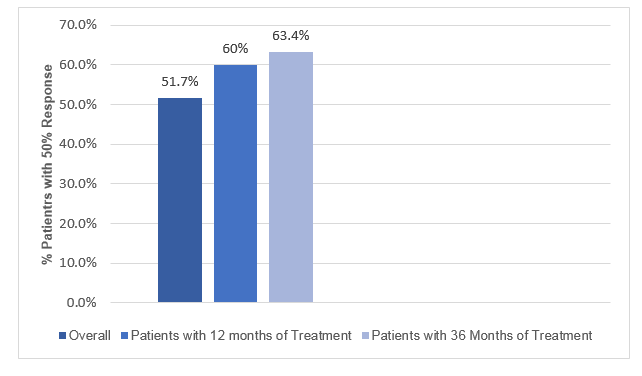
- Patients with focal seizures had a median percentage reduction in focal seizure frequency by 52.0%. Overall, the 50% responder rate was 51.7%; 60% in patients with at least 12 months of treatment and 63.4% in those who completed 36 months of treatment (Fig. 1).
Fig. 1: 50% Responder rate during the study period
- Nearly 26.0% patients remained seizure free continuously for 6 months, and 17.9% remained seizure free continuously for 12 months. Amongst patients who completed 12 months of treatment, continuous freedom from seizures was 17.8% and 6.3% at 6 and 12 months, respectively. The same was 29.5% and 18.2% amongst patients who completed the treatment for 36 months (Fig. 2).
Fig. 2: Proportion of patients with continuous seizure freedom

- Clinically meaningful improvements in QOLIE-31-P total score at 12 months and 24 months was seen in 42.4% and 46.8% patients, respectively.
Conclusion
- This LTFU provided long-term safety data on adjunctive therapy with BRV at flexible dose (up to 200 mg/day) for 8 years.
- The results being consistent with the previous trials indicated that long-term treatment with BRV was generally effective, safe and well-tolerated for treating patients with focal seizures.
Epilepsy Behav. 2021 Mar 26 (Published Online);doi: 10.1016/j.yebeh.2021.107897.
Related Topics
More From Area Of Interest
You may also like

13 May, 26

17 Apr, 26
Our Research
23 Feb, 26

23 Feb, 26

11 Feb, 26

11 Feb, 26

11 Feb, 26
Latest Items
Journal Scans
26 Jun, 26

26 Jun, 26

26 Jun, 26

25 Jun, 26


