




Lacosamide-Effective and Safe for treating Children with Epilepsy

28 Nov, 22


Background
Epilepsy is a common neurologic disease that is more likely to affect children than adults. Long-term treatment with antiepileptic drugs (AEDs) is recommended for epilepsy patients. Lacosamide (LCM) is a third generation AED approved for the treatment of epilepsy in adults and children aged 4 years and above. LCM was approved in China in 2018, but its safety in pediatric patients has not been established.
Aim
To determine the safety, efficacy, and tolerability of LCM in pediatric patients
Patient Profile
- Pediatric patients diagnosed with epilepsy (complex focal and/or secondarily generalized tonic-clonic seizures) and being treated with LCM therapy at a medical center in China (n=72, age; 0-14 years)
Methods
Study Design
- A single-center, retrospective analysis
Assessments
- Seizure frequencies at baseline, 3, 6, and 12 months after initiating LCM therapy
Outcomes
Primary Outcomes
- 50% responder rate
- Seizure-free rates
Secondary Outcomes
- Terminal 6-month seizure remission
- Percentages of discontinuation due to the lack of efficacy and tolerability
Safety Outcomes
- The incidence and intensity of adverse events (AEs)
Follow-up
- 12 months
Results
- The mean age of the study population was 7.2 years and 61.1% of them were males. The mean duration of epilepsy was 6.8 years. Twenty-seven patients had generalized seizure, 25 had focal seizure and 20 had complex seizures
- At the last follow-up, 15% of the patients (n=11) were on LCM monotherapy, 28% (n=20) on valproic acid combined therapy, 24% (n=17) on levetiracetam combined therapy, 21% (n=15) on oxcarbazepine combined therapy, 8% (n=6) on lamotrigine combined therapy, 3% (n=2) on clonazepam combined therapy, and 1% (n=1) on topiramate combined therapy.
- The mean LCM dose during the maintenance phase was 6.8 mg/kg/day, and the median dose was 6.2 mg/kg/day. Terminal seizure remission at 12 months with a mean LCM dose of 6.9 mg/kg/day was 36.1%.
- Of the entire study population, 69% (n=50) were responders (patients who responded to LCM therapy with a more than 50% reduction in the frequency of seizures). Only 11% (n=22) children had a less than 50% reduction in the seizure frequency.
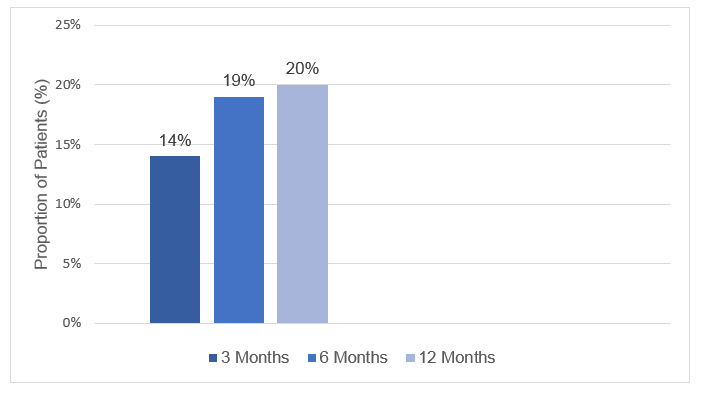
- Seizure-free rates increased over time, at 3, 6 and 12 months, respectively (Fig 1).
Fig. 1: Seizure-free rate during the study period
- At 3 months, 23% and 26% of children had a seizure reduction of ≥75% and ≥50%; these rates increased to 21% and 28% of children at 12 months. A seizure reduction <50% was observed in 37%, 35%, and 31% at 3, 6, and 12 months, respectively (Fig 2).
Fig 2: Treatment response of patients during the study

- The number of baseline AEDs and the order of LCM introduction had a substantial influence on the likelihood of seizure remission during the 12-month follow-up period (p < 0.05).
- Twenty-two children (30.5%) experienced at least one AE during the period of LCM treatment. The AEs were categorized as mild to moderate and most of them were transient.
Conclusion
- LCM therapy was safe and effective for treating epilepsy in pediatric patients and resulted in substantial reduction in the seizure rate.
Epilepsy Behav. 2021 Apr;117:107814. doi: 10.1016/j.yebeh.2021.107814.

More From Area Of Interest
You may also like
13 May, 26
17 Apr, 26
Our Research
23 Feb, 26
23 Feb, 26
11 Feb, 26
11 Feb, 26
11 Feb, 26
Latest Items
Journal Scans
26 Jun, 26

26 Jun, 26

26 Jun, 26

25 Jun, 26


