Insights from Analysis of ELEMENT 5 Study: LY IGlar vs. IGlar in Asian Indian and East Asian Population


Background
Lilly insulin glargine (LY IGlar]) is the biosimilar basal insulin glargine analog with identical amino acid sequence, similar pharmacological and efficacy/safety profile to reference insulin glargine (IGlar). The ELEMENT 5 study has already demonstrated similar efficacy and safety profiles between LY IGlar and IGlar in type-2 diabetes mellitus (T2DM) patients across many countries. Nearly 60% of the world’s diabetes population comprises of Asians. Since the physiological and pathological features of T2DM vary between Asian and Western T2DM patients, and because Asians have a more conservative approach towards insulin therapy, it would be interesting to analyze the results of ELEMENT 5 study with a focus on Asians.
Aim
Analyzing the results of Asian Indian and East Asian subpopulations from the ELEMENT 5 study
Patient Profile
- Asian Insulin na?ve T2DM patients [glycated hemoglobin (HbA1c) ≥ 7.0% and ≤ 11.0%] or on basal insulin (HbA1c ≤ 11.0%) and receiving at least two oral antidiabetic medications (OADs)
- Patients from India (n=100) and East Asia (Korea and Taiwan; n=134) (47.5% of the study population from the ELEMENT 5 study)
Methods
Study Design
- Post hoc analysis of ELEMENT 5 study
- ELEMENT 5 was a Phase 3, prospective, randomized, multinational, multicenter, two-arm, active-controlled, open label, parallel-design study
Treatment Strategy
- Patients were randomized to receive LY IGlar or IGlar along with the prescribed OADs for 24 weeks.
- The starting dose for Insulin-na?ve patients was 10 U/day. For patients receiving basal insulin before participating in the study, the starting dose was either the same as the QD dose or 80% of the BID dose.
- Patients were instructed to self-titrate from the starting dose by 1 unit/day until they achieved fasting blood glucose (FBG) 100 mg/dL.
Outcomes
- Change in HbA1c from baseline to week 24
- Treatment satisfaction for patients [using the Insulin Treatment Satisfaction Questionnaire (ITSQ)]
- Adverse events
Results
- Both the treatment groups achieved similar within-group least-squares mean (LSM) decrease (baseline to Week 24) in HbA1c. The upper limit of confidence interval (CI) for treatment difference remained below the defined 0.4% noninferiority margin in India (Figure 1).
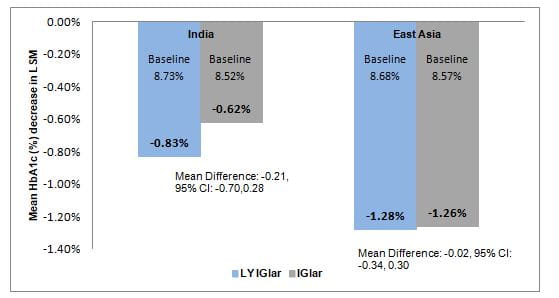
- The results of other efficacy and safety endpoints at week 24 did not differ significantly between treatments groups.
- The annualized rates of total hypoglycemia and nocturnal hypoglycemia did not differ significantly amongst patients treated with LY IGlar and IGlar in both the subpopulations.
- The incidence of adverse events was similar in both the study groups. No serious adverse events were reported in Indian subpopulation. The incidence of serious adverse event was similar in both the groups of East Asian subpopulation.
- Patient-reported health outcomes as assessed by the LSM scores of the ITSQ at Week 24 were comparable for LY IGlar and IGlar for both India and East Asia subpopulations
Conclusion
- Efficacy and safety profiles of LY IGlar and IGlar, in combination with OADs, were similar in India and East Asia subpopulations.
- The findings of the post hoc analysis were consistent with that observed in total population of ELEMENT 5.
Clin Drug Investig. 2019; 39:745–756.