




HERA Trial: Long-term Results of 1 year of Trastuzumab verses 2 years of Trastuzumab Treatment in HER2-positive Early Breast Cancer

6 Apr, 21


Introduction
Trastuzumab is a recombinant monoclonal antibody against HER2 receptor. It significantly improves overall survival and disease-free survival in women with HER2-positive early breast cancer. However long-term data is lacking.
Aim
HERA (HERceptin Adjuvant) trial compared the year of trastuzumab, and 2 years of trastuzumab treatment at a median follow-up of 11 years in HER2-positive early breast cancer
Patient Profile
- N=5102
- Women with HER2-positive early breast cancer
Methods
- Multicentre, open-label, phase 3 randomised trial

- Clinical and laboratory assessments were scheduled to occur every 6 months for years 3–5, and then once per year up to year 10
- Annual chest radiography was required up to year 5 and annual mammography up to year 10
Endpoints
- Primary endpoint was disease-free survival, and analyses are in the intention-to-treat population
- Comparison of 2 years versus 1 year of trastuzumab is based on 366-day landmark analyses
- Secondary endpoints included
- Overall survival
- Sites of first relapse
- Competing-risk cumulative incidence analysis of breast cancer a
- Non-breast cancer disease free survival events
- Cardiac safety
Results
- In 1 year of trastuzumab group, the median follow-up of 11 years showed significant reduction in the risk of a disease-free survival event (HR 0·76,) and death (0·74, 0·64–0·86) compared with observation
- 2 years of adjuvant trastuzumab did not improve disease free-survival outcomes compared with 1 year of this drug (HR 1·02)
Figure 1: Estimates of 10-year disease-free survival
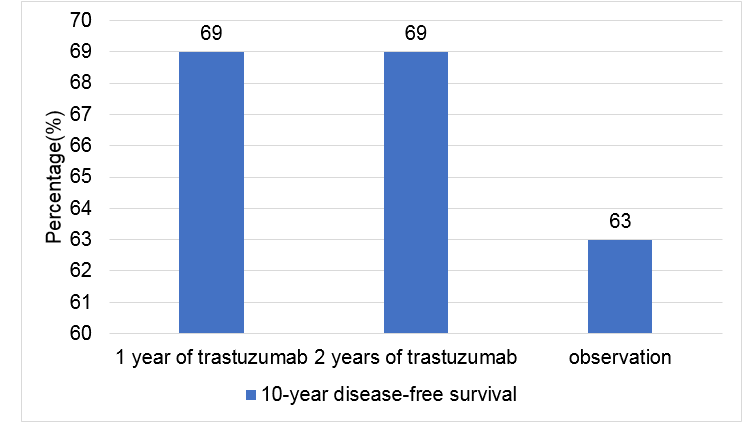
- 24% relative reduction in risk of a disease-free survival event, and a 26% relative reduction in risk of death was observed with the addition of 1 year of adjuvant trastuzumab in women with HER2-positive early breast cancer
Cardiac Toxicity
- Cardiac toxicity remained low in all groups and occurred mostly during the treatment phase
- No significant difference was noted in the occurrence of primary cardiac endpoints between the two trastuzumab groups
- Secondary cardiac endpoints occurred more frequently in the 2-years trastuzumab group than in the 1-year trastuzumab group and the observation group
Table 1: Incidence of cardiac toxicity
|
|
1-year trastuzumab group |
2-year trastuzumab group |
Observation group |
|
Primary Cardiac endpoints |
1% |
1% |
0.1% |
|
Secondary cardiac endpoints |
7.3% |
4.4% |
0.9% |
- Subgroup analysis of disease-free survival by nodal status showed the 10-year disease-free survival in
- 1-year trastuzumab group: 80% for the node-negative cohort, 75% for the cohort with one to three positive nodes, and 55% for the cohort with four or more positive nodes
- HRs (1-year trastuzumab vs observation) were 0.78 for the node-negative cohort, 0.64 for those with one to three positive nodes, and 0.82 in those with four or more positive nodes
Conclusion
- The HERA trial demonstrated that the addition of 1 year of adjuvant trastuzumab in women with HER2-positive
early breast cancer resulted in
- 24% relative reduction in risk of a disease-free survival event
- 26% relative reduction in risk of death
- The HERA study therefore shows that 1 year of trastuzumab is an important, and curative, part of the standard of care for women with HER2-positive early breast cancer.
Reference
Lancet.2017;389(10075):1195-1205
Related Topics
More From Area Of Interest
You may also like

13 May, 26

17 Apr, 26
Our Research
23 Feb, 26

23 Feb, 26
11 Feb, 26
11 Feb, 26
11 Feb, 26
Latest Items
Journal Scans
26 Jun, 26

26 Jun, 26

26 Jun, 26

25 Jun, 26


