

Esomeprazole Achieves Relief of Nighttime Heartburn and Improves Sleep Quality in GERD


Introduction
A significant proportion of patients with gastro-esophageal reflux disease (GERD) experience heartburn at night. The findings of a survey conducted in 1000 US patients with heartburn demonstrated that nighttime heartburn negatively affects their sleep and work productivity the next day. Reflux events that occur during the night last longer than those occurring during daytime. One placebo-controlled study showed that esomeprazole 40 mg and 20 mg was associated with a significant relief of nighttime heartburn symptoms as compared to placebo. This study was conducted to confirm these findings for esomeprazole 20 mg taken once daily in patients with GERD.
Aim
To evaluate the efficacy of esomeprazole 20 mg taken daily before breakfast on GERD-related nighttime heartburn and sleep disturbances.
Method
Study Design
- Multicenter, randomized, double-blind, placebo-controlled, prospective study
Inclusion Criteria
- Patients aged 18-85 years with episodes of heartburn or acid regurgitation for ≥3 months OR history of erosive esophagitis and nighttime GERD symptoms averaging atleast 2 episodes in the 7-day period before enrollment
- History of sleep disturbances for >1 month before enrollment
- Experiencing GERD-related sleep disturbances and moderate to severe nighttime heartburn on atleast 3 of the last 7 nights of the run-in period
Exclusion Criteria
- Patients with conditions other than GERD known to affect sleep
- Shift workers with working hours between midnight to 6 am
- Patients who had gastrointestinal bleeding
Treatment Strategy
- After a 1- to 2-week run-in period, patients were randomized to receive 20 mg esomeprazole once daily before breakfast or placebo for 4 weeks
- Daily diary card was used to evaluate the symptom severity every morning
Endpoints
- Relief of nighttime heartburn was defined as a daily diary response of ‘none’ on >6 days of the last 7 days of the study
- Complete resolution of nighttime heartburn was defined as daily diary response of ‘none’ for consecutive 7 days
- Complete resolution of GERD-related sleep disturbances defined as a daily response of ‘no’ for consecutive 7 days
- Sleep quality assessed using the Pittsburgh Sleep Quality Index (PSQI) questionnaire
- Work productivity evaluated using Work Productivity and Activity Impairment Questionnaire: Sleep Disturbance-GERD (WPAI-SLEEP-GERD)
- Adverse events
Results
- A total of 262 patients were recruited with 137 and 125 in the esomeprazole and placebo groups respectively
- Significantly more patients from the esomeprazole group achieved complete resolution and relief of heartburn as shown in figure 1.
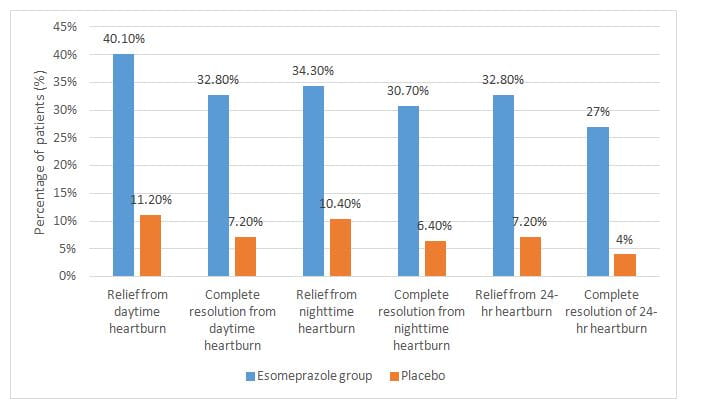
- Relief of GERD-related sleep disturbances (P = 0.006), days without GERD-related sleep disturbances (P = 0.0003) and complete resolution of sleep disturbances (P < 0.0001) favored esomeprazole over placebo
- The study group was associated with better sleep quality, work productivity and regular daily activities as compared to placebo
- The incidence of adverse events was 21% vs 18.2% in the study group and placebo respectively
- There were no serious adverse events related to esomeprazole use
Conclusion
- Treatment with esomeprazole 20 mg once daily significantly achieved relief of nighttime heartburn symptoms and improved sleep quality, work productivity and functionality in patients with moderate-to-severe nighttime heartburn and gastro-esophageal reflux disease-related sleep disturbances.
Aliment Pharmacol Ther. 2010 Jul;32(2):182-90. Doi: 10.1111/j.1365-2036.2010.04339.x.