Efficacy of Laparoscopic Ureterolithotomy Might be Superior to Other Surgical Modalities in Treatment of Large Ureteric Stones


Introduction
There are various surgical options such as shock wave lithotripsy (SWL), ureteroscopy (URS), percutaneous nephrolithotomy (PNL) and laparoscopic ureterolithotomy (LUL) for the management of ureteral stones. SWL or URS has been recommended as the first-line management option for upper ureteric stones <10 mm and URS for stones >10 mm as per the latest European Association of Urology (EAU) guidelines. Antegrade PNL and LUL is being used in case of large, impacted stones. However, there is lack of data on the comparative efficacy of these surgical modalities.
Aim
- The safety and efficacy of SWL, LUL, PNL and URS in the management of large (> 1 cm) upper ureteric stones has been compared.
Method
Study Design
- Systematic review and meta-analysis of randomized controlled trials (RCTs).
Treatment Strategy
- Electronic databases PubMed, Scopus and Web of Science were extensively searched
Endpoints
Primary Endpoint
- Final stone-free rate (SFR)
Secondary Endpoints
- Initial SFR
- Need for auxiliary procedures
- Duration of surgery
- Length of stay
- Rate of complications
Results
- The final analysis included 13 RCTs with 1871 patients having ureteric stones larger than 1 cm.
- LUL and PNL had significantly superior initial and final SFR as compared to URS and SWL.
- Pooled analysis of initial and final SFR of the 4 surgical modalities has been shown in Figure 1.
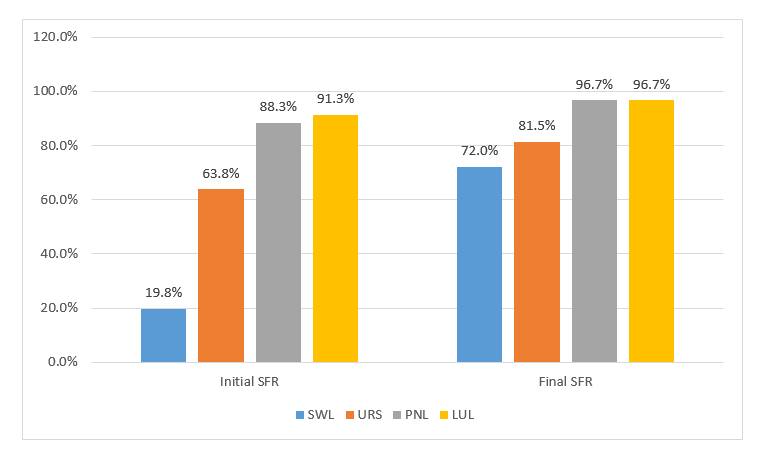
- The surface under the cumulative ranking curve (SUCRA) values were highest for LUL, followed by PNL and URS
- PNL and LUL were associated with a significantly lower need of auxiliary procedures as compared to SWL and URS.
- There was no significant difference in the duration of surgery among all the techniques on network analysis
- According to the SUCRA values, SWL was the best treatment
- Results from network analysis demonstrated significantly shorter length of hospital stay with URS.
- Both direct pairwise and network analysis revealed no significant differences in the overall complication rates.
- The SUCRA values for all treatment groups has been shown in Table 1.
|
Treatment (SUCRA) |
SWL (%) |
URS (%) |
PNL (%) |
LUL (%) |
|
Initial SFR |
68.5 |
97.1 |
5.8 |
28.6 |
|
Final SFR |
72.6 |
92.7 |
15.7 |
19 |
|
Auxilliary procedures |
77.5 |
88.3 |
11.6 |
22.5 |
|
Duration of surgery |
36.3 |
25.5 |
84.7 |
53.5 |
|
Length of hospital stay |
8.4 |
28.2 |
85.8 |
77.6 |
|
Complications |
33.3 |
73.2 |
54.3 |
38.8 |
- Certainty of evidence was evaluated using the CINeMa approach, and the confidence rating ranged from “very low” to “moderate” for various comparisons.
Conclusion
- Laparoscopic ureterolithotomy (LUL) followed by percutaneous nephrolithotomy (PNL) demonstrated superior stone-free rates and lesser need for auxiliary procedures as compared to shock-wave lithotripsy (SWL) and ureteroscopy (URS) and seems to be the most effective surgical modality in the treatment of large upper ureteric stones.
- High-quality randomized studies are warranted due to the poor quality of the included studies.
Sci Rep. 2021.11;11811. Doi: 10.1038/s41598-021-91364-3.