Efficacy and Safety of Single-Dose Russian-backbone Live Attenuated Influenza Vaccine among Children in Bangladesh


Introduction
The surveillance data in Bangladesh indicates that influenza virus circulates almost throughout the year and frequently leads to febrile illness and lower respiratory tract infections in children. Thus, preventing influenza illness might reduce the morbidity and mortality in children. Live attenuated influenza vaccine (LAIV) provides an attractive option due to its good efficacy and its easy intranasal mode of administration. Several manufacturers are developing reassortant LAIVs as a part of the WHO-sponsored technology transfer program. This initiative might provide influenza vaccines at an affordable price in low-resource countries like Bangladesh
Aim
To assess the clinical efficacy and safety of a Russian-backbone LAIV at two field sites (urban and rural) in Bangladesh.
Patient Profile
Healthy children aged 2-4 years from urban Kamalapur and rural Matlab, regions in Bangladesh (n=1761).
Methods
Study Design
Two-site, randomized, double-blind, placebo-controlled, parallel-group clinical trial.
Treatment Strategy
- Children were randomly assigned in a 2:1 ratio to receive one intranasal dose of 0.5 ml (half quantity delivered in each nostril) LAIV (2012–13 Northern Hemisphere formulation, manufactured by Serum Institute of India) or placebo between February 27 and April 9, 2013
- The vaccine contained A/California/7/2009 (H1N1)-like, A/Victoria/361/2011 (H3N2)-like, and B/Wisconsin/1/2010 (Yamagata lineage)-like reassortants
Follow-up
- Post-vaccination, children were monitored through weekly home visits till day 4 to monitor solicited adverse events (AEs), unsolicited AEs, protocol-defined wheezing illness (PDWI), and serious AEs
- Children were monitored thereafter weekly at home by trained field workers
Primary Outcome
- Symptomatic, laboratory-confirmed influenza illness due to vaccine-matched strains occurring up to December 31, 2013
Secondary Outcomes
- Symptomatic, laboratory confirmed influenza virus infection with any influenza virus strain
Safety Outcome
- Immediate reactions occurring within 30 minutes of vaccination
- Solicited reactions (nasal congestion, runny nose, ear pain, cough, sore throat, headache, fever, tachypnoea, muscle or joint pain, chills, irritability or decreased activity, and vomiting)
- Unsolicited AEs occurring up to 7 days after vaccination
Results
- Greater proportion of children administered placebo exhibited laboratory-confirmed influenza illness due to vaccine-matched strains vs. the LAIV-treated children (15·8% vs. 6·7%), translating into a vaccine efficacy of 57·5% (Table 1)
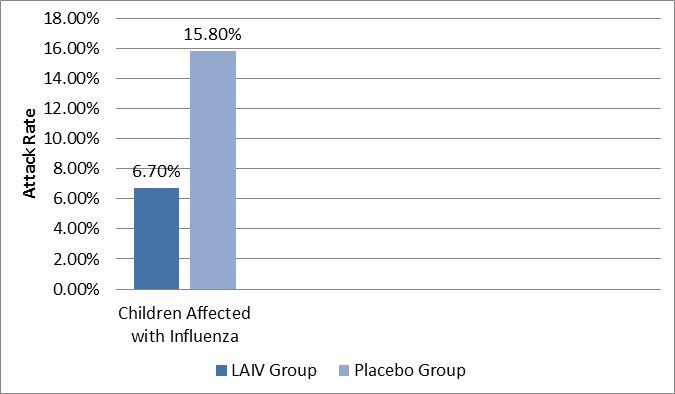
- As per a strain-specific analysis, the vaccine exhibited an efficacy of 50–60% for the H3N2 and H1N1 strains.
- The vaccine was well tolerated, with AEs balanced between the groups.
- No immediate reactions were evident in both the study groups
- Runny nose, cough and tachypnoea were the most common AEs reported in the 7 days after vaccination
- Most of the AEs were of mild intensity and of similar proportion in both the study groups
Conclusion
- The single-dose Russian-backbone LAIV with intranasal delivery was effective in preventing symptomatic laboratory-confirmed influenza illness in children from the urban and rural region of Bangladesh
- The vaccine also had a good safety profile with AEs almost similar to that seen with placebo
- Integration of LAIV programmes in low- and middle-income countries might diminish the burden of influenza illness
Lancet Glob Health. 2016; 4(12): 946-54.